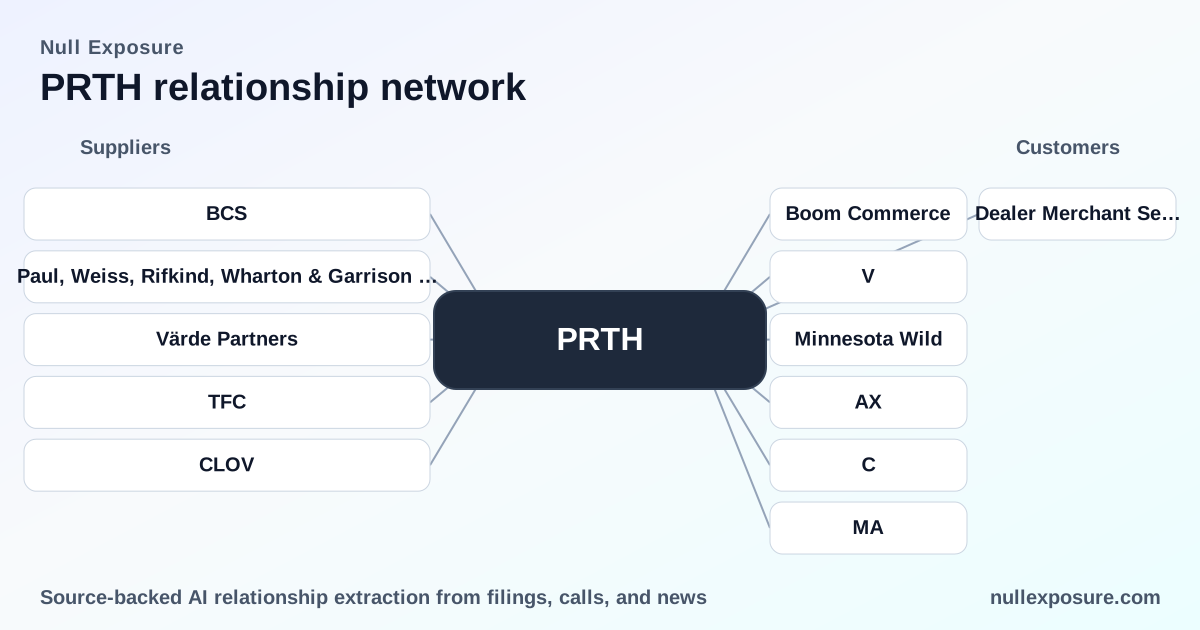
Priority Technology Holdings (PRTH): Customer relationships that drive recurring payments revenue
Priority Technology Holdings operates a payments and banking fintech platform that monetizes through transaction fees, monthly subscription/maintenance fees, and long-term services contracts delivered to both enterprise ISVs and SMB merchants. The company sells embedded payments, banking-as-a-service and payables automation to financial institutions, software partners and retail customers, generating high-margin recurring revenue backed by multi-year contracts and subscription economics. For a focused read on counterparties and commercial reach, visit the NullExposure homepage: https://nullexposure.com/.
How to read these customer ties — the operating model in practice
Priority’s commercial model is contract-led and recurring: subscription fees are recognized monthly, and payment processing income is governed by multi-year customer agreements. The company targets a mix of large enterprise customers and SMBs, distributes through ISVs and direct channels, and operates primarily in the U.S. while maintaining a global development and support footprint. Management discloses that no single merchant customer contributed 10% or more of consolidated revenue for the last three fiscal years, which points to low revenue concentration despite serving enterprise accounts.
Key operating characteristics:
- Contracting posture: multi-year processing agreements plus monthly subscription revenue support predictable top-line streams.
- Customer mix: enterprise-grade ISVs and financial institutions for embedded finance, complemented by SMB acquiring through ISOs and resellers.
- Geographic focus: domestic money transmission across 46 states and D.C., with global talent centers for scale and delivery.
- Materiality: individual merchants are immaterial to consolidated revenue, supporting resilience against single-customer churn.
- Segment focus: payments, payables (B2B), and banking & treasury services — all sold as integrated, recurring offerings.
Relationship-by-relationship readout (each result in the record)
Below are concise, source-linked summaries of every customer relationship mentioned in the records.
-
AX — Rollfi was selected to supply embedded and white-label payroll and benefits infrastructure to enhance Axos’s business banking platform; reported in a Quantisnow article on May 2, 2026. Source: https://www.quantisnow.com/insight/axos-bank-selects-priority-rollfi-to-power-back-office-payroll-and-benefits-solutions-6371709
-
Visa — Priority’s B2B Payments segment lists Visa among listed partners and clients for accounts payable automation and FI integrations, reflecting card-network relationships supporting corporate payables products (FY2026). Source: https://intellectia.ai/news/stock/kaskela-law-investigates-priority-technology-holdings-amid-stock-decline
-
Mastercard — Mastercard is named alongside other financial institutions as an ecosystem partner for Priority’s AP automation and payments integrations (FY2026). Source: https://intellectia.ai/news/stock/kaskela-law-investigates-priority-technology-holdings-amid-stock-decline
-
Boom Commerce — Priority acquired Boom’s revenue agreements and customer relationships, absorbing an existing reseller partner’s book into Priority’s channel (reported in the context of a financing facility). Source: https://financialit.net/news/fundraising-news/priority-secures-50-million-financing-facility
-
Minnesota Wild — The Minnesota Wild selected Priority to streamline ticket payments and create new revenue channels; the announcement is sourced from a Business Wire distribution reported May 1, 2025. Source: https://markets.financialcontent.com/stocks/quote/news?CurrentPage=1&Symbol=NQ%3APRTH
-
Minnesota Wild (earnings call mention) — Management referenced ticket sales work for the Minnesota Wild as an example of using Priority’s payments platform to acquire new customers and enter vertical relationships (Q3 2025 earnings call transcript). Source: https://www.insidermonkey.com/blog/priority-technology-holdings-inc-nasdaqprth-q3-2025-earnings-call-transcript-1641887/
-
AX (ad-hoc news) — An ad-hoc news summary on Feb 3 reported that Axos Bank selected Priority Rollfi to streamline payroll and benefits back-office processes, reinforcing institutional adoption by a commercial bank (FY2026 coverage). Source: https://www.ad-hoc-news.de/boerse/ueberblick/priority-technology-holdings-strategic-moves-and-a-pivotal-buyout-bid/68561176
-
Axos Bank — Intellectia’s coverage described Axos selecting Priority Rollfi through a competitive RFP to provide embedded, white-label payroll and benefits technology for its business banking platform (first seen Mar 10, 2026). Source: https://intellectia.ai/news/stock/kaskela-law-investigates-priority-technology-holdings-amid-stock-decline
-
Axos Bank (ad-hoc duplicate) — A separate ad-hoc-news entry reiterates Axos Bank’s selection of Priority Rollfi to streamline back-office payroll and benefits administration, underscoring the commercial win (FY2026). Source: https://www.ad-hoc-news.de/boerse/news/ueberblick/priority-technology-holdings-strategic-moves-and-a-pivotal-buyout-bid/68561176
-
C (symbol) — Priority’s B2B Payments disclosures list Citibank (symbol C) in the roster of financial institution partners for AP automation solutions, indicating platform integrations with global banks (FY2026). Source: https://intellectia.ai/news/stock/kaskela-law-investigates-priority-technology-holdings-amid-stock-decline
-
Citibank — The filing and related news explicitly name Citibank as a recipient of Priority’s accounts payable automation and payment services, reflecting institutional distribution for the company’s B2B payments product (FY2026). Source: https://intellectia.ai/news/stock/kaskela-law-investigates-priority-technology-holdings-amid-stock-decline
-
Dealer Merchant Services (DMS) — Coverage notes integration of Dealer Merchant Services with Priority’s commerce platform to improve dealership operations from POS through back-office, broadening vertical reach into automotive retail finance and payments (FY2026). Source: https://intellectia.ai/news/stock/kaskela-law-investigates-priority-technology-holdings-amid-stock-decline
-
AX (intellectia duplicate) — Intellectia’s reporting also lists Axos Bank (AX) partnership highlights with Priority Rollfi; this duplicate entry affirms repeated market reporting of the Axos engagement (FY2026). Source: https://intellectia.ai/news/stock/kaskela-law-investigates-priority-technology-holdings-amid-stock-decline
-
AX (alternate intellectia entry) — An additional Intellectia item reiterates Axos Bank’s competitive RFP selection of Priority Rollfi for embedded payroll and benefits, underscoring consistent media coverage of the deal (FY2026). Source: https://intellectia.ai/news/stock/kaskela-law-investigates-priority-technology-holdings-amid-stock-decline
What these customer ties imply for investors
- Recurring revenue backbone: Subscription and processing fees support predictable cash flow and improve valuation visibility; Priority’s disclosures and evidence excerpts document monthly subscription recognition and multi-year processing agreements.
- Low single-customer concentration: Public disclosures state no merchant accounted for ≥10% of revenue in recent years, which reduces idiosyncratic counterparty risk even while the company pursues larger institutional clients.
- Balanced go-to-market: The company intentionally serves both enterprise ISVs/financial institutions and SMBs, which creates diversified growth vectors — enterprise embedded finance yields scale, while SMB acquiring sustains broad transactional volume.
- Commercial criticality to FIs and partners: Partnerships with banks (Axos, Citibank) and card networks (Visa, Mastercard) position Priority as an infrastructure supplier; losses would be disruptive but are managed through multi-year contracting and reseller relationships (example: Boom acquisition of reseller revenue).
- Geographic and operational scale: Heavy U.S. operations with international engineering support enable delivery at scale while keeping regulatory and payments execution anchored domestically.
If you want a structured view of how these relationships map to Priority’s revenue streams and contract types, NullExposure provides analyst-ready relationship profiles and revenue mapping — see https://nullexposure.com/.
Bottom line
Priority’s customer footprint spans institutional banks, card networks, vertical resellers and event/retail customers, underpinned by subscription economics and multi-year processing contracts that drive recurring revenue and limit concentration risk. The Axos Bank integration and reseller book acquisition are the most visible commercial catalysts in recent press, while partnerships with Visa, Mastercard and Citibank anchor Priority’s payments credibility in the financial ecosystem. Investors should track execution of these enterprise wins against churn in the SMB channel to assess sustainable margin expansion and revenue visibility.