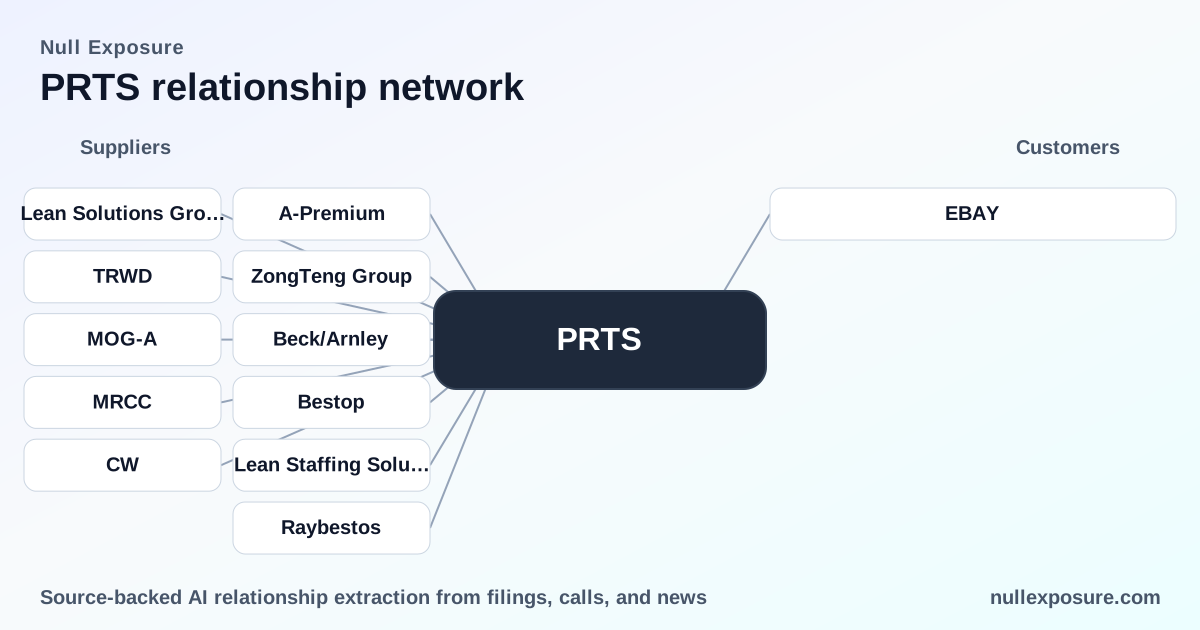
How CarParts.com (PRTS) monetizes customer relationships and why a single marketplace deal matters
CarParts.com monetizes by selling auto parts and accessories direct-to-consumer through its flagship website, mobile app, third‑party marketplaces, and a parallel offline wholesale channel; revenue derives from product margin, private‑label brands, and marketplace distribution agreements. Recent activity — notably the roll‑out of the Evan Fischer private label as an exclusive brand on eBay — is a strategic distribution play that shifts go‑to‑market mix toward third‑party marketplaces while preserving its DTC and wholesale channels. For investors, the key questions are how distribution concentration, channel economics, and profitability trends interact with that marketplace dependency.
If you want a concise view of partner signals and implications, visit https://nullexposure.com/ for a focused market intelligence snapshot.
Why the eBay exclusivity matters for cash generation and channel strategy
CarParts.com’s announcement that its Evan Fischer brand will be carried exclusively on eBay changes the commercial calculus in three ways: it accelerates private‑label scale via an established marketplace audience, it materially increases reliance on a single marketplace for that brand’s distribution, and it creates potential margin leverage if CarParts captures higher volume with lower customer acquisition costs.
From a monetization standpoint, exclusive marketplace relationships can reduce marketing spend per sale and increase turnover, but they also transfer pricing control and customer relationship depth to the marketplace operator. Given CarParts’ negative operating margins and recent EBITDA losses, the company needs distribution levers that can boost gross turnover without proportionally increasing SG&A; this eBay agreement is a direct attempt to do exactly that.
Relationship details every investor should track
eBay — exclusive marketplace agreement for the Evan Fischer private label
CarParts.com will offer its proprietary Evan Fischer brand exclusively on eBay, making eBay the only third‑party marketplace carrying the full catalog of these replacement parts and common wear items, a move the company announced for FY2026. According to a Sahm Capital press release dated January 27, 2026, the exclusivity is intended to deepen an already long‑standing relationship between CarParts.com and eBay; the announcement was also summarized by Finviz in March 2026 and reported on Simply Wall St in May 2026. (Sources: Sahm Capital press release, Jan 27, 2026; Finviz news summary, Mar 2026; Simply Wall St, May 3, 2026.)
What the relationship signals for contract posture and commercial risk
Company‑level signals drawn from public disclosures show that CarParts.com primarily sells to individual consumers in the United States through its own site, app, and online marketplaces, while maintaining an offline wholesale distribution channel. This positioning creates several operating characteristics investors should price into valuation and risk:
- Contracting posture: CarParts operates as a branded retailer with bilateral relationships — direct consumer commerce on its owned channels and commercial agreements with marketplace partners and wholesale distributors. These are standard retail distribution agreements rather than long‑term exclusive manufacturing contracts, so contractual flexibility is present but not unlimited.
- Customer concentration: The company’s sales footprint is geographically concentrated in North America, and public statements emphasize individual consumers as the primary counterparty. That increases sensitivity to U.S. consumer demand and auto maintenance cycles.
- Channel criticality and concentration risk: The eBay exclusivity for the Evan Fischer brand increases the criticality of eBay as a distribution channel for that product line; however, CarParts still operates owned channels and wholesale channels, which provides partial mitigation. The net effect is higher channel concentration for the Evan Fischer line specifically, but diversified distribution at the company level.
- Maturity and leverage: CarParts is a mature online retail operator in the auto parts niche with established fulfillment and catalog capabilities, yet financial metrics show ongoing profitability pressure — negative EPS and operating margin — indicating that scale and improved channel economics are required to reach durable profitability.
Financial backdrop that frames the partner strategy
CarParts reported trailing twelve‑month revenue of approximately $547.5 million with gross profit near $179.3 million, but it remains unprofitable on the bottom line (EPS of -$0.82, negative operating margin and EBITDA). This economics profile explains the strategic urgency to expand lower‑cost, higher‑velocity channels such as marketplace exclusives: when acquisition costs on owned channels are high, a concentrated marketplace distribution can compress unit economics and lift utilization of existing inventory and fulfillment infrastructure.
Risk and upside checklist for investors
- Upside catalysts: If the eBay exclusivity drives sustained higher turnover and lower marketing spend per sale for the Evan Fischer brand, CarParts can accelerate gross merchandise velocity and improve leverage on fixed fulfillment costs, supporting margin improvement.
- Key risks: Exclusivity elevates dependence on eBay for that brand, giving the marketplace pricing and promotional leverage; simultaneous weakness in core consumer demand or marketplace traffic would materially impair the expected lift. Additionally, CarParts’ overall negative profitability and slim margins mean the company has limited buffer for execution missteps.
- Operational mitigants: The company’s existing DTC platform and wholesale relationships act as fallback channels, and the multi‑channel model reduces single‑point failure risk even when one brand is exclusive to a marketplace.
Bottom line for investors valuing CarParts’ customer relationships
The eBay exclusivity for Evan Fischer is a clear strategic move to scale a private‑label brand quickly by leveraging a large third‑party marketplace audience. For investors, the deal increases near‑term upside if marketplace economics improve unit profitability, but it also raises channel concentration risk for that product line. Company disclosures indicate CarParts sells primarily to U.S. individual consumers through multiple channels and maintains wholesale distribution — a mixed model that both enables scale and introduces dependency on external platforms.
If you want a succinct, investor‑grade synthesis of partner relationships and how they affect valuation, see the company overview and partner signals at https://nullexposure.com/.
Bold, focused partner plays like the eBay deal are the kinds of strategic commercial moves that convert audience reach into predictable revenue — but execution and marketplace economics will determine whether CarParts’ channel strategy translates into sustainable profitability.