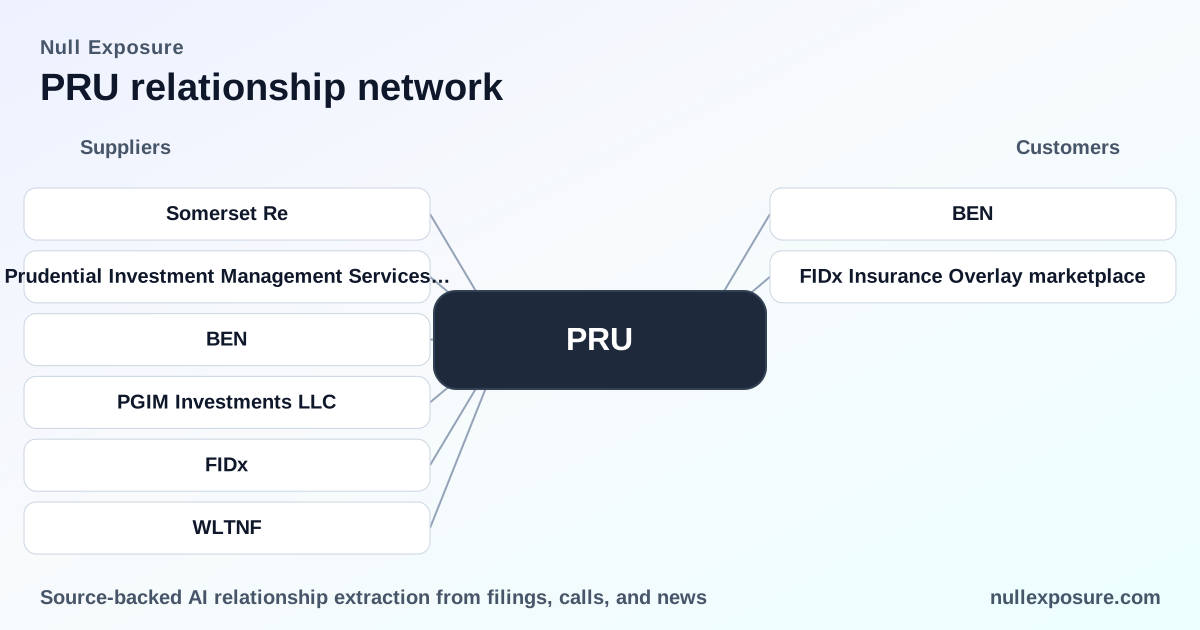
Prudential Financial (PRU): Customer relationships that shape earnings and liabilities
Prudential Financial operates a bifurcated business model: insurance underwriters and annuity issuers collect premiums and assume long-duration liabilities, while PGIM generates fee income as a global asset manager — together monetizing through underwriting margins, investment returns, and management fees. For investors, the signal set to watch is clear: long-term liability exposures (annuities, pension risk transfers) coexist with short-term liquidity activities (repos, securities lending) and platform distribution partnerships that scale guaranteed-income products. For a refreshed map of counterparty and product linkages, visit https://nullexposure.com/.
Why these customer relationships matter to valuation
Prudential’s top-line is driven by premium and fee flows but its risk profile is defined by the counterparties and channels that accept or distribute its guarantees. Distribution partnerships widen addressable markets for guaranteed-income overlays, while reinsurance stakes and corporate buyouts into ceded risk influence capital and reserve dynamics. Investors should parse each relationship for distribution reach, counterparty credit, and the tenor mismatch between assets and liabilities.
Relationship roll call — the recent items you need to read
BEN (NJBiz coverage — March 2026)
Prudential is collaborating with Franklin Templeton to expand access to its ActiveIncome insurance overlay, placing Prudential’s annuity-style guarantee onto Franklin Templeton’s Canvas platform to reach retail managed-account clients. (NJBiz, Mar 2026; https://njbiz.com/prudential-franklin-templeton-activeincome-canvas/)
Franklin Templeton (NJBiz entry — March 2026)
Franklin Templeton’s Canvas platform will host Prudential’s contingent deferred annuity overlay, enabling advisers and retail managed accounts to layer lifetime income solutions without moving core savings. (NJBiz, Mar 2026; https://njbiz.com/prudential-franklin-templeton-activeincome-canvas/)
BEN (StockTitan bulletin — March 2026)
Prudential announced the ActiveIncome insurance overlay for retail managed accounts on Franklin Templeton’s Canvas, a product launch positioning Prudential as the insurance overlay provider on third‑party investment platforms. (StockTitan, Mar 2026; https://www.stocktitan.net/news/BEN/prudential-launches-its-active-income-insurance-overlay-on-franklin-3qryes8naqxj.html)
LPLA (Q4 2025 earnings call excerpt)
An LPLA earnings call referenced an expected full-year expense impact related to Commonwealth integration, quantifying ~$380–$390 million and projecting core G&A for 2026; the mention is relevant as a comparator for acquisition-related cost recognition among large financial services firms. (LPLA Q4 2025 earnings call transcript, Mar 2026)
KKR & Co. Inc. (SimplyWall summary — May 2026)
Funds managed by KKR agreed to acquire an 11.27% stake in Peak Reinsurance from Prudential, indicating Prudential’s active portfolio rebalancing of minority positions in reinsurance ventures. (SimplyWall.St, May 2026; https://simplywall.st/stocks/us/insurance/nyse-pru/prudential-financial)
Metallus Inc. (Pensions & Investments / P&I — March 2026)
Metallus completed the termination of its salaried pension plan through a buyout with Prudential, a classic pension-risk-transfer transaction that removes long-dated liabilities from a corporate sponsor in exchange for a lump-sum premium paid to Prudential. (Pensions & Investments, Mar 2026; https://www.pionline.com/pension-risk-transfer/metallus-inc-completes-termination-salaried-pension-plan-through-buyout/)
Alico, Inc. (SEC filing excerpt via StockTitan — May 2026)
Alico repaid borrowings and terminated a loan agreement under Prudential Mortgage Capital Company, signaling that Prudential had been a lender in customized mortgage financing for smaller corporates and that those exposures can be refinanced away. (StockTitan / SEC filings, May 2026; https://www.stocktitan.net/sec-filings/ALCO/page-3.html)
Winmark Corp. (TradingView summary — March 2026)
A Winmark SEC report notes a Note Agreement with PGIM for $30 million at 3.18% interest, showing PGIM’s role as a direct-credit provider and confirming Prudential’s affiliate PGIM participates in corporate lending markets. (TradingView summarizing Winmark 10-K, Mar 2026; https://www.tradingview.com/news/tradingview:c601b6742e032:0-winmark-corp-sec-10-k-report/)
FIDx Insurance Overlay marketplace (NJBiz — March 2026)
Prudential’s ActiveIncome vehicle is now available through the FIDx Insurance Overlay marketplace on Canvas, allowing advisers to layer a contingent deferred annuity on top of clients’ existing accounts — an example of platform-enabled product distribution. (NJBiz, Mar 2026; https://njbiz.com/prudential-franklin-templeton-activeincome-canvas/)
Dimensional Managed Accounts (SimplyWall summary — May 2026)
Prudential announced ActiveIncome availability for Dimensional-managed accounts, indicating multiple platform partnerships and a strategy to embed lifetime-income across different managed-account providers. (SimplyWall.St, May 2026; https://simplywall.st/stocks/us/insurance/nyse-pru/prudential-financial)
Operating model constraints and what they signal for investors
Prudential’s constraint profile reads like a financial conglomerate balancing short-term liquidity and long-duration guarantees. Contracting posture is dual-natured: the company engages in short-term market operations (repos and securities lending) to manage liquidity, while also underwriting long-term insurance and annuity contracts that lock in reserve assumptions and require long-term hedging. The presence of pension risk transfers and group annuity contracts indicates high contractual maturity and criticality for liability management — these are multi-decade obligations that drive capital and duration hedging strategies.
Geographically, Prudential is globally diversified with concentrated franchises in North America, APAC (notably Japan), and Latin America; this broad footprint reduces single-market concentration but increases operational and regulatory complexity. Counterparty mix is broad: the company serves both individual retail customers (annuities, life, retirement) and large institutional clients (PGIM’s institutional asset management), so credit and distribution counterparty risk is mixed across segments.
Relationship roles skew toward seller and service provider: Prudential sells insurance guarantees and provides investment-management services through PGIM, creating recurring fee and premium streams but also concentrated exposure to longevity, interest-rate, and credit cycles. The constraints also flag an ongoing winding-down of certain traditional participating products, a signal of product-line maturity and legacy liability runoff.
Investment implications — distilled
- Distribution partnerships (Canvas, Dimensional, Franklin Templeton) are high-impact levers: they scale annuity overlays without transferring core investment assets off platform, improving sales efficiency and fee capture. These are positive revenue optionality.
- Pension risk transfers and reinsurance stakes (e.g., Peak Re) are capital and reserve events that materially affect liability duration and capital ratios; monitor capital moves and minority stake sales for balance-sheet direction.
- Short-term liquidity activity (repos, securities lending) is routine but increases sensitivity to market stress; prudent liquidity buffers matter given long-duration underwriting.
For a concise counterparty map and to track how partner moves influence Prudential’s risk-adjusted returns, see our platform: https://nullexposure.com/.
Bottom line
Prudential continues to monetize guaranteed-income demand by embedding annuity overlays into third‑party platforms while simultaneously managing long-duration liabilities and trimming noncore stakes. The company’s revenue base benefits from diversified fee and premium streams, but investor returns will hinge on reserve assumptions, hedging effectiveness, and the credit/operational strength of distribution partners.