Privia Health (PRVA) — Customer Relationships and Commercial Implications
Privia Health operates as a hybrid population-health technology and medical practice management platform that monetizes through three core revenue streams: fee-for-service clinical care, per-member-per-month (PMPM) care management/subscription fees, and value-based care (VBC) arrangements including capitated payments and shared savings. The company combines long-term contracting with MSO-style management services and a cloud-based technology layer to extract margins from payer arrangements and to scale sales across new markets. For investors, the critical question is whether Privia’s customer mix, contract structures and service-first posture deliver predictable, durable cash flows sufficient to justify current valuation multiples. Learn more at https://nullexposure.com/.
Why customer relationships determine valuation for Privia
Privia’s commercial model is not a simple vendor relationship — it is a platform-plus-services business where customers are simultaneously payers, member populations and physician groups. Public filings and corporate disclosures establish these key structural facts:
- Long-dated contracts predominate. Privia signs multi-year agreements—often 3–5 year initial terms and MSAs as long as 5–20 years—which creates a baseline of revenue visibility and increases switching friction for medical groups and payers.
- Subscription-style, PMPM economics underpin recurring revenue. A meaningful portion of revenue is delivered as PMPM care management fees and administrative fees, driving predictable monthly cash flow when population counts stabilize.
- Payer and government exposure is strategic and material. The company contracts with U.S. federal programs and large payer organizations; public filings disclose revenue concentrations with major payers that exceed 10% of total revenues.
- Privia acts as principal and service provider. The company records fees gross because it coordinates and controls the non-clinical services under capitated payer contracts, a sign that Privia is not a passive reseller but an active manager of flows and collections.
- National footprint with regional execution. Privia operates across roughly 14–15 markets and numerous states, giving both diversification benefits and executional complexity as it expands.
Taken together, these characteristics create high revenue durability but also concentrated counterparty and execution risk: durable base revenue from PMPM and multi-year MSAs, counterbalanced by dependency on large payers, ACO performance and the company’s ability to onboard and monetize new regional partners.
Active customer relationships identified in public sources
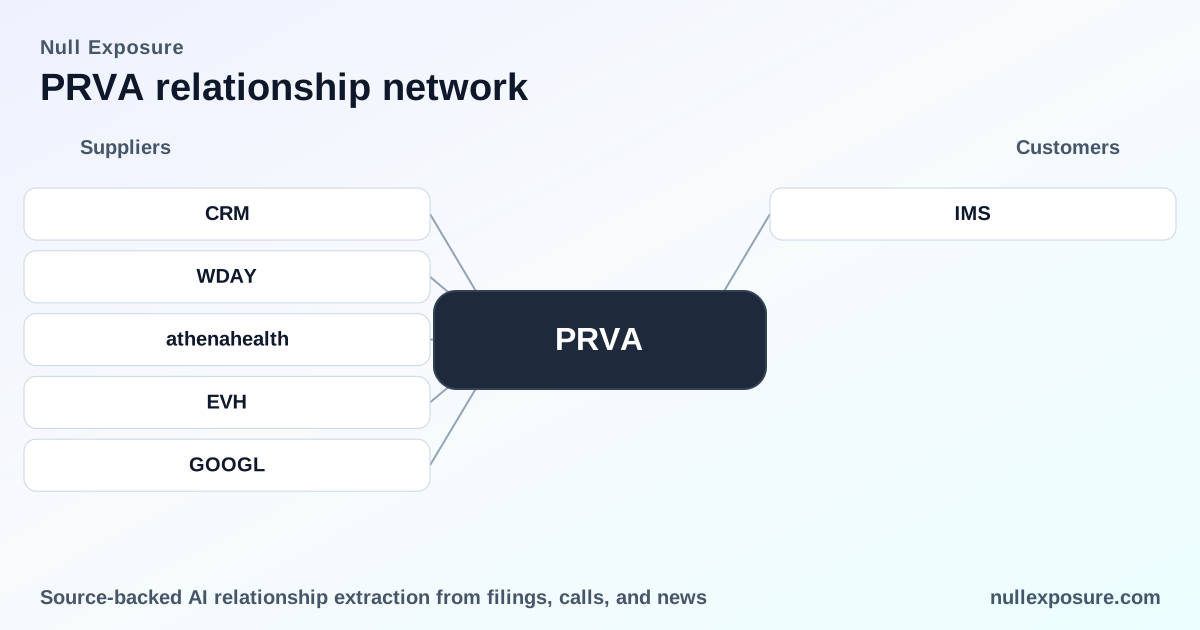
Privia’s public disclosures and earnings commentary have highlighted partner implementations and go-to-market progress. The sets of results provided identify a single counterparty relationship: IMS. Below are concise, source-backed descriptions for each reported item.
IMS — anchor partner implemented in Arizona (InsiderMonkey transcript)
Privia implemented IMS on its platform at the end of Q3 and reported strong sales momentum in Arizona after the go-live, signaling that the IMS relationship is being used as an anchor to accelerate state expansion. This detail comes from the Q4 2025 earnings call transcript captured by InsiderMonkey in March 2026.
IMS — corroborating earnings transcript coverage (The Globe and Mail / Motley Fool)
The company reiterated that IMS was implemented on the Privia platform at the end of Q3 and that management is seeing robust sales traction in the state, as noted in the Q4 2025 earnings transcript summarized by The Globe and Mail / Motley Fool in March 2026.
Both entries reference the same commercial event: an IMS implementation used to catalyze Privia’s Arizona market growth and downstream sales momentum.
How these relationship signals affect operating constraints and capital allocation
Translate the constraints and contractual evidence into investor-relevant operational inferences:
- Contracting posture and maturity: Multiyear MSAs and 3–5 year payer contracts indicate an emphasis on long-term revenue capture and retention; this supports capital allocation toward onboarding, tech integration and MSO operations rather than one-off sales.
- Concentration and counterparty criticality: Public filings note payer revenue concentrations above 10%; this is a material counterparty risk that demands active payer-management and diversification strategies from management.
- Revenue recognition and margin dynamics: Recording fees gross and acting as the principal in service delivery implies Privia assumes operational and financial responsibility for collections and risk under capitated arrangements — that creates greater upside in upside scenarios and greater downside in under-performance.
- Geographic execution risk: Operating in multiple, heterogeneous markets delivers growth optionality but requires localized MSO capabilities and clinical partner alignment to realize PMPM economics.
- Service + software positioning: The business reports a single operating segment that blends services and a cloud-based technology solution; this hybrid model drives cross-selling potential but complicates margin expansion versus pure-play software peers.
These constraints should frame any model of recurring revenue growth, churn assumptions for medical groups, and the timing of margin improvement.
Investment implications and risk checklist
Privia’s current financials show scale—over $2.1B in trailing revenue—but thin operating margins and elevated valuation multiples indicate the market is pricing growth recovery and VBC upside. Key items for investors to monitor:
- Renewal cadence and term lengths across MSAs and payer contracts.
- Payer concentration trends: whether top payers fall below materiality thresholds or become more concentrated.
- ACO and VBC performance metrics tied to capitated revenue and shared savings.
- Speed and efficiency of onboarding anchor partners (example: IMS in Arizona) and conversion of implemented providers to revenue-generating populations.
- Cash flow stability given gross revenue recognition and collection risk under capitated arrangements.
If Privia sustains PMPM growth, improves ACO outcomes and controls payer concentration, the platform’s long-dated contracts should support multiple expansion; if reimbursement or ACO performance deteriorates, downside can be amplified by the firm’s role as principal under capitated programs.
Learn more about relationship-driven risk analysis at https://nullexposure.com/.
What to watch next (practical signals)
- Quarterly disclosures on PMPM population growth and geographic rollouts.
- Payer revenue share tables in annual filings to track concentration moves.
- ACO performance and shared-savings realization reported each fiscal year.
- New anchor partnerships and implementation timelines akin to IMS in Arizona.
- Any changes in revenue recognition policy or gross-fee reporting that would shift principal versus agent risk.
Conclusion
Privia’s business converts contractual relationships—multi-year MSAs, PMPM subscriptions and capitated payer deals—into recurring cash flows through an active service-provider posture backed by a cloud platform. The investment case rests on execution: scaling anchor partnerships, improving ACO performance, and reducing payer concentration while preserving durable PMPM revenue. Investors should evaluate new partnership rollouts and payer exposures as the clearest near-term drivers of valuation.