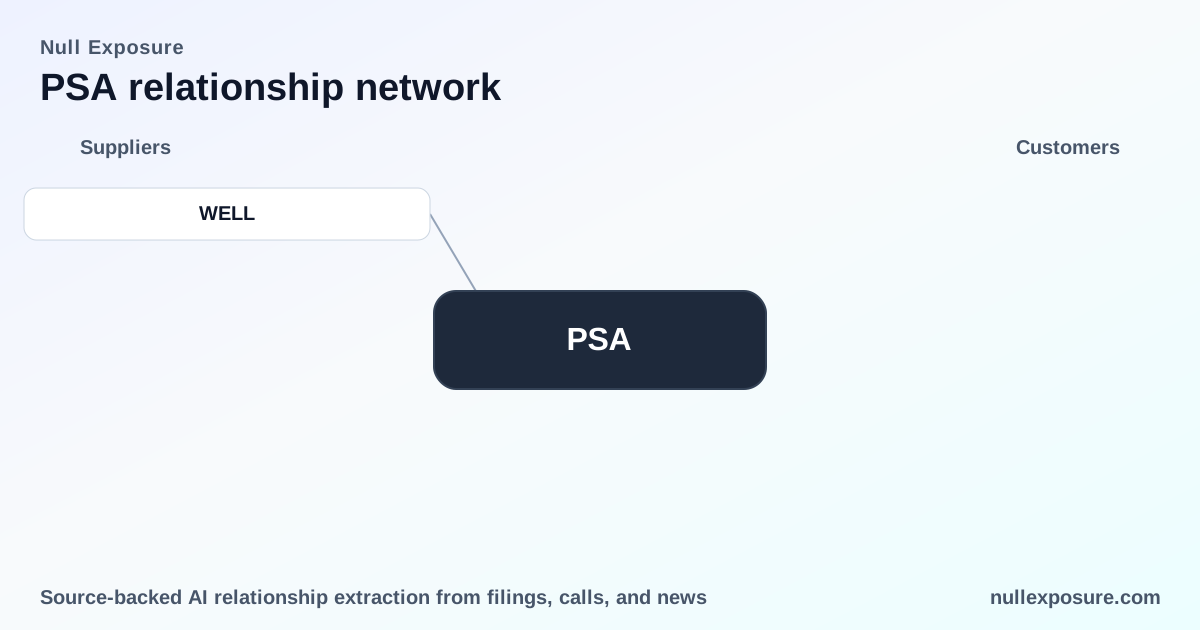
Public Storage (PSA): Customer Relationships, Revenue Levers, and Operational Constraints
Public Storage operates as a large-cap REIT that owns, operates, and manages self-storage facilities while capturing recurring cash flows from month-to-month leases, tenant insurance, ancillary sales, management fees and selective financing arrangements. Its monetization model blends high-margin service income (tenant reinsurance and third‑party property management) with stable rental revenue from a geographically diversified U.S. footprint; investors should value PSA as a cash-flow business with adjacent fee opportunities that expand margins without heavy incremental capital deployment. Learn more at https://nullexposure.com/.
How PSA’s customer posture shapes cash flow and risk
Public Storage’s core economics flow from short-term, high-turnover consumer leases and a broad retail customer base. The company leases storage units on a month-to-month basis, which creates both pricing agility and volatility in occupancy. Counterparty concentration is low because the bulk of customers are individuals rather than large corporate tenants, reducing single‑counterparty credit risk while increasing churn exposure and marketing spend to retain utilization.
PSA’s operating model already exhibits meaningful diversification beyond unit rent:
- Tenant reinsurance and premium revenue scale with its occupied base and add recurring, higher-margin income.
- Third-party property management and related bridge lending convert operating scale into fee and financing income, and they make PSA a service provider as well as an owner.
- Trademark licensing and on-site merchandise sales are adjacent revenue lines that are small but recurring and improve per-customer yield.
Collectively these elements produce a hybrid business: REIT-like capital intensity at the asset level combined with service and fee dynamics that are more typical of scaled consumer platforms. That hybridization raises the importance of operational execution—pricing, digital customer acquisition, and third-party management—rather than pure portfolio growth.
All reported customer relationships in the feed
GameStop / Push Start Arcade — beta partnership (FY2025)
Press coverage indicates GameStop launched Push Start Arcade in beta with a partnership that leverages PSA’s brand in card grading and collectibles infrastructure, positioning PSA as the grading authority for the initiative. InsiderMonkey reported this connection as part of GameStop’s efforts to address friction points in collectibles (Mar 9, 2026).
GameStop / Power Packs — fee streams from graded collectibles (FY2026)
Analysts described GameStop’s Power Packs launch as a targeted attempt to drive higher-margin collectibles revenue by using PSA’s grading and handling infrastructure to create new fee streams without taking on inventory risk. Sahm Capital covered this strategic use of PSA’s capabilities in April 2026, highlighting the fee-generation angle (Apr 18, 2026).
GameStop / Power Packs — physical cards unlock tied to PSA grading (FY2026)
Reporting on GameStop’s public launch noted that digital trading card purchases can unlock physical PSA‑graded cards, signaling a direct commercial integration where PSA grading lifts the value proposition of collectible products. Sahm Capital’s April 16, 2026 report summarized how PSA’s grading function is being embedded in the product experience to support collectible categories such as Pokémon and sports cards (Apr 16, 2026).
National Storage Partners JV — management role in $3.3B portfolio (FY2026)
Industry coverage reported a $3.3 billion joint venture in which National Storage Partners would own 80% and Public Storage would manage the portfolio, demonstrating PSA’s ongoing role as a third‑party manager and platform operator beyond assets it owns outright. InsiderMonkey covered the JV structure and PSA’s management appointment (May 3, 2026).
What these relationships imply for revenue composition and strategy
The press references of PSA as a grading partner to GameStop and as a manager in a large JV convey two strategic themes that matter for investors:
- Fee expansion through platform services. PSA’s grading and fulfillment role with GameStop is an example of monetizing core competencies (branding, authentication, logistics) into third-party fee income without incremental real estate capex. This raises margin optionality and offers non-rental cash flow that scales with partnerships.
- Management and capital-lite growth. The National Storage Partners JV demonstrates how PSA converts operational capacity into recurring management fees and financing opportunities. Managing third‑party portfolios and providing bridge loans increases earnings diversification while preserving capital discipline.
Both threads point to a company pivoting toward higher-margin services layered on top of stable rental cash flows—a structural improvement to long-term profitability if execution remains disciplined.
Operational constraints and their investor implications
The company disclosures and evidence create a clear profile of operating constraints and business characteristics:
- Contracting posture: month-to-month leases dominate, giving PSA pricing flexibility but making occupancy and revenue more cyclical.
- Counterparty makeup: customers are predominantly individuals, which lowers single-counterparty risk and increases churn and customer-acquisition emphasis.
- Geography: PSA’s operations are primarily North American, with a nationwide U.S. footprint across major markets that limits foreign geopolitical exposure but concentrates economic risk on the U.S. consumer cycle.
- Relationship roles: PSA acts as an owner-operator, third‑party manager, insurer/reinsurer program sponsor, licensor, and seller of adjacent goods, demonstrating multi-channel monetization and operational complexity.
- Maturity and criticality: storage is a mature real‑estate sub-sector with predictable structural demand drivers, while newer service lines (grading partnerships, JV management) are incrementally strategic and materially increase revenue optionality without materially changing balance-sheet intensity.
Investors should treat the service and licensing activities as company-level signals that incrementally de-risk growth via fee income, not as replacements for core rental yields.
Key risks and what to watch next
- Occupancy and average rent trends remain the dominant short‑term driver of cash flow—monitor monthly occupancy, blended rent per sq. ft., and same-store revenue growth.
- Growth of tenant reinsurance premiums and third‑party management portfolio size signal margin trajectory; rising fee income reduces sensitivity to occupancy swings.
- Partnership traction (for example, additional integrations like the GameStop initiatives) will materially affect non‑rental revenue growth; watch announcements and early monetization metrics.
- Capital allocation: evidence of more JVs and bridge lending suggests PSA will continue to pursue capital-light growth, but investors should monitor credit exposure from financing programs.
For a concise briefing on how PSA’s partner relationships feed into cash flow and downside protection, visit https://nullexposure.com/ for more analysis.
Bottom line
Public Storage remains a balanced REIT with growing service economics. Short-term retail leases underpin steady cash flow while third-party management, tenant insurance, trademark licensing and new partnerships (including collectibles grading) expand high-margin revenue streams. For investors, the primary valuation hinge continues to be occupancy and rent growth, with the added potential upside from fee diversification and capital-light management contracts.