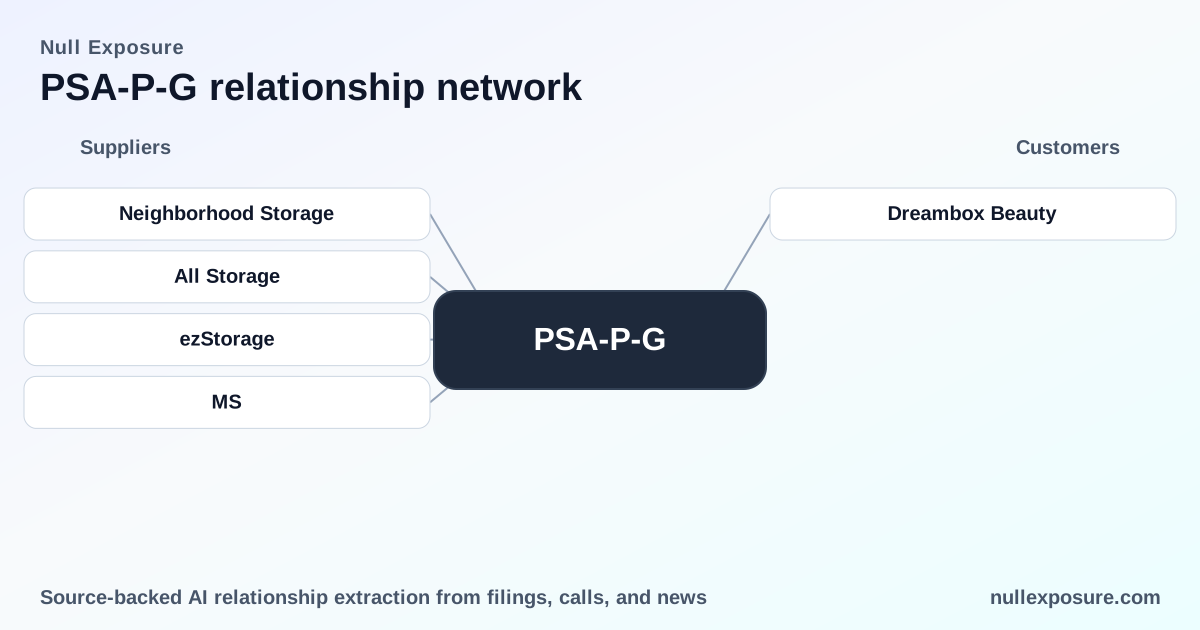
Public Storage (PSA-P-G) — Customer Relationship Snapshot and Investment Implications
Public Storage operates one of the largest self-storage REIT platforms in the United States, monetizing through rental income on storage units, ancillary fees (insurance, late fees, retail sales), and portfolio management of real estate assets; PSA-P-G represents a series of depositary preferred shares tied to that platform’s capital structure. For investors evaluating customer relationships, these interactions provide direct signals about operational execution, tenant mix, and reputational risk that can affect occupancy, pricing power, and operating expense trends. For a broader view of tenant-level issues across portfolios, visit https://nullexposure.com/.
A single customer incident can reveal system-level dynamics
The customer-level record available for PSA-P-G shows one media-captured incident involving a small retail brand that used a Public Storage unit for inventory. This single event is not an earnings release, but it is a concrete operational data point about tenant experience, on-site security, and front-line staff response.
Dreambox Beauty — what happened and why it matters
A news article from ABC7 on March 10, 2026 recounts that Jennifer Taylor, founder of Dreambox Beauty, discovered her storage unit had been ransacked and reported approximately 75% of inventory stolen, with company staff saying multiple units had been targeted over several days. The coverage cites tenant remarks that staff were aware of multiple incidents at the facility. (ABC7, March 10, 2026: https://abc7.com/post/public-storage-santa-ana-burglaries-theft/12810927/)
- Plain-English takeaway: Dreambox Beauty’s experience highlights an acute retail-loss event at a Public Storage location that directly impacts small-business tenants and creates potential reputational and customer-retention challenges for the operator.
- Source: ABC7 local news report, March 2026.
What this relationship—and the absence of others—signals about Public Storage’s operating model
With only one customer-level relationship captured in the set, make the following company-level inferences about operating posture and business model characteristics:
- Contracting posture: Public Storage runs standard short-term rental agreements and month-to-month occupancy models that create high tenant turnover and low contracting friction; these terms drive predictable revenue per unit but limit contractual leverage to enforce tenant security practices.
- Customer concentration: The customer base is highly atomized across small retail, personal, and commercial users, producing low single-tenant concentration risk at the portfolio level but higher vulnerability for individual tenants (like Dreambox Beauty) to discrete loss events.
- Criticality of service: For many tenants the storage service is important but not mission-critical—loss of inventory can be materially disruptive to small businesses, but the asset class does not typically serve as core infrastructure for larger corporate customers.
- Maturity and scale: As a mature REIT platform, Public Storage operates a standardized operational playbook; incidents like the Dreambox theft are operational shocks that test site-level security protocols, staff training, and incident escalation pathways.
- Constraints signal: No formal constraints were captured for PSA-P-G in the reviewed data, which is itself a signal: data collection did not surface contractual limitations, vendor disputes, or litigation items tied to customer relationships in this sample. Treat this as a company-level absence of captured constraints rather than affirmative confirmation of none.
Investment implications: risk levers and monitoring priorities
Operational incidents involving tenant inventory translate into several measurable risks and a few potential opportunities:
- Reputational risk: High-visibility thefts can reduce local demand and pressure occupancy or pricing at the affected facility; reinforce monitoring of localized occupancy and same-store revenue trends after an incident.
- Cost risk: Increased incidents drive higher insurance claims and potential for raised insurance premiums, and can require capital expenditure on security upgrades (cameras, gates, lighting).
- Tenant economics: Small-business tenants represent a portion of revenue that is sensitive to trust in on-site management; losses can accelerate churn among these tenants, compressing lifetime value.
- Operational improvement opportunity: Consistent front-line reporting of multiple units being targeted suggests a gap in loss-prevention protocols; an operator that moves quickly to upgrade security and communicate remedies can recover occupancy and pricing power.
Key investor actionables:
- Monitor regional press for facility-level incidents and follow-up company communications for remediation steps.
- Watch same-store occupancy, revenue per available unit (RevPAU), and ancillary revenue trends in the quarters following reported incidents.
- Track corporate disclosures about capital allocation to site security and insurance cost trends in filings and earnings calls.
How to weigh a single incident against portfolio strength
A solitary tenant incident is a red flag for facility-level management rather than a wholesale indictment of the business model. The self-storage industry’s diversified tenant mix dilutes the financial impact of single-unit losses, but repeated or systemic incidents concentrated by geography would raise capital and reputational concerns. Investors should treat local events as early-warning signals and escalate scrutiny if similar incidents cluster across multiple facilities or geographies.
Practical checklist for analysts and operators
- Request or review site-level incident logs and remediation timelines for any facility with media coverage.
- Confirm whether insurance recoveries and tenant compensations are proxied in the company’s operating expense disclosures.
- Seek management commentary on security capital expenditures and whether incidents have produced underwriting or pricing impacts from insurers.
- For operators: prioritize visible, low-cost security upgrades and transparent tenant communications to limit churn and negative press.
For a concise portfolio-level overview and ongoing tracking of customer-facing incidents, see https://nullexposure.com/ — it aggregates facility and tenant signals that matter to investors and operators.
Bottom line
The Dreambox Beauty incident is a tangible customer relationship data point that highlights security, tenant-reputation, and execution risks at the facility level for Public Storage. While the company’s broad tenant base and standardized operating model limit systemic exposure from a single event, investors should monitor post-incident occupancy and management remediation steps closely as leading indicators of operational resilience and cost pressure.