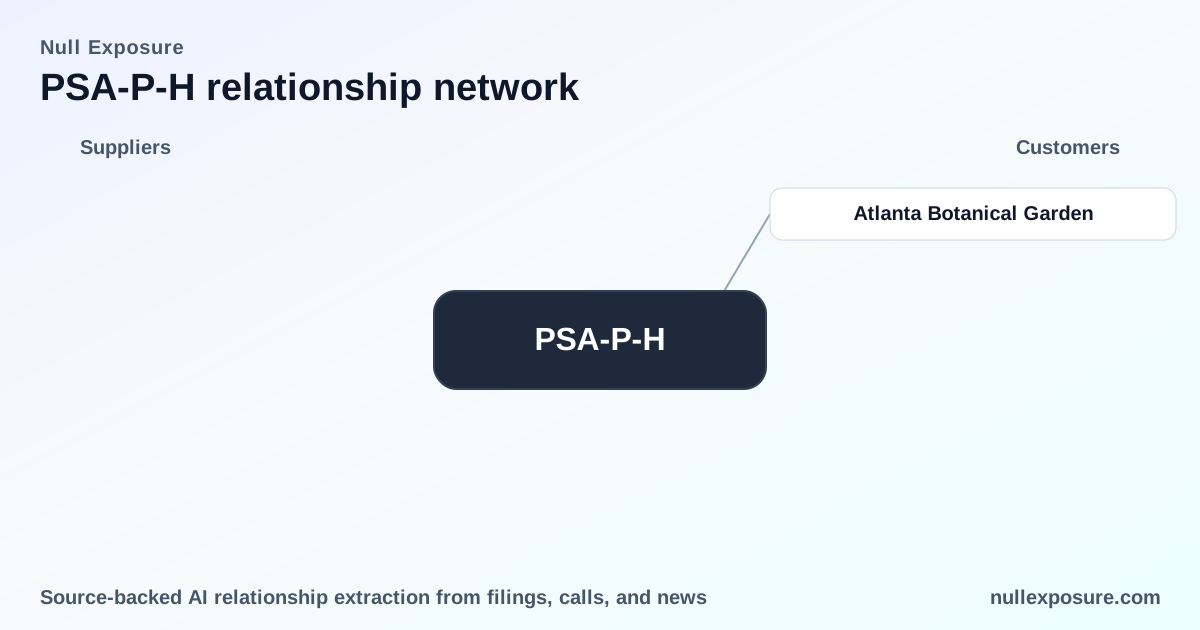
Public Storage (PSA-P-H) — Customer Relationship Review: Atlanta Botanical Garden
Public Storage is a capital-intensive REIT that generates cash flow by owning, operating, and selectively trading self-storage real estate and related facilities; it monetizes through rental income, ancillary service fees, disciplined acquisitions and dispositions, and balance-sheet leverage. For holders of the preferred tranche PSA-P-H, property-level transactions influence asset values and portfolio optionality more than near-term coupon mechanics, so tracking counterparties and disposition patterns is essential for assessing franchise durability and downside protection. For a consolidated view of recorded customer activity and counterparties, visit the NullExposure home page: https://nullexposure.com/
Deal snapshot: Atlanta Botanical Garden land swap and what it signals
Public Storage completed a geographically-specific asset exchange with the Atlanta Botanical Garden in a transaction that involved two cash legs: Public Storage purchased land on Monroe Drive for $13.5 million, while the Garden purchased Public Storage’s Piedmont Avenue facility for $40 million. A local news report covering the deal was published on March 10, 2026 by 11Alive and documents the swap and relative price points.
Key takeaway: this is an example of asset-level portfolio rotation where Public Storage acquires strategic land parcels while monetizing operating real estate—an active capital-allocation move rather than a routine lease or franchise arrangement.
Why this single-counterparty transaction matters for investors
This transaction illustrates several concrete business-model behaviors that matter for PSA-P-H holders:
- Active portfolio management: Public Storage is executing targeted dispositions and acquisitions to optimize location mix and long-term earnings potential. The cash inflows from facility sales materially fund site purchases or redevelopment where management sees higher residual value.
- Local-market repositioning: Buying Monroe Drive land while selling a Piedmont Avenue facility reflects granular, city-level decisioning rather than passive holding; that increases the company’s exposure to idiosyncratic municipal outcomes but also creates upside through redevelopment optionality.
- Counterparty structure: Transactions with civic or nonprofit entities (like a botanical garden) alter the typical buyer-seller dynamic; such counterparties can create unique negotiation outcomes and price asymmetries versus institutional investors.
These behaviors are consistent with a REIT that treats property sales and land acquisition as tools of capital allocation, affecting long-term NAV and therefore the security’s risk-offset profile.
Relationship catalog: every customer linkage in scope
- Atlanta Botanical Garden — Public Storage purchased land on Monroe Drive from the Garden for $13.5 million, while the Garden acquired Public Storage’s Piedmont Avenue facility for $40 million; transaction reported by 11Alive on March 10, 2026. (11Alive local news report, Mar 10, 2026)
This listing represents the complete set of customer relationships surfaced for the PSA-P-H scope in the current review.
Constraints and company-level signals you need to know
The available records for PSA-P-H include no explicit contractual constraints or vendor limitations recorded in this scope. Treat that absence as a company-level signal: the source set did not flag concentrated supplier or counterparty dependencies for this security’s customer relationships. From an operational standpoint this translates into:
- Contracting posture: Transactions are asset-focused and bilateral; Public Storage exercises direct control over asset ownership decisions rather than relying on outsourced operating partners in a way that would create single-point failure.
- Concentration: There is no evidence here of customer concentration risk beyond individual asset counterparties; the single recorded relationship is a localized property-level swap rather than an ongoing revenue contract.
- Criticality: The deal is material at the asset level but not demonstrably critical to franchise-wide cash flow based on the information captured.
- Maturity: This is an executed one-off transaction rather than a multi-year commercial contract; therefore counterparty longevity is not established in the record.
These company-level signals support a view of operational flexibility and asset-level decisioning rather than lock-in dependency with specific customers.
Practical risk considerations for preferred-holders and operators
For investors focused on preferred securities like PSA-P-H, the implications of transactions such as this are predictable and actionable:
- Valuation and execution risk: Asset swaps and swaps-for-cash require accurate local valuation and timing. A sale that funds a land purchase shifts near-term liquidity but can enhance long-term NAV if redevelopment or rezoning realizes value.
- Local regulatory and community risk: Dispositions and acquisitions in urban cores often face zoning, environmental, and community-review processes that can affect project timelines and returns.
- Earnings signal vs. cash-signal: For preferred holders, the operational income stream is more relevant than a single transaction’s headline dollar value, but repeated asset sales at depressed prices could erode NAV cushions supporting preferred claims.
In plain terms: this transaction demonstrates management’s willingness to trade operating assets for land and vice versa, a strategic play that increases optionality but requires disciplined execution and local-market expertise.
Bottom line and next steps for investors and operators
The Atlanta Botanical Garden transaction is a useful microcosm: Public Storage is actively reallocating capital at the asset level, using property sales to fund land purchases that could support development upside. For PSA-P-H stakeholders, this dynamic is a double-edged sword—it supports long-term NAV management but demands scrutiny of valuation execution and municipal risks.
If you want a consolidated, investor-ready view of customer-level counterparties, transactions, and relationship signals for preferred and common tranches, explore additional coverage at https://nullexposure.com/ — the site aggregates these relationship touchpoints to help prioritize due diligence and monitor counterparty exposure.