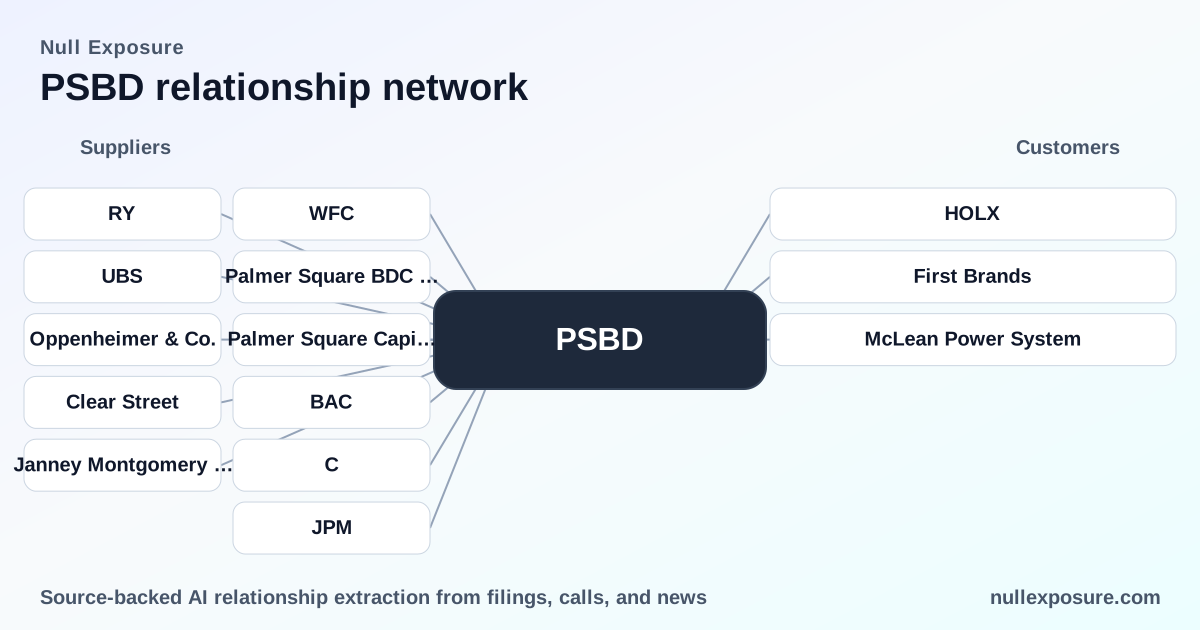
PSBD: Private-credit bets, active portfolio management, and where capital flowed in FY2026
Palmer Square Capital BDC Inc. (PSBD) is a public BDC that underwrites middle‑market debt and selectively structures equity-like instruments, monetizing through interest income, fees and realized gains on negotiated private credit deals. The company operates as an active credit investor and collateral manager, deploying capital across first- and second‑lien tranches while using portfolio-level discipline to reallocate exposure as borrower fundamentals evolve. For investors, PSBD’s returns derive from yield pickup in private credit plus portfolio construction and opportunistic trading of positions.
For a concise view of PSBD’s research and signals, visit https://nullexposure.com/.
How Palmer Square actually makes money and runs risk
PSBD sources loans and structured credit for middle‑market borrowers and sits either as a lender or as a collateral manager on securitizations. Revenue is produced from contractual interest and fees on privately negotiated facilities and from realized gains when portfolio positions are resized or exited. The company couples direct lending with CLO/collateral manager activities, which creates fee income and alignment incentives when PSBD serves as collateral manager for sponsored vehicles.
Operationally, PSBD’s model is both active and opportunistic: management underwrites deals across a spread of borrower sizes and industries, syndicates portions where appropriate, and adjusts funding commitments when syndication outcomes or borrower signals change. This is a capital‑intensive, relationship‑driven business in which credit selection, second‑lien exposures and manager discretion determine near‑term earnings volatility.
Deal flow and customer relationships that moved the needle in FY2026
Below are the customer relationships identified in public coverage and management commentary in FY2026; each relationship is summarized in plain English with source attribution.
Hologic (HOLX) — a material second‑lien private credit participation
Palmer Square committed $100 million to the second‑lien tranche of Hologic’s take‑private financing and ultimately funded $75 million after the deal was resized following a strong first‑lien syndication process. According to the company’s earnings call transcript reported by The Globe and Mail (March 10, 2026), PSBD acted as a private credit provider on the transaction, reflecting willingness to take subordinated debt positions when risk‑adjusted spreads justify the commitment. This is a clear example of PSBD stepping into large corporate financings and then adjusting funded exposure to market syndication dynamics.
Source: The Globe and Mail / earnings call transcript (Mar 10, 2026); related Motley Markets reporting (May 3, 2026).
First Brands — active de‑risking amid sales‑process uncertainty
Management identified First Brands as the most notable credit development in the quarter and reduced most of PSBD’s exposure in January, choosing not to commit incremental capital given uncertainty around the borrower’s sales process and weakening customer sentiment. As discussed on the same earnings call transcript, PSBD prioritized capital preservation by trimming exposure rather than adding to the position. This demonstrates PSBD’s portfolio‑level decision to exit or shrink positions when event risk rises.
Source: The Globe and Mail / earnings call transcript (Mar 10, 2026; May 3, 2026).
McLean Power System — the same active reduction playbook
PSBD reported applying a “similar approach” to the McLean Power System transaction, indicating that management reduced exposure there as well instead of increasing commitments. The earnings call commentary highlights a consistent playbook: evaluate ongoing transaction outcomes and shrink funded exposure where downside signals outweigh prospective return. This reinforces an active risk‑management posture rather than a buy‑and‑hold approach for marginal credits.
Source: The Globe and Mail / earnings call transcript (May 3, 2026).
What these relationships collectively reveal about PSBD’s operating model
The FY2026 relationship set and company filings convey multiple characteristics of PSBD’s business that are relevant for investors evaluating customer credit risk and revenue durability.
- Contracting posture: predominantly transactional and flexible. Management’s resizing of Hologic funding and reductions in other credits indicate short‑to‑medium horizon commitments where PSBD adjusts funded amounts in response to syndication and borrower signals. This is consistent with a short‑term contracting posture noted in company disclosures about stock plans and repurchases.
- Counterparty mix: broad spectrum from small businesses to large enterprises. Filings and disclosures state PSBD lends to “small to large private U.S. companies,” signaling diversity of borrower size and correspondent credit work required across the book.
- Geographic concentration: North America focus. Public filings consistently describe lending to U.S.-based private companies.
- Relationship role: lender and service provider. PSBD acts as both a direct lender and a collateral manager (including formal collateral management agreements and securitization arrangements in filings), so the company collects both interest and management/arrangement fees.
- Relationship stage and maturity: active, ongoing portfolio. Management reports hundreds of investments with meaningful fair value on the balance sheet, signaling a mature, actively managed portfolio.
- Spend/commitment scale: single‑deal commitments can reach multi‑millions, but firmwide capital commitments and internal share purchase plans indicate mid‑single‑digit millions level programs. Public disclosures reference share purchase plans and PSCM purchase amounts in the low millions as governance and capital‑alignment signals.
These items are company‑level signals drawn from management commentary and regulatory exhibits (Form 10‑K, Form 8‑K filings and earnings transcripts covering FY2024–FY2026).
Key risk vectors and what investors should watch
- Credit selection and second‑lien exposure: Participation in subordinated tranches (e.g., Hologic second‑lien) elevates credit sensitivity; underwriting consistency and recovery assumptions will determine realized returns.
- Concentration and event risk: Several FY2026 actions (First Brands, McLean Power) show material moves to reduce exposure when sales processes or customer sentiment deteriorate, underscoring event‑driven downside risk in parts of the book.
- Fee and manager revenue dependency: PSBD’s role as collateral manager generates fee income that supplements interest yield; changes in securitization activity can alter near‑term revenue mix.
- Liquidity and capital allocation signals: Management’s stock purchase plan and stated amounts for repurchases and PSCM purchases (documented in filings) offer modest alignment with shareholders but are not a substitute for strong credit performance.
Practical investor takeaway
Palmer Square operates as an active private‑credit allocator with a bias toward opportunistic second‑lien and structured positions, coupled with active de‑risking when borrower prospects change. The FY2026 portfolio actions—funding a scaled second‑lien for Hologic while trimming First Brands and McLean Power exposures—illustrate disciplined capital allocation and an emphasis on downside protection. For investors evaluating PSBD, focus on credit underwriting quality, realized recoveries on stressed positions, and the cadence of collateral‑management fee generation.
For rolling updates and deeper relationship screening on PSBD and peer BDCs, see https://nullexposure.com/.
(Primary sources: PSBD earnings call transcript coverage in The Globe and Mail and related market reporting, and company filings including Form 10‑K and Form 8‑K referenced in public disclosures from 2024–2026.)