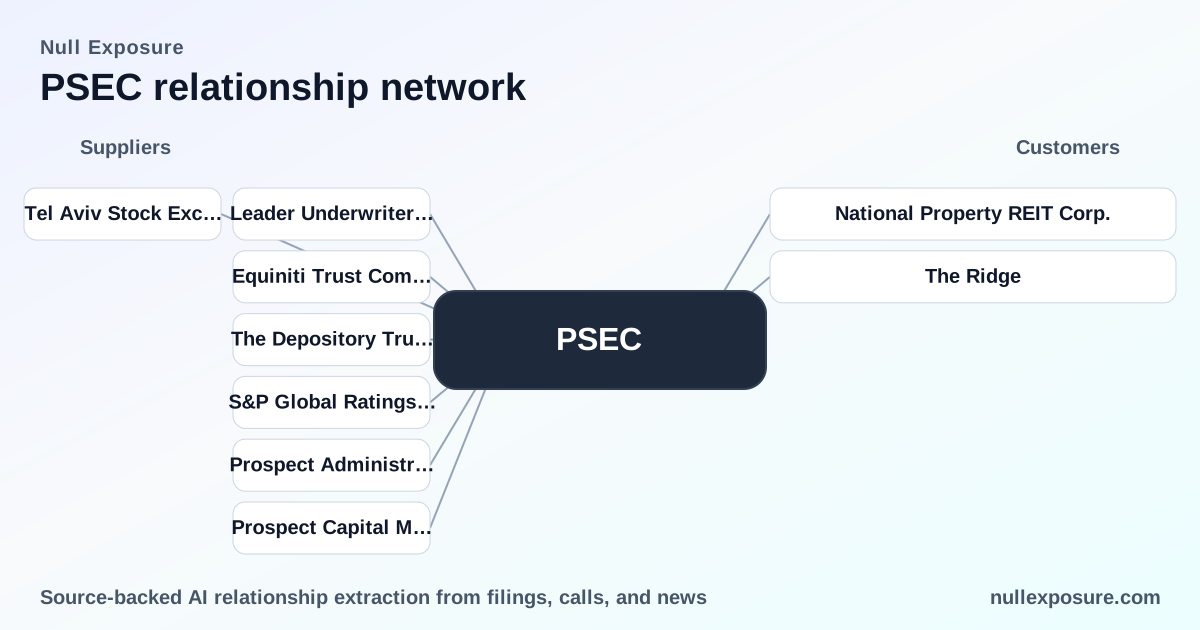
Prospect Capital (PSEC) customer relationships: what investors need to know
Prospect Capital Corporation is a publicly traded business development company that originates and acquires middle‑market debt and equity positions, generating cash through interest, fees and equity upside while distributing a high yield to shareholders. The firm's operating model is loan‑centric: it structures first‑lien and second‑lien term loans, delayed draw facilities and opportunistic equity investments into privately held U.S. companies, then monetizes those positions through interest income, repayment and selective portfolio realizations. For a concise view of Prospect’s research and relationship mapping, visit https://nullexposure.com/ for more context on counterparties and contract profiles.
How the PSEC operating model shapes customer relationships
Prospect runs the classic BDC playbook: long‑dated, concentrated exposures to middle‑market borrowers in the U.S. across services, manufacturing, distribution and software verticals. The company’s filings and relationship evidence produce four practical operating characteristics investors should internalize:
- Contracting posture: long‑term financing predominates. Prospect’s notes and many loan facilities have multi‑year maturities; company disclosures list note maturities stretching from 2027 through 2034, signaling a patient book that funds multi‑year capital needs and creates duration in the portfolio (company FY2025 10‑K).
- Counterparty profile: mid‑market focus and geographic concentration. Prospect explicitly targets U.S. middle‑market borrowers (annual revenue generally under $750 million), which concentrates credit risk in the domestic, privately owned middle market (company FY2025 10‑K).
- Role and criticality: lender and managerial assistance provider. Prospect routinely provides first‑lien and second‑lien loans and, under the 1940 Act, supplies managerial assistance—so relationships are transactional and operationally engaged, not one‑off product sales (company FY2025 10‑K).
- Maturity and spend scale: layered ticket sizes with both large capital programs and mid‑sized loans. Prospect funds through corporate notes (Prospect Capital InterNotes® outstanding were reported at $647,232 aggregate principal as of June 30, 2025) while also making individual loans in the $10m–$100m band, revealing a funding engine that supports both portfolio liquidity and mid‑sized credit exposures (company FY2025 10‑K).
These constraints create a portfolio that is loan‑heavy, U.S. concentrated, and oriented toward durable cash yields rather than short‑term trading gains. For additional proprietary mapping of PSEC counterparties, see the firm profile at https://nullexposure.com/.
Relationship snapshots investors should factor into their credit view
Below are the specific customer relationships extracted from PSEC materials and market reporting. Each entry gives a concise plain‑English summary and a source reference.
National Property REIT Corp.
Prospect provided debt financing to National Property REIT Corp. (NPRC) to fund real estate capital expenditures and working capital, and the FY2025 10‑K records royalty, net profit and revenue interests tied to NPRC in the company’s portfolio accounting. The filing notes a specific financing of $96,995 during the year ended June 30, 2025 and lists royalty/net profit interest amounts in the FY2025 10‑K. (Source: Prospect Capital FY2025 Form 10‑K, fiscal year ended June 30, 2025.)
The Ridge
Prospect, in partnership with Thesis Capital Partners, provided a first‑lien senior secured term loan and an equity investment to The Ridge, a physician‑led addiction treatment facility that offers residential care; the transaction is characterized as senior secured lending coupled with an equity stake. (Source: market coverage, Yahoo Finance report on Prospect Capital and Thesis Capital Partners, March 2026.)
PRIF‑P‑J (Priority Income Fund)
PRIF‑P‑J is a closed‑end preference/security linked to the Priority Income Fund that is managed by Prospect Capital Management; external reporting highlights Prospect’s asset management scale and stewardship role—Prospect Capital Management reported $8.8 billion of assets under management as of December 31, 2022 in industry coverage. (Source: CFI.co award profile and commentary, 2023, referencing Prospect Capital Management AUM as of Dec. 31, 2022.)
What these relationships reveal about portfolio risk and return
Several durable themes emerge from Prospect’s customer list and the constraints in its public materials:
- High yield, illiquid credit profile. Prospect’s emphasis on first‑lien and second‑lien loans and equity positions to middle‑market borrowers produces higher coupon income but creates liquidity dispersion and valuation sensitivity when credit cycles turn (company FY2025 10‑K).
- Concentrated underwriting and active engagement. The firm’s need to provide managerial assistance and structure bespoke facilities increases idiosyncratic risk while giving Prospect control levers to protect capital—this is an operational advantage when underwriting quality and workout skills are strong (company FY2025 10‑K).
- Ticket diversity supports portfolio construction. The coexistence of corporate funding (InterNotes) and individual loans in the $10m–$100m range gives Prospect the funding scale to hold and service larger exposures while maintaining a diversified roster of mid‑market credits.
- Sector mix drives cyclicality. Relationship evidence spans services, distribution, manufacturing and software; this cross‑sector exposure reduces single‑industry concentration but requires distinct credit expertise for each vertical (company FY2025 10‑K excerpts).
Risk considerations and monitoring checklist for investors
Investors evaluating PSEC should track a short list of leading indicators tied to its customer relationships:
- Portfolio performance by borrower cohort (services vs. manufacturing vs. software), since sector mix changes credit volatility.
- Maturity ladder and refinancing risk of Prospect’s own debt (note maturities into 2027–2034).
- Realized losses and provisioning on mid‑market borrower vintages.
- Funding stability reflected in InterNotes outstanding and appetite for new note issuances.
Bold takeaway: Prospect’s customer relationships are structurally long‑dated and managerial‑intensive, creating a high‑income profile with elevated idiosyncratic credit risk that requires active monitoring of borrower performance and funding stability.
For investors and operators who want granular counterparty and contract intelligence on PSEC relationships, Null Exposure maintains a centralized profile hub with parsed relationship evidence and constraint summaries — explore the platform at https://nullexposure.com/ to review mapped counterparty interactions and document links.