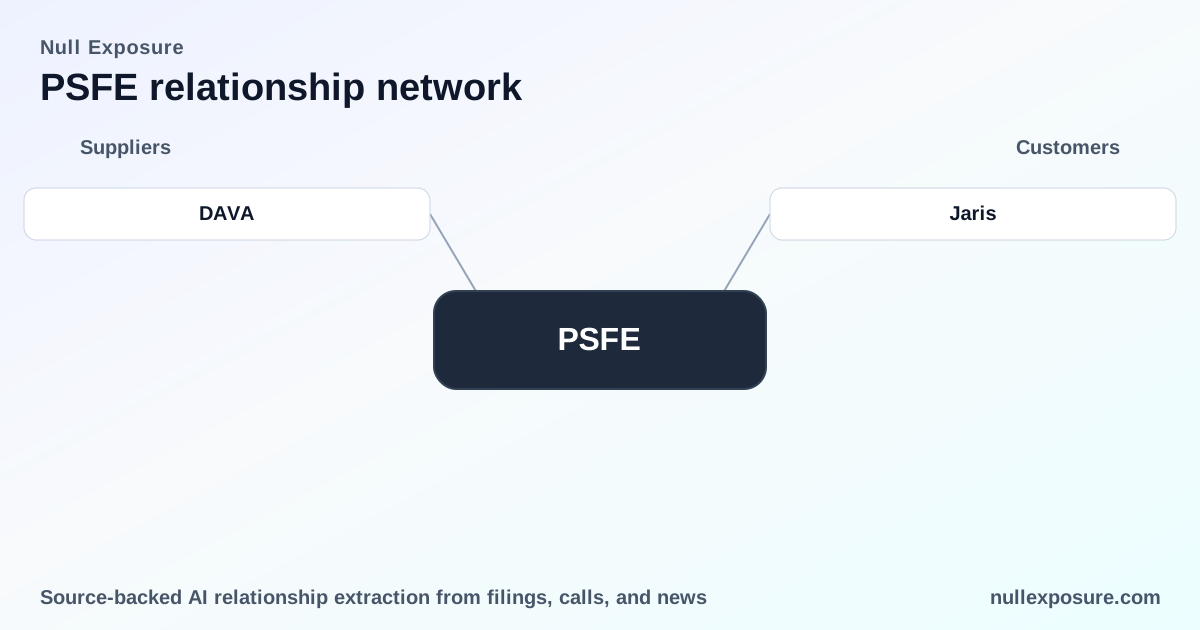
Paysafe (PSFE) — Customer Relationships and Revenue Implications
Paysafe operates a global payments network that monetizes by taking fees on payment acceptance, issuing, and payout services for online businesses and SMEs, supplemented by value-added solutions such as risk management and wallet products. The company’s revenue profile is transaction-driven and scale-sensitive: greater merchant volume and geographic breadth directly increase fee income and cross-sell opportunities. For investor due diligence, focus on customer expansion into payout products, partner-driven distribution, and concentration of revenue streams. Learn more about our coverage at https://nullexposure.com/.
What the Jaris expansion signals about Paysafe’s go-to-market
Paysafe’s partnership activity with platform and service partners is a practical lever for faster merchant acquisition and for pushing higher-margin payout products. The announced expansion with Jaris to deliver Instant Payouts for US SMBs is a clear example of product-led growth via distribution partners, which converts platform integrations into incremental revenue for payout and processing services. According to Finviz’s news aggregation (FY2026), the deal is positioned to bring instant payout capability to small and medium-sized businesses in the United States, extending Paysafe’s reach into a high-velocity merchant segment.
Customer relationship: Jaris — direct expansion into instant payouts
Jaris expanded its partnership with Paysafe to enable Instant Payouts to US SMBs, leveraging Paysafe’s payout rails to accelerate settlement for small merchants and service providers. This extension underlines Paysafe’s strategy of monetizing payout flows and embedding payment rails into partner platforms. Source: Finviz news aggregation referencing the February FY2026 announcement.
How this partnership fits into Paysafe’s commercial playbook
Paysafe’s commercial model blends three monetization vectors:
- Transaction fees and processing margins on acceptance and acquiring services.
- Payout and issuance fees, which capture value when partners speed settlement to payees.
- Value-added services (fraud/risk, wallets, integrations) that deepen wallet share and stickiness.
The Jaris relationship is functional evidence that Paysafe is executing on the second vector—payouts—where margins and competitive differentiation come from speed, coverage, and integration ease. For institutional investors, partner-led payout rollouts are capital-efficient customer acquisition and retention channels.
Business-model constraints and operating posture (company-level signals)
The information provided contains no explicit relationship-level constraints; treat the following as company-level operating signals derived from Paysafe’s profile and the nature of partner expansions:
- Contracting posture: Paysafe operates through multi-tier partnerships and platform integrations rather than exclusive direct sales alone, which reduces single-channel distribution risk but increases reliance on partner economics and integration timelines.
- Customer concentration and scalability: Partner distribution like the Jaris expansion indicates scalable, platform-driven growth, but concentration risk persists if a limited number of platform partners deliver disproportionate volume.
- Criticality and product maturity: Instant payouts are a mature, commercially adopted payment product; embedding that capability with partners signals movement from pilot to scale, increasing the criticality of Paysafe’s rails for participating SMB ecosystems.
- Commercial risk levers: Revenue is sensitive to transaction volume growth, cross-sell success on value-added services, and competitive pricing in the payouts market.
These signals should be considered alongside Paysafe’s public financials—$1.7B revenue TTM and a gross profit of ~$960M—when evaluating how partner expansions translate to top-line and margin leverage.
Key investment takeaways and risk factors
- Positive takeaway — Partner-led product monetization: The Jaris deal is a textbook example of monetizing payout rails through partners, which accelerates merchant access and increases processed volume without proportional sales expense.
- Operational leverage: Payout services typically scale with limited incremental variable costs once rails and compliance are established, improving operating margins as volumes grow.
- Risks — concentration and competitive pressure: Partner reliance creates counterparty concentration risk; competitors with broader acquiring footprints or dual-sided platforms can undercut pricing or bundle payouts into other offerings.
- Regulatory and credit exposure: As a payments infrastructure provider, Paysafe is exposed to regulatory compliance and credit operations; investors should weigh legal, AML/KYC, and reserve adequacy dynamics in parallel with customer expansion.
What investors should watch next
- Merchant volume and payout transaction growth reported in upcoming quarters, which will show whether partner expansions like Jaris convert into sustained revenue.
- Margin progression driven by payout scale and cross-sell of risk and wallet services.
- Any filings or disclosures related to reserve adequacy or litigation that could alter free cash flow and capital allocation.
For readers wanting ongoing trackers of partner-driven customer activity and firm-level implications, visit https://nullexposure.com/ for continuous updates and deeper relationship mapping.
Final read: synthesis for portfolio decisions
Paysafe’s Jaris partnership confirms a deliberate strategy to monetize payout rails via partner ecosystems—a high-conviction execution path that increases distribution while preserving capital efficiency. For investors, the critical question is whether these partner-led expansions scale quickly enough to move the revenue and margin needle; early signs are positive, but monitor reported volumes and partner concentration metrics closely.