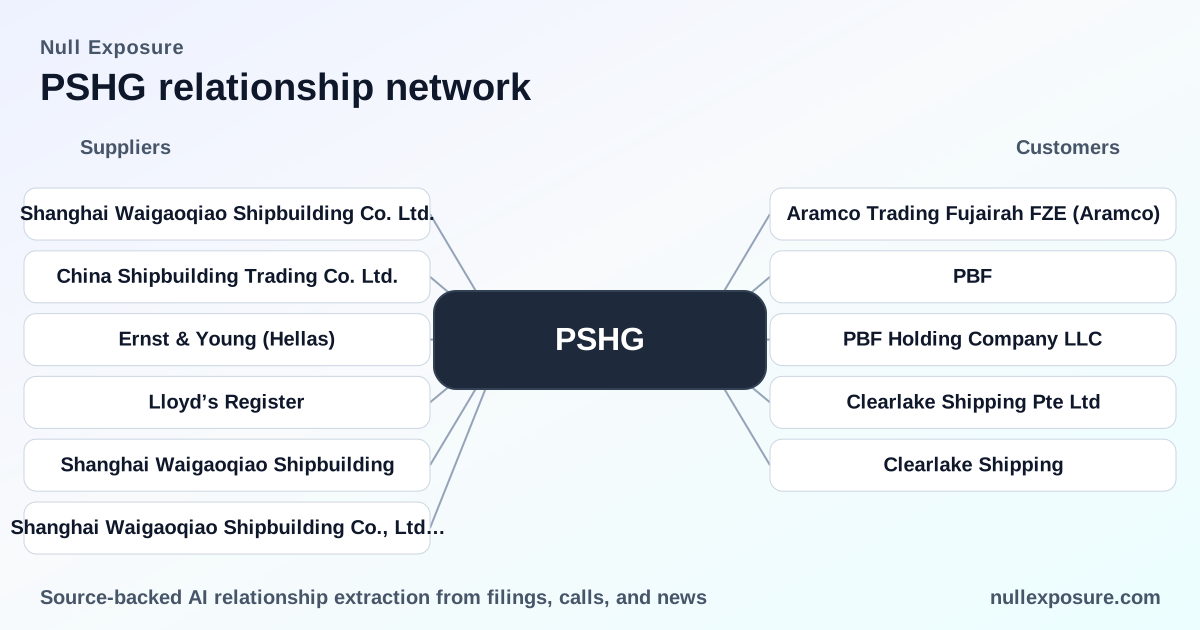
Performance Shipping (PSHG): customer relationships that underwrite cash flow and asset rotation
Performance Shipping operates a capital-intensive, asset-light-ish model for a small tanker owner: the company owns and sells tankers while locking-in earnings through multi-year time charters and sale‑and‑leaseback financings. It monetizes primarily through day‑rate income from time charters, supplemented by asset sales and structured financings that accelerate fleet renewal and shore up the balance sheet. For investors, the current profile is one of higher contracted revenue visibility from a small number of large counterparties, paired with active fleet management to convert older tonnage into liquidity. Learn more at https://nullexposure.com/.
Why the customer roster matters for a marine owner-operator
Performance’s commercial strategy is straightforward: secure long-term employment for newbuilds and modern tonnage and sell or recycle older vessels. Long-term charters at fixed gross daily rates provide cashflow coverage above breakeven, while sale-and-leaseback and outright sales fund fleet renewal. That combination reduces spot exposure but increases reliance on a handful of commodity traders and refiners for consistent utilization and pricing.
Detailed relationship map (each counterparty in the public record)
Below are the counterparties cited in recent coverage, with a short plain-English description and source reference for each.
Mercuria Energy Trading S.A.
Performance has a firm four‑year charter in place for a new LR1 tanker at a gross rate of $23,750 per day, with extension options; that charter was part of a sale‑and‑leaseback that locks in earnings above cashflow breakeven for the vessel. (IndexBox / The Globe and Mail / TipRanks reporting, May 2026)
PBF Holding Company LLC (PBF / PBF Energy)
PSHG entered a three‑year time charter for the Aframax M/T P. Monterey at $31,000 per day, expected to start mid‑February and to generate roughly $33 million over the minimum term — a material, short‑term revenue commitment from a downstream refiner/trader. (ShippingTelegraph / TipRanks / GlobeNewswire, January–March 2026)
Aramco Trading Fujairah FZE (Aramco)
Performance fixed the 2011-built Aframax M/T “Briolette” on a time charter to Aramco Trading Fujairah FZE, demonstrating access to major integrated oil company employment channels for vintage Aframax tonnage. (ShippingTelegraph, reported March 2026)
Trafigura Maritime Logistics Pte. Ltd.
Performance signed a Memorandum of Agreement to sell its oldest Aframax, M/T P. Aliki (2010), to Trafigura Maritime Logistics for US$42.65 million, a fleet‑renewal sale expected to close around Q3 2026 subject to charter expiries and customary conditions. (MarketScreener / TipRanks / Imarinenews, April–May 2026)
Repsol Trading S.A.
Performance entered time charter agreements with Repsol Trading for two newbuilding 158,000 dwt Suezmax tankers, supplying long‑term employment for those units and locking revenue for the newbuild program. (MarketScreener / QuiverQuant / Imarinenews, April–May 2026)
Pakistan National Shipping Corporation
The sale timetable for M/T P. Aliki is coordinated with the vessel’s existing time charter to Pakistan National Shipping Corporation at US$30,000 per day, which expires prior to delivery to the buyer — an example of transitional counterparty commitments that affect sale timing. (MarketScreener / TipRanks / Imarinenews, May 2026)
Clearlake Shipping Pte Ltd (Gunvor Group subsidiary)
All three newbuilding LR2 vessels secured five‑year time charter contracts with Clearlake Shipping Pte Ltd, a Gunvor Group subsidiary, illustrating multi‑year commitments from large trading houses for PSHG’s modern LR2 newbuilds. (Offshore‑Energy / QuiverQuant, 2025–2026)
Sphinx Investment Corp. (corporate event)
Independent of chartering, Sphinx Investment Corp. terminated its announced offer to acquire all outstanding shares of Performance Shipping, removing an external takeover variable from the near-term corporate landscape. (Yahoo Finance / press release, 2026)
(Each relationship item above is drawn from contemporaneous press and trade reporting between January and May 2026.)
What these relationships collectively tell investors about PSHG’s operating model
- Contracting posture: Performance pursues multi‑year time charters for newbuilds and modern tonnage, prioritizing fixed gross day rates to guarantee operating income and support structured financings. The company supplements charters with sale transactions to recycle older assets.
- Customer concentration: The counterparty list is concentrated among large commodity traders and refiners (Mercuria, Trafigura, Gunvor/Clearlake, Repsol, PBF, Aramco) — a desirable profile in terms of credit quality but one that creates counterparty concentration risk if a few contracts drive a large share of utilization.
- Criticality: For PSHG, these relationships are functionally critical — securing employment for newbuilds underwrites debt or lease obligations and directly impacts fleet cashflow coverage.
- Maturity and structure: Contracts are predominantly time charters with fixed day rates and extension options, and PSHG actively uses asset sale and sale‑and‑leaseback as financing tools to mature the fleet and strengthen liquidity.
These are company‑level operating signals drawn from the public record and recent transactions; they reflect how PSHG is monetizing assets and balancing cashflow visibility with periodic asset rotation.
Investment implications and principal risks
- Positive: Long‑dated, fixed-rate charters and sale proceeds from older tonnage provide immediate cashflow visibility and support balance sheet management, improving short‑term earnings predictability. Long‑term charters to major trading houses and refiners materially de‑risk spot exposure.
- Negative: The business remains dependent on a small counterparty set and on timing of vessel disposals and leaseback economics; any disruption to charterers’ demand or delays in asset sales would compress liquidity and fleet renewal plans.
- Valuation context: Given PSHG’s small market cap and concentrated earnings drivers, investor returns will be sensitive to the company’s ability to execute its fleet renewal and sale/leaseback playbook at expected prices and timeframes.
For investors and operators evaluating counterparties and contract risk, the current evidence shows intentional de‑risking through multi‑year charters and targeted asset sales, but with residual concentration and execution risk.
Explore deeper relationship analytics and transaction timelines at https://nullexposure.com/.
Bottom line: Performance Shipping has structured recent deals to replace vintage tonnage and lock in mid‑to‑multi‑year revenue with creditworthy counterparties — a strategy that improves near‑term cashflow certainty but places a premium on successful execution of asset disposals and charter renewals.