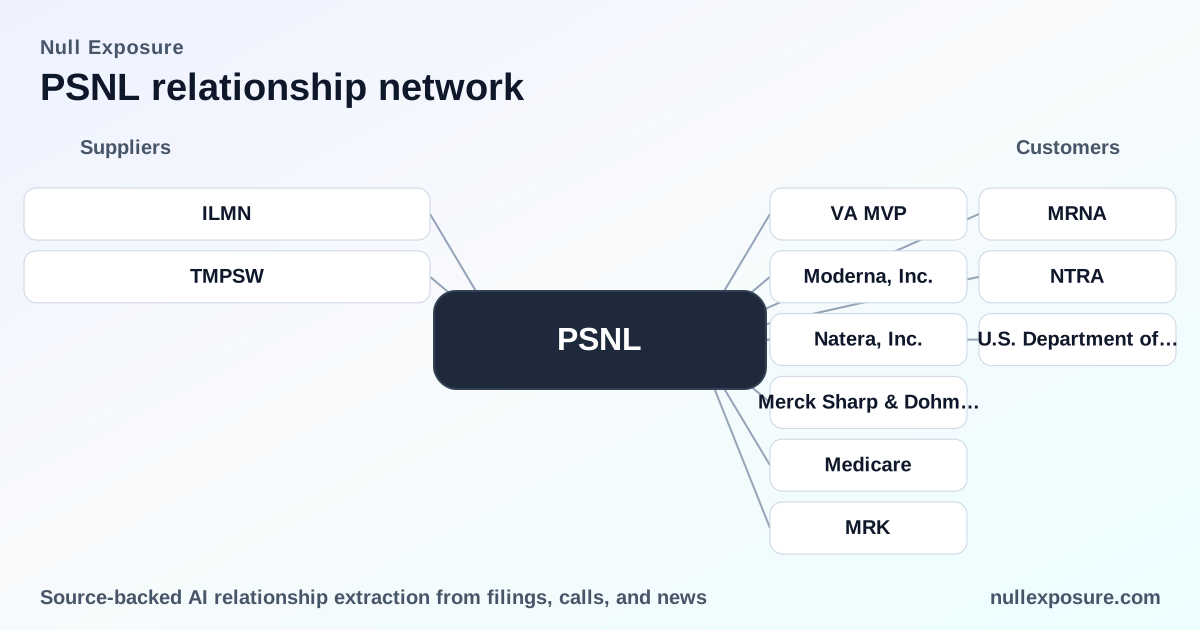
Personalis (PSNL): Customer relationships that define revenue, risk, and upside
Personalis operates as an advanced cancer genomics services company that monetizes by selling high-sensitivity genomic testing and analytics to pharmaceutical and diagnostics partners, government population-sequencing programs, and by capturing value through partnerships, contractual services and licensing receipts; reimbursement for its NeXT Personal MRD test adds an emerging payor revenue stream. Revenue is concentrated, contract-driven, and shifting from one-off project work toward higher-margin molecular residual disease (MRD) partnerships and reimbursement-backed clinical surveillance. For more structured exposures and relationship intelligence, see https://nullexposure.com/.
Why customer relationships are the investment lens here
Personalis’ commercial profile is not a broad retail story — it is a services-led clinical and B2B business where a handful of large relationships drive most revenue, and contract cadence determines near-term volatility. The company sells laboratory testing and analytics, performs population sequencing under government contracts, licenses intellectual property, and benefits from emerging Medicare coverage for its MRD product, which transitions part of the business toward recurring, clinically reimbursed demand. These structural points explain why revenue swings with large customers and why payor coverage materially changes the valuation calculus.
If you want a concise commercial map and relationship scoring, visit https://nullexposure.com/ for a tailored view.
What the relationship roster looks like (one-by-one)
This section covers every counterparty cited in the available results and the practical implication for revenue and risk.
-
VA MVP — The U.S. Department of Veterans Affairs Million Veteran Program has been a meaningful revenue source: Personalis stated that revenue from population-sequencing under contract with the VA MVP accounted for 9% of revenue in 2024 (and had been higher in prior years). Source: Personalis 2024 Form 10‑K (FY2024).
-
U.S. Department of Veterans Affairs Million Veterans Program (VA MVP) — Corporate disclosures and subsequent press summaries aggregate VA MVP as part of enterprise/population sequencing revenue that, together with major enterprise partners, contributed roughly $17.6–$18.0 million reported in certain FY2025 highlights. Source: company press releases summarized in BioSpace (FY2026).
-
Moderna, Inc. — Personalis provides genomic testing to Moderna for ongoing clinical trials of a personalized cancer therapy and received material customer deposits related to that agreement in 1H 2023; trial-related revenue fluctuated as enrollment concluded. Source: Personalis 2024 Form 10‑K (FY2024) and FY2025 earnings commentary (FY2026).
-
Moderna (ticker variant MRNA) — Company commentary on FY2025 results notes the completion of the Moderna melanoma trial enrollment, linked to roughly a $10 million decline versus 2024; this underscores how clinical trial timelines directly affect Personalis’ top-line. Source: Q4 2025 earnings call transcript coverage (InsiderMonkey, FY2026).
-
ModernaTX, Inc. — Company investor materials and press releases list ModernaTX among the biopharma customers whose order timing and pace affect Personalis’ revenues, reinforcing the operational sensitivity to large pharma trial schedules. Source: FY2025 press release summarized on BioSpace (FY2026).
-
Merck Sharp & Dohme LLC — After Merck became a related party in December 2024, Personalis invoiced $2.0 million under a Master Agreement for genomic testing services; Merck is listed among biopharma customers influencing near-term order pacing. Source: Personalis 2024 Form 10‑K (FY2024) and FY2025 press release commentary (FY2026).
-
Merck (ticker MRK) — Press materials repeat Merck’s inclusion among the named customers whose order timing is a stated revenue driver and risk. Source: BioSpace press release (FY2026).
-
Natera, Inc. — Personalis has an agreement to provide advanced tumor analysis for use in Natera’s MRD testing, and historically revenue from the Natera partnership represented a substantial portion of enterprise sales; the company reported a planned decline in lower-value project work from Natera as it shifted to higher-value MRD partnerships. Source: Personalis 2024 Form 10‑K (FY2024) and FY2025 earnings commentary (InsiderMonkey/BioSpace, FY2026).
-
Natera (ticker variant NTRA) — Quarterly summaries and FY2025 highlights repeatedly single out Natera as a key enterprise partner, with enterprise sales tied to this relationship totaling part of the multi‑million-dollar revenue bucket reported in FY2025. Source: BioSpace press releases and FY2025 highlights (FY2026).
-
Medicare — Major commercial development: multiple news items reported that Medicare will reimburse the NeXT Personal MRD test for surveillance of Stage I–III non‑small cell lung cancer, creating a new clinical-reimbursement pathway that converts some testing revenue from project to payor‑driven clinical demand. Source: press coverage including StockTwits, TheFly and OncoDaily reporting on Medicare coverage (FY2026).
-
Vanderbilt‑Ingram Cancer Center — Academic collaboration/publication: Vanderbilt researchers highlighted Personalis’ technology sensitivity (detection down to 1–3 parts per million) and published work that advances neoadjuvant treatment monitoring, validating the clinical utility that supports MRD commercialization. Source: company press release summarizing the Vanderbilt publication (FY2026).
Constraints and what they tell investors about the operating model
Personalis’ public disclosures surface a set of company-level constraints that shape stability and upside.
-
Revenue concentration and materiality. Personalis states that its top five customers — explicitly naming VA MVP, Moderna and Natera among them — accounted for 81% of revenue in 2024 (74% in 2023). This is a central valuation risk: large customer cadence drives the P&L. Source: Personalis 2024 Form 10‑K.
-
Geographic concentration. The business derives 96% of revenue from the United States in 2024, indicating payor, regulatory and hospital/system exposure is U.S.-centric. Source: Personalis 2024 Form 10‑K.
-
Contracting posture. Disclosed annual task order volumes were $7.5 million in both 2023 and 2024, reflecting short‑term, task-based government work alongside project contracts with biopharma clients. Source: Personalis 2024 Form 10‑K.
-
Licensing and IP monetization. The company has engaged in licensing deals (e.g., an S&L Agreement that grants non-exclusive patent rights in exchange for low single-digit tiered royalties), signaling an additional, albeit likely modest, royalty revenue stream. Source: public agreement excerpts described in company filings (FY2024 evidence).
-
Customer mix and maturity. The customer base spans very large enterprises (biopharma), government programs, non‑profits, universities and individual patients, and the company reports a single reportable segment focused on advanced genomic tests and services — indicating a focused but multi-stakeholder commercial model. Source: Personalis 2024 Form 10‑K.
Investment takeaways
- Concentration is the dominant risk: a handful of relationships explain nearly all revenue; pipeline timing with large pharma and government contracts will control quarterly volatility.
- MRD commercialization plus Medicare coverage is the structural upside: payor reimbursement for NeXT Personal transforms portions of future revenue into recurring clinical surveillance use, improving long‑term revenue quality.
- Operational exposure remains U.S.-centric and contract-sensitive: investors should model order timing from Natera, Moderna and VA MVP explicitly.
For a concise relationship map and exposure scoring tailored to institutional use, consult our analytical hub at https://nullexposure.com/.
Overall, Personalis is a specialized services company where customer agreements, trial timelines and reimbursement events will dictate the next phase of revenue stability and value realization.