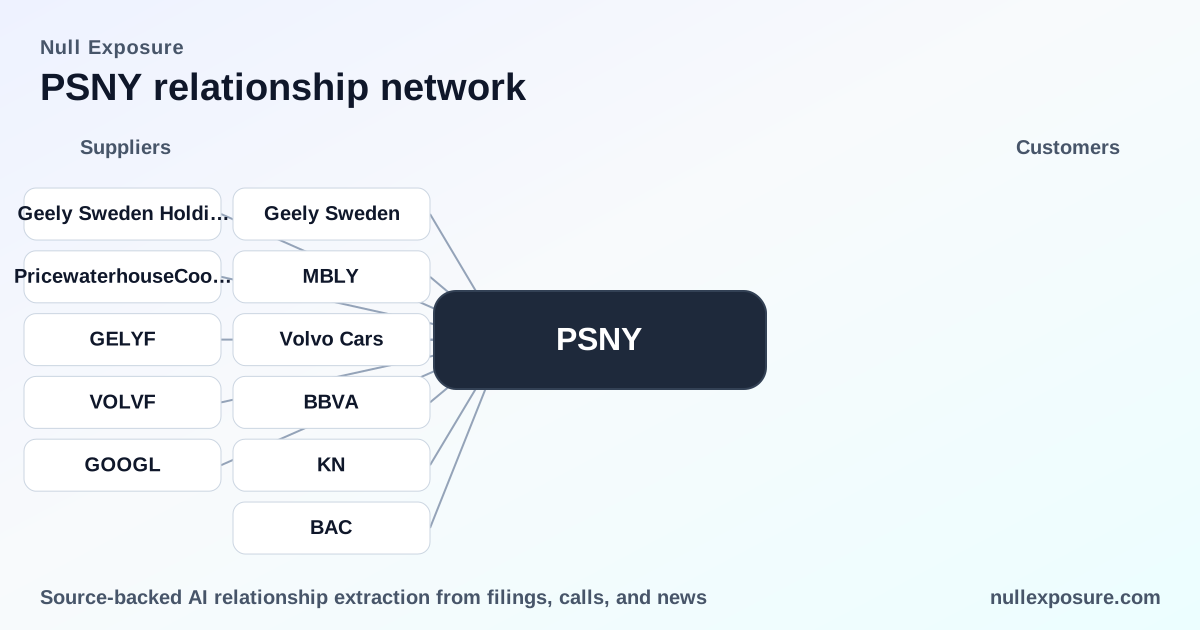
Polestar (PSNY) customer relationships: capital partners and service network that shape near-term runway
Polestar operates as a vertically branded electric performance vehicle maker, monetizing through vehicle sales, aftersales services, and strategic capital raises that extend its operational runway. The company pairs distributed service partnerships in key markets with targeted institutional equity placements to fund growth and model launches. Investors should evaluate both the financing counterparties that supply liquidity and the local service partners that underpin customer experience when assessing Polestar’s execution risk.
For a closer look at relationship mapping and capital partners, visit https://nullexposure.com/ for additional intelligence on counterparties and disclosures.
What the recent customer relationships tell investors about Polestar’s financing posture
Polestar executed securities purchase agreements in FY2026 that reflect an active, institution-led approach to equity financing. These transactions show the company is comfortable raising capital through placements of Class A American Depositary Shares, drawing on bank and institution purchasers to support near-term liquidity.
- Crédit Agricole Corporate and Investment Bank participated as one of the purchasers in a block sale of Class A ADS in FY2026, taking part in an issuance of 15,511,891 ADS priced at US$19.34 for gross proceeds of roughly US$300 million. According to a SimplyWallSt news update in May 2026, Crédit Agricole CIB was included among the purchasers for that tranche.
- Feathertop Funding Limited subscribed in a separate purchase agreement in FY2026, taking part in an issuance of 20,682,522 Class A ADS priced at US$19.34 for proceeds of approximately US$400 million that were allocated to Feathertop and Standard Chartered (Hong Kong). SimplyWallSt’s FY2026 coverage notes Feathertop Funding Limited as a purchaser in that placement.
- Standard Chartered Bank (Hong Kong) Limited joined Feathertop in the same FY2026 securities purchase agreement that covered 20,682,522 Class A ADS at US$19.34 per share, according to the same SimplyWallSt FY2026 update.
These financings signal direct dependence on institutional purchasers for equity capital rather than private or retail subscription, and they materially affect dilution, liquidity runway, and investor composition.
Service partnerships: localized aftersales execution in Finland
- Wetteri was designated as Polestar’s authorised service partner across multiple Finnish cities—Joensuu, Kajaani, Kemi, Kuusamo, Lempaala, Pori, Rauma, and Ylivieska—per a client announcement captured in SimplyWallSt’s FY2025 profile. This relationship expands Polestar’s authorized service network in Finland and strengthens local customer support and warranty execution.
That appointment is a practical signal that Polestar uses third-party authorized partners to scale aftersales coverage in regions where it lacks a dense proprietary dealer footprint, improving service accessibility without heavy capex.
Constraint and operating-model signals investors should weigh
There are no explicit contract-level constraints listed in available relationship excerpts; therefore the following are company-level signals derived from disclosed activity and financials:
- Capital intensity and external financing posture. Recent FY2026 equity placements to institutional purchasers indicate Polestar relies on equity injections to fund operations and growth. Given FY2025–FY2026 operating losses and negative EBITDA, institutional placements are a cornerstone of near-term cash strategy rather than one-off events.
- After-sales decentralization. The use of authorized local partners like Wetteri shows a contracting posture that favors partnerships over building a dense, owned dealer network; this decreases upfront CAPEX but increases reliance on partner quality and contractual service standards.
- Concentration and ownership structure. Insider ownership is exceptionally high (86.33%) while institutional ownership is around 19.38%, per company profile data; this ownership split affects governance dynamics and the potential influence of external purchasers in future financings.
- Maturity and margin profile. Polestar reports negative gross profit and operating losses with substantial revenue growth (revenue TTM ~US$3.058 billion but with negative gross profit and EBITDA losses), indicating a growth-stage manufacturer that still consumes capital to scale production and distribution. These financials create a sustained need for access to institutional capital markets.
Relationship-by-relationship takeaway (concise)
- Crédit Agricole Corporate and Investment Bank: Participated as one of four purchasers in a FY2026 block sale of 15,511,891 Class A ADS at US$19.34, providing roughly US$300 million in gross proceeds to Polestar, which directly bolsters liquidity in the near term (SimplyWallSt, May 2026).
- Feathertop Funding Limited: Subscribed to 20,682,522 Class A ADS at US$19.34 in FY2026 alongside Standard Chartered (Hong Kong), delivering about US$400 million of proceeds for that tranche and signaling institutional appetite for Polestar placements (SimplyWallSt, May 2026).
- Standard Chartered Bank (Hong Kong) Limited: Co-purchased in the FY2026 issuance that covered 20,682,522 ADS at US$19.34, demonstrating participation from global banking counterparty channels in Polestar’s capital raises (SimplyWallSt, May 2026).
- Wetteri: Appointed as an authorised service partner across multiple Finnish cities per a FY2025 client announcement, expanding Polestar’s authorized aftersales network in Finland and supporting localized warranty and service coverage (SimplyWallSt, FY2025 update).
Investor implications and operational recommendations
- Assess financing cadence and dilution risk. Recurring institutional placements suggest a pattern: evaluate how many quarters of runway current capital provides relative to burn, and model dilution scenarios under continued equity raises. Polestar’s negative margins make access to capital a material risk variable.
- Monitor service partner performance as a revenue enabler. Authorized partners like Wetteri materially affect customer satisfaction and residual values; operators should track service KPIs and contractual safeguards to protect brand experience.
- Governance and control dynamics are non-trivial. High insider ownership combined with selective institutional participation in placements creates governance asymmetry; investors should monitor whether future capital raises change the ownership mix materially.
- Prioritize sources that map to strategic markets. The mix of European service partnerships and Asia/EM capital partners highlights Polestar’s dual focus: scale aftersales where vehicles are sold while tapping global banks for liquidity.
For a deeper map of these counterparties and to monitor new purchaser or partner filings as they appear, visit https://nullexposure.com/ — our platform tracks counterparties, filings, and public disclosures to help investors and operators make informed decisions.
Conclusion: hedge financing dependency with operational execution
Polestar’s customer-relationship profile is bifurcated between institutional capital counterparties that fund growth and localized service partners that deliver the product experience. Both relationship sets are equally material: financing secures runway while service partners determine customer retention and resale economics. Investors and operators should evaluate Polestar through both lenses—balance-sheet durability and the quality of execution at the point of service—when sizing exposure or operational investments.