Postal Realty Trust (PSTL): The USPS Relationship That Defines the Business
Postal Realty Trust is an internally managed REIT that owns and operates a concentrated portfolio of postal properties leased primarily to the United States Postal Service. The company monetizes through long‑term net lease income and direct financing leases recorded as net investment in financing leases, producing predictable cash flow that supports dividends while exposing equity holders to tenant concentration and lease‑roll risk.
If you want structured visibility on PSTL’s tenant exposure and filings, visit the research hub at NullExposure.
The single biggest customer relationship — clear and material
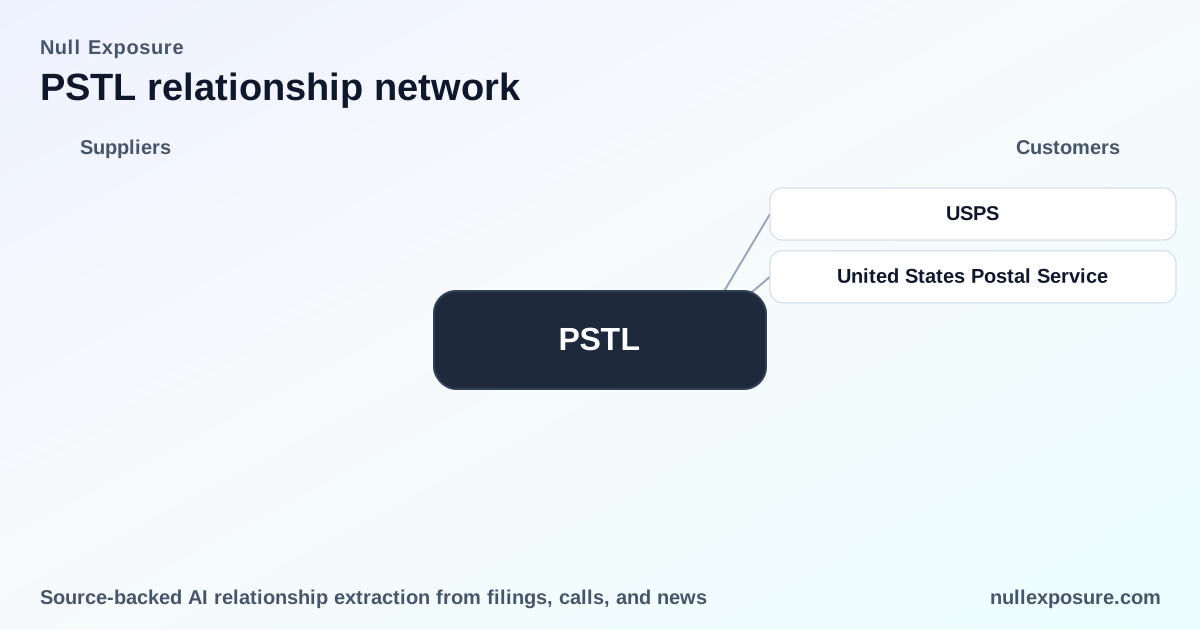
Postal Realty’s customer profile is dominated by one counterparty: the United States Postal Service (USPS). The firm’s operating model and valuation are anchored to this relationship, and investors need to treat the USPS exposure as the primary driver of both income stability and downside risk.
From the 10‑K: lease accounting and concentration (FY2024)
Postal Realty’s 2024 Form 10‑K discloses that the company records direct financing leases on the balance sheet as an “Investment in financing leases, net,” and that a significant portion of rental income is geographically concentrated (for example, roughly 11.9% of rental income in 2024 came from Pennsylvania). The filing establishes that properties are leased primarily to the USPS and lays out the basic structure of how rental streams are recognized. (Source: Postal Realty Trust, Form 10‑K for the year ended December 31, 2024.)
From market coverage: how the relationship is described publicly (FY2025/Mar 2026)
Public reporting and investor communications reiterate that Postal Realty owns and manages over 2,200 properties leased primarily to the USPS, spanning last‑mile post offices through industrial facilities — language used in recent presentations and market writeups about the company’s footprint and strategy. (Source: Yahoo Finance / news report summarizing Postal Realty presentations, March 10, 2026.)
Complete coverage of the disclosed relationships
-
Postal Realty — United States Postal Service (10‑K, FY2024): The company’s 2024 annual filing confirms that the portfolio is leased primarily to the USPS and that lease accounting for many properties is recorded as direct financing leases on the balance sheet. (Source: Postal Realty Trust, 10‑K, year ended 12/31/2024.)
-
Postal Realty — United States Postal Service (press/news, FY2025): External investor materials and news coverage note Postal Realty manages over 2,200 USPS‑leased properties ranging from post offices to industrial facilities, reinforcing the same tenant concentration highlighted in the 10‑K. (Source: Yahoo Finance investor coverage, March 10, 2026.)
Constraints that shape the operating model and investor risk profile
The filings and evidence supplied produce a tight set of business model constraints that investors must fold into valuation and risk analysis:
-
Government counterparty: The USPS is the primary tenant. Postal Realty’s income is intimately linked to the financial and operational stability of a government service provider; that relationship is explicitly called out in filings and is central to cash‑flow forecasting. (Company disclosure, FY2024.)
-
High concentration and materiality: Postal Realty discloses reliance on the USPS as material to operations; the company warns that USPS financial deterioration or reduced leasing demand would have a material adverse effect on the business. That is not a peripheral risk — it is the central credit and demand assumption driving valuation. (Company disclosure, FY2024.)
-
Seller posture with active leases: Postal Realty’s role is that of landlord/seller of long‑term lease exposure to the USPS; leases are active, with a weighted average remaining lease term of roughly four years (through expirations out to 2035 when tenants do not exercise options), and many properties are accounted for as financing leases. These are operating realities, not hypothetical scenarios. (Company disclosure, FY2024.)
-
National footprint: The portfolio spans 49 states and one territory with roughly 6.4 million net leasable interior square feet and high occupancy (99.6% as of 12/31/2024), signaling broad geographic distribution but still concentrated in a single tenant type (postal operations). This is a company‑level footprint signal that tempers single‑market re‑leasing risk but preserves tenant concentration risk. (Company disclosure, FY2024.)
Taken together, these constraints define a REIT that trades on the intersection of tenant credit (government), lease term roll dynamics, and real estate market conditions across North America.
Valuation and capital market signals investors should weigh
Market data and company metrics as of the latest quarter (12/31/2025) show a premium valuation relative to book and sales multiples that presumes steady USPS performance:
- Market capitalization roughly $754.6M and EV/EBITDA ~16.9, with Price/Book ~2.14 and a trailing P/E ~47.5. Dividend yield is roughly 4.4% based on the declared dividend, and analysts carry a consensus target price near $22.21 with most ratings clustered in Buy/Strong Buy territory. (Market and company data, latest quarter.)
These figures imply investor willingness to pay a premium for the predictable cash flow that USPS leases provide, but they also compress the margin for error if lease renewals, policy changes, or USPS fiscal pressure accelerate.
Upside vectors and downside triggers (practical investor checklist)
-
Upside: Stable rental rolls, successful lease extensions, and opportunistic acquisitions of additional USPS‑leased properties would sustain and modestly expand distributable cash flow; a re‑rating would follow stable occupancy and longer weighted lease terms.
-
Downside: USPS budgetary/operational strain, policy decisions reducing footprint, or concentrated expirations without renewals will directly pressure revenue and the dividend. Lease concentration amplifies downside volatility even if individual properties are well located.
If you want consolidated analysis on tenant counterparty risk and portfolio concentration across similar REITs, explore more research at NullExposure.
Bottom line: a single‑tenant REIT for investors who underwrite government lease risk
Postal Realty Trust delivers a clean, income‑oriented REIT exposure whose economics are dominated by the USPS relationship. That relationship is the company’s primary asset and its primary risk: investors receive predictable, government‑backed rental cash flow today, and they accept concentrated tenant and lease maturity risk tomorrow. For active investors, the decision hinges on conviction in USPS fiscal stability and the company’s ability to manage renewals and reinvestment around the four‑year average lease maturity.