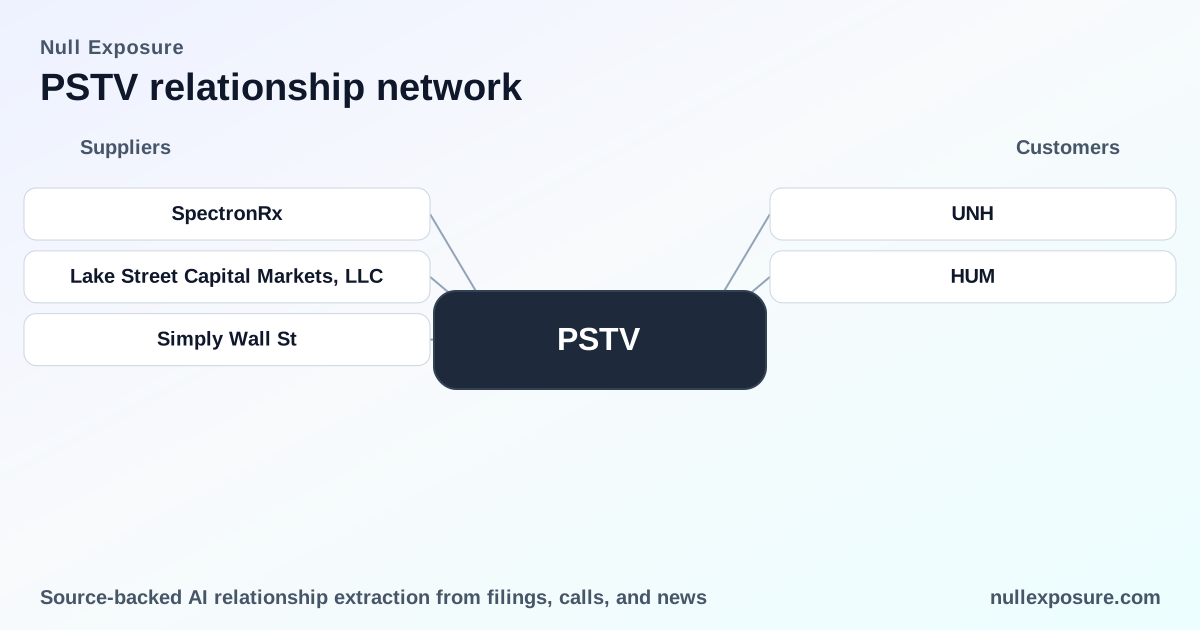
Plus Therapeutics (PSTV): payer deals are the commercial spine — early, concentrated, but strategically important
Plus Therapeutics operates as a clinical-stage biotech with an emerging commercial arm built around CNSide Diagnostics, a wholly‑owned subsidiary that sells the CNSide® CSF Tumor Cell Enumeration (TCE) assay and seeks reimbursement from health plans. The company monetizes by delivering a lab-developed diagnostic test for metastatic central nervous system cancers and extracting revenue through payer coverage agreements and subsequent claims reimbursement; product revenue is nascent but the payer relationships are the principal commercial trigger for scaling adoption. For deeper customer intelligence, visit https://nullexposure.com/.
How Plus Therapeutics actually makes money and what investors should watch
Plus is not a traditional pharmaceutical revenue machine yet — its current commercial lever is the CNSide diagnostic rather than broad drug sales. Revenue growth depends on expanding payer coverage (national and regional insurers), converting covered lives into ordered tests, and sustaining favorable reimbursement rates. The operating model’s characteristics are clear: contracting posture is proactive (company-led national launches and payor outreach), commercial concentration is meaningful (a small set of large payers drive near-term coverage), criticality is high (payer coverage directly enables immediate revenue), and maturity is early (launch-phase diagnostics with incremental coverage wins in 2025–2026). For investor due diligence on customer dynamics, see https://nullexposure.com/ for detailed relationship mapping.
What the public record shows — each reported customer relationship
Below are concise, plain-English summaries for every relationship mention captured in the public record for PSTV’s customer scope, listed in chronological source order as surfaced in the results.
-
Humana — GlobeNewswire (Dec 9, 2025). Plus stated it is progressing toward national launch and expanding test coverage, naming previously announced agreements with UnitedHealthcare and Humana as part of its payer footprint. Source: GlobeNewswire, Dec 9, 2025 — https://www.globenewswire.com/news-release/2025/12/09/3202254/0/en/Plus-Therapeutics-Announces-Expansion-of-CNSide-Team-and-Issuance-of-Inducement-Grants.html
-
UnitedHealthcare — Benzinga (Jan 2026). In September 2025, CNSide Diagnostics signed a national agreement with UnitedHealthcare, positioning the test for broad commercial access under a national policy. Source: Benzinga, Jan 2026 — https://www.benzinga.com/markets/penny-stocks/26/01/49912177/penny-cancer-stock-plus-therapeutics-raises-15-million-at-discount-stock-plunges
-
UNH (duplicate entry) — Benzinga (Jan 2026). The Benzinga note reiterates the national agreement with UnitedHealthcare (UNH) executed in September 2025. Source: Benzinga, Jan 2026 — https://www.benzinga.com/markets/penny-stocks/26/01/49912177/penny-cancer-stock-plus-therapeutics-raises-15-million-at-discount-stock-plunges
-
UnitedHealthcare — GlobeNewswire (Dec 9, 2025). Plus referenced UnitedHealthcare among early national payor agreements as the company prepares for commercial launch of CNSide. Source: GlobeNewswire, Dec 9, 2025 — https://www.globenewswire.com/news-release/2025/12/09/3202254/0/en/Plus-Therapeutics-Announces-Expansion-of-CNSide-Team-and-Issuance-of-Inducement-Grants.html
-
UNH (duplicate entry) — GlobeNewswire (Dec 9, 2025). The same GlobeNewswire release cites both UnitedHealthcare and Humana in the company’s commercial roll‑out commentary. Source: GlobeNewswire, Dec 9, 2025 — https://www.globenewswire.com/news-release/2025/12/09/3202254/0/en/Plus-Therapeutics-Announces-Expansion-of-CNSide-Team-and-Issuance-of-Inducement-Grants.html
-
Blue Shield of California — Yahoo/UK Finance (May 3, 2026). CNSide Diagnostics announced a payer coverage agreement with Blue Shield of California effective April 2026, providing reimbursement for the CNSide CSF TCE assay for metastatic CNS cancer patients. Source: Yahoo/UK Finance, May 3, 2026 — https://uk.finance.yahoo.com/news/plus-therapeutics-secures-blue-shield-113000314.html
-
Highmark — Yahoo Finance (May 3, 2026). Plus announced a new payer coverage agreement with Highmark effective April 1, 2026, adding regional reimbursement for the CNSide CSF assay. Source: Yahoo Finance, May 3, 2026 — https://finance.yahoo.com/sectors/healthcare/articles/plus-therapeutics-secures-highmark-coverage-113000950.html
-
Humana — Yahoo Finance (May 3, 2026). Yahoo noted that Highmark joins a growing list of payers—including UnitedHealthcare and Humana—that provide coverage for CNSide, reinforcing payor breadth. Source: Yahoo Finance, May 3, 2026 — https://finance.yahoo.com/sectors/healthcare/articles/plus-therapeutics-secures-highmark-coverage-113000950.html
-
United Healthcare — Yahoo Finance (May 3, 2026). The same report positioned UnitedHealthcare among the national and regional payers covering CNSide, underscoring scale of covered lives. Source: Yahoo Finance, May 3, 2026 — https://finance.yahoo.com/sectors/healthcare/articles/plus-therapeutics-secures-highmark-coverage-113000950.html
-
UNH — GlobeNewswire (Oct 21, 2025). Plus reported that CNSide signed a national policy agreement with UnitedHealthcare covering more than 51 million people in the U.S. Source: GlobeNewswire, Oct 21, 2025 — https://www.globenewswire.com/news-release/2025/10/21/3170080/0/en/Plus-Therapeutics-Updates-on-CNSide-Diagnostic-Platform-Launch.html
-
UnitedHealthcare — GlobeNewswire (Oct 21, 2025). The Oct 21 release explicitly quantified the UnitedHealthcare national policy as covering over 51 million lives—a material coverage milestone. Source: GlobeNewswire, Oct 21, 2025 — https://www.globenewswire.com/news-release/2025/10/21/3170080/0/en/Plus-Therapeutics-Updates-on-CNSide-Diagnostic-Platform-Launch.html
-
UnitedHealthcare — Sahm Capital (Dec 9, 2025). An alternate press repost emphasized the company’s plan to expand payor agreements beyond the existing UnitedHealthcare and Humana relationships. Source: Sahm Capital, Dec 9, 2025 — https://www.sahmcapital.com/news/content/plus-therapeutics-announces-expansion-of-cnside-team-and-issuance-of-inducement-grants-2025-12-09
-
Humana — Yahoo/UK Finance (May 3, 2026). The Blue Shield announcement explicitly called out Humana among payers now providing coverage for CNSide, reinforcing payer adoption across regions. Source: Yahoo/UK Finance, May 3, 2026 — https://uk.finance.yahoo.com/news/plus-therapeutics-secures-blue-shield-113000314.html
-
HUM (ticker reference) — Yahoo/UK Finance (May 3, 2026). That same Yahoo UK piece restated that Blue Shield joins a list of payers including UnitedHealthcare, Humana (HUM), and Highmark. Source: Yahoo/UK Finance, May 3, 2026 — https://uk.finance.yahoo.com/news/plus-therapeutics-secures-blue-shield-113000314.html
-
Humana — Sahm Capital (Dec 9, 2025). Sahm Capital reposted the GlobeNewswire content referencing Humana as an early payor partner in the CNSide roll‑out. Source: Sahm Capital, Dec 9, 2025 — https://www.sahmcapital.com/news/content/plus-therapeutics-announces-expansion-of-cnside-team-and-issuance-of-inducement-grants-2025-12-09
-
UNH — Sahm Capital (Dec 9, 2025). Sahm Capital’s repost also reiterated the UnitedHealthcare agreement as part of Plus’ payor expansion narrative. Source: Sahm Capital, Dec 9, 2025 — https://www.sahmcapital.com/news/content/plus-therapeutics-announces-expansion-of-cnside-team-and-issuance-of-inducement-grants-2025-12-09
-
Blue Shield of California — GlobeNewswire (Apr 7, 2026). A GlobeNewswire release tied the Blue Shield coverage announcement to progress on reimbursement and the assignment of an AMA PLA code that advances commercial adoption. Source: GlobeNewswire, Apr 7, 2026 — https://www.globenewswire.com/news-release/2026/04/07/3268999/0/en/plus-therapeutics-receives-ama-pla-code-for-cnside-csf-tumor-cell-enumeration-test-advancing-reimbursement-and-u-s-commercial-adoption.html
-
Blue Shield of California — GlobeNewswire (Apr 22, 2026). A subsequent GlobeNewswire filing reiterated Blue Shield coverage in the context of other corporate disclosures. Source: GlobeNewswire, Apr 22, 2026 — https://www.globenewswire.com/news-release/2026/04/22/3279419/0/en/plus-therapeutics-reports-granting-of-inducement-awards-under-nasdaq-listing-rule-5635-c-4.html
-
Highmark — Yahoo/UK Finance (May 3, 2026). The Yahoo distribution again reported Highmark’s new coverage effective April 2026, confirming multiple regional payers have executed reimbursement agreements. Source: Yahoo/UK Finance, May 3, 2026 — https://uk.finance.yahoo.com/news/plus-therapeutics-secures-blue-shield-113000314.html
-
Blue Shield of California — GlobeNewswire (Apr 8, 2026). An April press release reiterated that Blue Shield coverage supports CNSide’s commercial expansion across the U.S. Source: GlobeNewswire, Apr 8, 2026 — https://www.globenewswire.com/news-release/2026/04/08/3270005/0/en/Plus-Therapeutics-Granted-U-S-FDA-Orphan-Drug-Designation-to-REYOBIQ-in-Pediatric-Malignant-Gliomas.html
-
Blue Shield of California — GlobeNewswire (Apr 21, 2026). An Apr 21 corporate update repeated the Blue Shield coverage message in the company’s NASDAQ compliance and investor communications. Source: GlobeNewswire, Apr 21, 2026 — https://www.globenewswire.com/news-release/2026/04/21/3277801/0/en/plus-therapeutics-regains-compliance-with-nasdaq-minimum-bid-price-requirement.html
-
Blue Shield of California (duplicate notice) — GlobeNewswire (Apr 21, 2026). The Apr 21 release appears in multiple investor-facing filings and press reposts that underscore payer coverage as a recurring corporate disclosure. Source: GlobeNewswire, Apr 21, 2026 — https://www.globenewswire.com/news-release/2026/04/21/3277801/0/en/plus-therapeutics-regains-compliance-with-nasdaq-minimum-bid-price-requirement.html
-
Blue Shield of California (further repost) — GlobeNewswire (Apr 7–22, 2026 aggregate). Multiple GlobeNewswire items across April 2026 repeat the Blue Shield coverage and AMA PLA code linkage, signaling coordinated disclosure across investor communications. Source: GlobeNewswire releases, Apr 2026 — see links above.
Operating constraints and company-level signals
- Contracting posture: Plus is executing a proactive payor engagement strategy, pursuing national policy agreements (e.g., UnitedHealthcare) and regional coverage (Highmark, Blue Shield of California). This is an active commercial posture rather than passive reimbursement acceptance.
- Concentration: Current commercial exposure is concentrated toward a handful of large payers; a small number of agreements controls access to a large share of covered lives. That concentration increases short-term revenue leverage to each payor decision.
- Criticality: Payer coverage is critical to converting the CNSide assay into revenue — coverage wins are direct revenue enablers rather than optional marketing.
- Maturity: The commercial program is in early launch phase; coverage announcements cluster in late 2025 and early‑to‑mid 2026, indicating a ramp rather than a mature reimbursement base.
- Constraints present in record: No explicit contractual constraints or limiting covenants were found in the customer‑relationship entries captured.
Investment implications — what this means for operators and investors
- Positive read: National coverage with UnitedHealthcare and regional reimbursement from Blue Shield of California, Highmark and Humana provide a credible pathway to near‑term revenue growth for CNSide. Coverage of >51 million lives under UNH is a material commercialization milestone.
- Risk profile: Revenue remains dependent on conversion of covered lives to ordered tests and on maintaining reimbursement levels; a small number of payers dominating coverage creates downside concentration risk if any policy changes.
- What to watch next: test-order volumes, reimbursement rates, additional national payers, and any contract language that ties reimbursement to utilization thresholds or preauthorization rules.
For a structured view of these payer relationships and how they map to commercial risk, visit https://nullexposure.com/ for relationship analytics and ongoing monitoring.
Key takeaway: Plus Therapeutics has translated R&D progress into a commercial trajectory centered on CNSide, and payer relationships are the single most important customer metric for validating revenue growth in 2026.