Poseida Therapeutics (PSTX): Partner-driven revenue with concentrated counterparties
Poseida Therapeutics operates as a platform-centric cell and gene therapy developer that monetizes primarily through partnership licensing, upfront payments, R&D cost reimbursement and milestone-based payouts from large biopharma partners, while retaining ownership of select programs for longer-term value capture. For investors, Poseida’s commercial profile is that of a biotech that converts platform IP into near-term cash via collaborations and transfers downstream development and commercialization risk — a model that produces episodic revenues tied to a small set of counterparties. Learn more about how we track partner exposure at https://nullexposure.com/.
How Poseida’s business model converts science into cash
Poseida’s operating model is straightforward: it develops non-viral delivery and CAR‑T platforms, then negotiates collaboration and license agreements that deliver upfront cash, cost reimbursement, and milestone contingent payments. These licensing deals shift substantial clinical and commercialization execution to large pharmaceutical partners in exchange for near-term liquidity and option-like upside if programs progress to major milestones or commercial launch.
This structure yields several predictable characteristics: revenue concentration around a few large deals, lumpy recognition tied to milestones, and asymmetric upside if partnered programs succeed. For investors and operators evaluating counterparties, the actionable item is to treat Poseida as a partner‑reliant firm whose cash flows are driven by contracting cadence rather than product sales.
Who pays Poseida: the partner roster in plain English
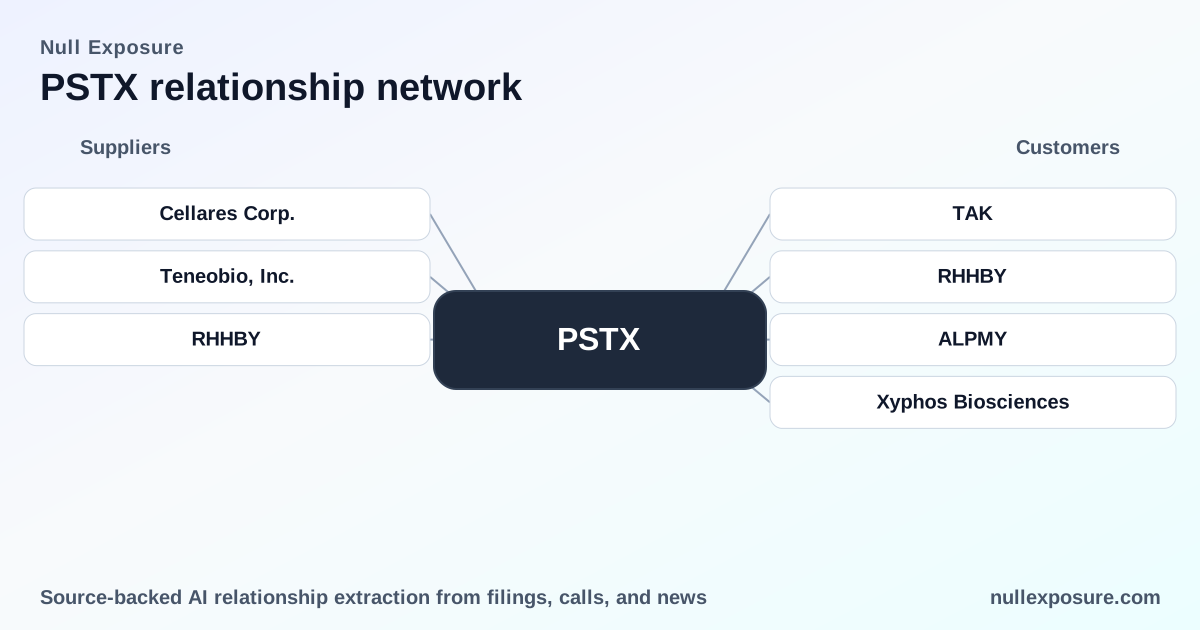
Below are the customer relationships found in public reporting and trade press, summarized concisely with sources.
-
Takeda Pharmaceutical (TAK) — Takeda licensed Poseida’s Cas‑CLOVER non‑viral delivery and genetic engineering platforms under a multi-program pact that included an upfront payment to Poseida; the transaction broadened Takeda’s gene therapy access beyond viral approaches. According to BioSpace and BioPharmaDive reporting in March–May 2026, the arrangement gave Takeda rights to multiple programs and included an upfront payment structure. (BioSpace; BioPharmaDive, 2026)
-
Roche / Roche Holdings Inc. (RHHBY) — Roche entered a strategic global collaboration for allogeneic CAR‑T programs, paying Poseida a reported $110 million upfront and reserving up to billions in potential downstream milestones for programs such as P‑BCMA‑ALLO1. Multiple press releases and trade articles document the upfront and large contingent-value structure and note that some of the licensed assets were in early clinical stages at the time of the deal. (PR Newswire; BioSpace; BioWorld; BioPharmaDive, 2022–2024 reporting compiled 2026)
-
Astellas Pharma (ALPMY) — Astellas signed a collaboration and license agreement with Poseida to develop novel CAR‑T therapies for solid tumors, establishing Poseida as a technology provider and Astellas as sponsor for R&D and future commercialization under a reimbursed cost model. BioSpace reported the Astellas pact and the structure of the R&D and licensing relationship. (BioSpace, 2024–2026)
-
Xyphos Biosciences — Under a reported agreement tied to the Astellas collaboration disclosure, Xyphos agreed to reimburse Poseida for costs and to take responsibility for R&D activities and potential commercialization of products arising from their arrangement. The press coverage clarifies that Poseida’s role includes cost-recovery from Xyphos while R&D obligations shift to the partner. (BioSpace, 2024)
What the partner mix reveals about operating constraints
Poseida’s partner list and deal design produce several company‑level operational signals that investors must treat as business constraints:
-
Contracting posture: Poseida consistently uses collaboration and license frameworks with upfront payments, R&D reimbursements and milestone schedules. This posture prioritizes cash today and risk transfer for later-stage development.
-
Concentration: A small number of large biopharma partners dominate Poseida’s revenue potential. That concentration produces meaningful counterparty risk: a single program termination or re-prioritization by a partner can materially reduce Poseida’s near-term receipts.
-
Criticality versus optionality: Poseida’s platforms are strategic and complementary to partner pipelines — partners obtain technical capabilities (non‑viral delivery, allogeneic CAR‑T) that accelerate their programs, while Poseida’s financial return depends on the partner exercising options and achieving milestones.
-
Maturity profile: The collaborations are development-stage, often referencing Phase 1 or preclinical programs; therefore, revenue is largely milestone-driven rather than product sales. This implies persistent binary development risk and multi-year cashflow visibility tied to partner decisions.
-
Operational leverage and reimbursement: Several agreements include explicit cost reimbursement terms, which mitigate R&D burn for Poseida in the short run but also indicate reliance on partner-run development execution.
These signals should be treated as company-level constraints because they describe how Poseida conducts business across its partner base rather than attributes of a single counterparty.
Investment implications: upside with partner dependency
For investors, the thesis is clear: Poseida’s valuation is levered to partner execution on a small number of large deals. The advantages of this model are immediate liquidity and de‑risking of late‑stage spend; the tradeoffs are limited revenue diversification and binary developmental exposures.
Key risk considerations:
- Revenue lumpiness and concentration risk driven by upfronts and milestone timing.
- Dependence on partner prioritization — pipeline reprioritization at Roche, Takeda, or Astellas directly impacts Poseida’s cash receipts.
- Clinical and regulatory binary outcomes because several partnered programs are in early clinical phases.
Key operational strengths:
- High‑value counterparty validation from top-tier pharmaceutical firms supports Poseida’s IP and negotiation leverage.
- Cost reimbursement mechanisms reduce near-term cash burn and extend runway while partners advance development.
What to watch next and how to act
Monitor partner milestone schedules, press releases from Roche, Takeda and Astellas, and any updates on program progress (e.g., P‑BCMA‑ALLO1 development timelines). Changes to partner priorities or announcements of milestone failures will be the primary drivers of short-term PSI (price-sensitive information) for Poseida.
For deeper counterparty mapping and to track how those relationships evolve quarter to quarter, see our ongoing coverage at https://nullexposure.com/.
Bottom line
Poseida executes a partner-first monetization strategy that produces cash through licensing and milestones while concentrating development and commercialization risk with large pharmaceutical partners. Investors valuing PSTX should price in both the upside potential of partner-led late‑stage success and the downside that follows from partner reprioritization or clinical setbacks.