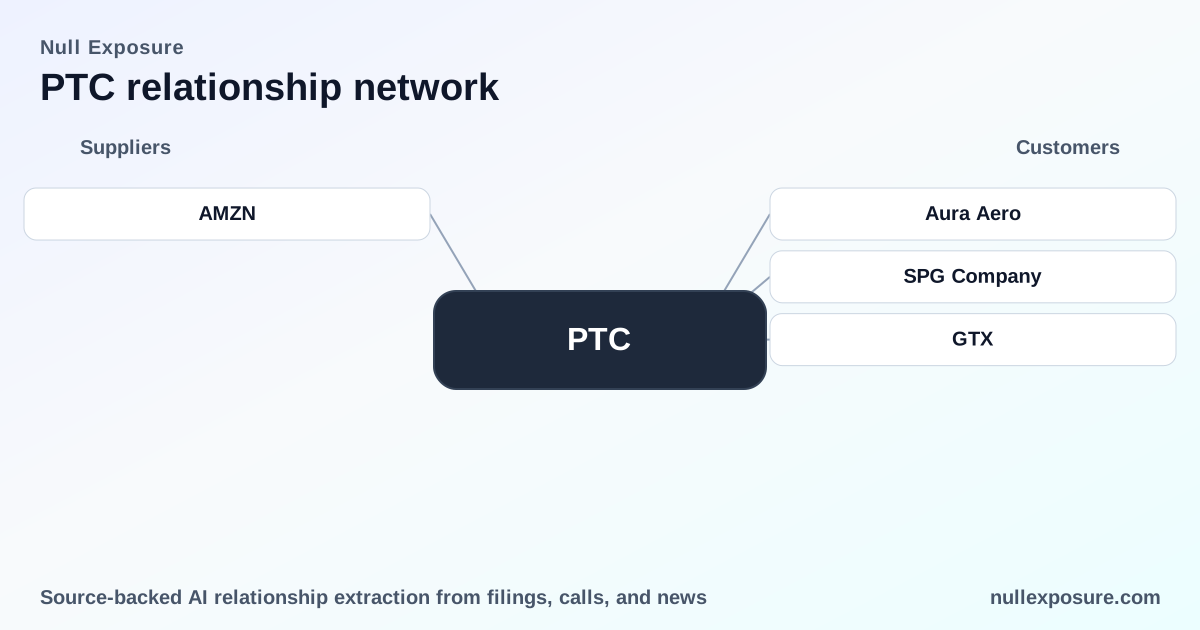
PTC’s customer map in 2026: what large accounts and recent transactions tell investors
PTC operates a software-first, subscription-led business that monetizes through enterprise licensing, cloud subscriptions, and professional services tied to product lifecycle and digital engineering tools. The company generates recurring revenue from large and mid-market manufacturers while supplementing cash flow with one-off transactions and divestitures — a mix that supports steady margins but concentrates strategic risk around a set of flagship enterprise wins and portfolio refocusing moves.
For a concise dossier on PTC customer relationships and what they imply for revenue durability and enterprise expansion, see more at https://nullexposure.com/.
Why customer relationships matter for PTC’s investment case
PTC’s growth thesis for investors is straightforward: enterprise digital transformation in product development and manufacturing drives multi-year subscription contracts, cross-sell of PLM/CAD/ALM modules, and professional services revenue. That monetization pattern produces high gross margins and recurring cash flow, but it also means single strategic wins — and portfolio reshapes — materially move the story for revenue growth and investor sentiment.
Below I walk through every named customer and counterparty found in recent coverage, summarizing the commercial reality and citing the reporting that confirms each relationship.
Enterprise wins that validate the product strategy
BMW Group — enterprise standardization with Codebeamer
BMW Group has implemented PTC’s Codebeamer application lifecycle management solution as the foundation for a next‑generation digital engineering platform, replacing fragmented legacy requirements systems with a single enterprise standard. (PTC press coverage and market reporting, March–May 2026)
Sources: PTC PR distribution and market coverage reported across PR Newswire, MarketScreener and TradingView in 2026.
Garrett Motion (GTX) — expansion into automotive supply chains
Garrett Motion expanded its engagement with PTC by selecting Windchill+ for PLM and Codebeamer+ for ALM, an expansion that replaces incumbent vendors and signals PTC’s ability to land both product and lifecycle modules with Tier‑1 suppliers. (Tikr analysis, March 2026)
Source: Tikr report on PTC customer wins, FY2026 coverage.
Bobcat — integrated lifecycle on display at Hannover Messe
Bobcat was showcased as a customer using PTC’s integrated CAD, PLM, service and AI-enabled lifecycle solutions to streamline development and operations of compact excavators, a practical demonstration of cross‑product adoption. (PTC PR and SimplyWall.st reporting, April 2026)
Source: PTC PR Newswire and SimplyWall.st event coverage, FY2026.
ProGlove — manufacturing-level digital transformation example
ProGlove was highlighted alongside Bobcat as a manufacturer using PTC’s cloud-native, AI-driven tools across design, manufacturing and service, demonstrating real-world deployment in operational settings. (SimplyWall.st coverage at Hannover Messe 2026)
Source: SimplyWall.st reporting of Hannover Messe 2026 demonstrations, FY2026.
Aura Aero — early adopter of model-based definition in Onshape
Aura Aero is cited as an early user of Model-Based Definition (MBD) capabilities in Onshape, carrying certification and manufacturing requirements inside the model to reduce rework and accelerate cycles — a practical endorsement of Onshape’s MBD features. (Product launch coverage, March 2026)
Source: Finviz/SahmCapital summaries of Onshape product announcements and customer quotes, FY2026.
SPG Company — FlexPLM adopted for licensed product operations
SPG Company selected PTC’s FlexPLM to modernize retail product lifecycle processes for a licensed-products business, indicating demand for PTC’s PLM solutions in consumer-facing product flows. (PR and analyst coverage, February 2026)
Source: PTC PR and Morningstar/TradingView writeups, FY2026.
Strategic counterparties and portfolio moves that affect customer mix
TPG — purchaser of Kepware and ThingWorx assets
PTC completed the sale of Kepware and ThingWorx to TPG, receiving $523 million in cash proceeds (including working‑capital and indebtedness adjustments), a transaction that materially refocuses PTC toward its core PLM/ALM/CAD franchise. (Company confirmations and market reports, March 16, 2026)
Source: Reporting in Yahoo Finance and Insidermonkey on the completed divestiture, FY2026.
Parrot US Buyer, L.P. — reported counterparty in an asset purchase agreement
Separate reporting references Parrot US Buyer, L.P. entering an asset purchase agreement to acquire Kepware and ThingWorx for roughly $730 million, reflecting alternate commercial reporting on buyer identity and deal economics in market summaries. (SimplyWall.st coverage, 2026)
Source: SimplyWall.st summary of asset purchase transaction, FY2026.
Novartis Pharmaceuticals — large upfront development commitment cited in press
A press piece records that PTC stands to receive an initial $1 billion as part of an agreement to develop an oral therapy with Novartis Pharmaceuticals, signaling PTC’s occasional exposure to large, non‑core strategic partnerships in life sciences. (European Pharmaceutical Review coverage, FY2026)
Source: European Pharmaceutical Review article describing the Novartis agreement, FY2026.
What these relationships imply about PTC’s operating model and risks
PTC’s public filings and the relationship evidence together paint a consistent company‑level picture:
- Contracting posture: PTC is predominantly subscription‑oriented, with disclosures noting that its business is subscription‑based and that a large majority of revenue is recurring (95% recurring in 2025). The company still sells licenses and professional services, so contracts range from multi‑year SaaS arrangements to perpetual licenses with support.
- Revenue concentration and customer type: The commercial focus is on large enterprise accounts supported by a reseller channel for mid‑market and small business customers; enterprise deals (e.g., BMW, Garrett) carry outsized strategic importance.
- Geographic footprint and resilience: PTC operates globally, with meaningful revenue in North America, EMEA (including Germany), and APAC, supporting diversified geographic exposure but also sensitivity to regional manufacturing cycles.
- Criticality to customers: PTC’s tools are positioned as mission‑critical for regulated and complex engineered products (automotive, aerospace, medical), increasing stickiness but raising implementation and retention risk around platform migrations.
- Maturity and mix: The company is a mature software vendor with a balanced software + services mix; professional services and support are persistent revenue streams that both increase gross margins and introduce variable delivery risk.
- Recent portfolio refocus: The sale of Kepware/ThingWorx is a deliberate refocus that concentrates PTC on PLM/ALM/CAD offerings and shores up the balance sheet — a near‑term capital event with medium‑term implications for product breadth and recurring revenue composition.
These signals inform two investor‑facing conclusions: PTC’s recurring revenue profile supports valuation at premium multiples to traditional software peers, but deal concentration and strategic portfolio moves amplify cyclical sensitivity and execution risk.
For practitioners: PTC’s focus on large accounts implies that customer success and cross‑product adoption are the levers that move ARR growth — winning ALM and PLM at the same customer (as with Garrett or BMW) is the highest‑value outcome.
If you want a consolidated feed tracking these customer relationships and deal narratives, explore our coverage at https://nullexposure.com/.
Final takeaways for investors and operators
- Customer momentum in 2026 is anchored by marquee enterprise wins (BMW, Garrett) and demonstrable cross‑product adoption (Bobcat, ProGlove).
- The divestiture of IoT/connectivity assets (Kepware/ThingWorx) to financial buyers shifts PTC toward a higher‑margin, product‑engineering software profile — with immediate cash but a narrower product set.
- Subscription dominance and global diversification support predictability, but dependency on large enterprise contracts means revenue cycles are lumpy and execution matters.
For continued monitoring of PTC’s enterprise relationships and how they translate into ARR and margin dynamics, NullExposure maintains an updated tracker and analysis hub at https://nullexposure.com/.