PTC Therapeutics (PTCT): customer map, monetization and partnership risks for investors
PTC Therapeutics commercializes rare-disease therapies and monetizes through three primary channels: direct product sales (global and regional distributors and payors), licensing and milestone receipts, and the strategic sale of royalty streams. The company’s transformation over the past three years—accelerated royalty monetizations and a major Novartis collaboration—has converted future royalty upside to near-term cash while leaving product revenue and distributor relationships as the ongoing commercial engine.
If you want a centralized view of PTC’s customer relationships and deal counterparties, review this analysis and the primary sources cited throughout; for curated counterparty intelligence and tracking, visit https://nullexposure.com/.
How PTC’s commercial model actually works — what drives cash and where the contracts sit
PTC operates a hybrid commercial-licensing model common in specialty biotech: products are sold through distributors, pharmacies and government payors; intellectual property is licensed and recognized upfront when distinct; and royalty income can be monetized for cash through structured sales. The company invoices on short payment terms for product sales (typically 30–90 days), recognizes licensing revenue up front where IP is distinct, and satisfies its product obligations at a point in time—generally upon delivery.
Key operational characteristics and constraints (company-level signals):
- Contracting posture: Short-term invoicing and point-in-time product performance obligations dominate; licensing contracts are recognized up front when distinct.
- Revenue mix and concentration: Product sales outside the U.S. are material—U.S., Russia and Brazil each contributed ≥10% of net product sales in 2024, indicating geographic concentration risk.
- Counterparty types: Mix of commercial distributors/resellers, government payors, and strategic partners; government customers and payor negotiations are a material aspect of pricing and rebates.
- Role diversity: PTC functions as seller, licensor and historically as a manufacturer; the company sold its Hopewell Township gene therapy manufacturing business in June 2024, shifting manufacturing risk profile.
- Maturity and criticality: Commercial-stage products (Translarna, Emflaza, Upstaza and others) drive near-term cash; licensing and royalty transactions have been used to de-risk cash flow and fund development.
- Distributor concentration: Two distributors each accounted for over 10% of net product sales in 2024, amplifying operational dependence on a small number of distribution partners.
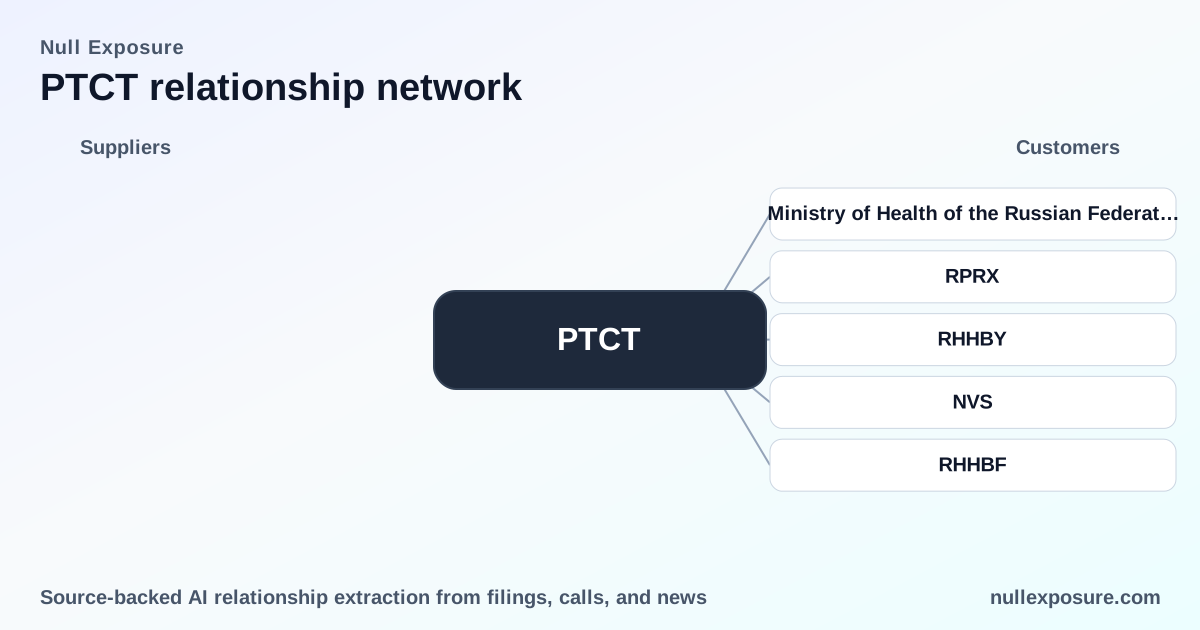
Counterparty relationships — an itemized roll call (exhaustive)
PTC’s public disclosures and recent press coverage identify the following counterparties and the nature of each relationship.
Ministry of Health of the Russian Federation
PTC sells Translarna through a distributor to the Russian Ministry of Health to serve nmDMD patients, with orders placed through that distributor intended to cover multiple months of therapy. This relationship is documented in PTC’s FY2024 Form 10‑K filing. (Source: PTC 2024 Form 10‑K, ptct-2024-12-31.)
Royalty Pharma (RPRX)
Royalty Pharma executed a multi-year purchase of Evrysdi royalties from PTC: an initial $1.0 billion transaction in October 2023 followed by subsequent tranches, and the final portion was sold in December 2025 for $240 million upfront plus up to $60 million in sales‑based milestones. The cumulative monetizations delivered material cash to PTC while transferring future royalty cash flows to Royalty Pharma. (Sources: Royalty Pharma SEC press release (Oct 2023) and PTC Q4 2025 earnings call; press reports including InsiderMonkey and Investing.com reporting on the December 2025 tranche.)
Roche (RHHBY / RHHBF)
Roche is the commercial maker of Evrysdi and the contracting party for PTC’s SMA-related license arrangements; Roche reported approximately USD 584 million in Evrysdi global Q4 revenue that produced royalty receipts attributable to PTC (about $79 million in that quarter). PTC’s FY2024 10‑K also records milestone and royalty payments from Roche under their SMA license arrangement and cites Roche‑related revenue tied to the SMA program. (Sources: PTC FY2024 Form 10‑K and PTC Q4 2025 earnings call transcript reported by InsiderMonkey.)
Novartis (NVS)
Novartis entered a collaboration with PTC on votoplam and committed approximately $998.4 million as an initial investment, a transaction PTC reported as a major revenue and cash event that materially boosted 2025 guidance. The structure provides PTC near‑term cash and an external development partner for a potential first‑in‑class oral therapy. (Sources: European Pharmaceutical Review coverage and Globe and Mail reporting on PTC’s press release, FY2026 period reporting.)
What the relationship map implies for risk, valuation and operations
- Cash conversion vs. recurring income tradeoff: The sale of Evrysdi royalties to Royalty Pharma delivered substantial near‑term cash but reduced recurring royalty income. For valuation, this is a clear trade: accelerated liquidity at the expense of multi‑year cash flows. Source disclosures support both the magnitude and timing of those transactions (PTC filings and press coverage cited above).
- Geopolitical and customer concentration: Russia and Brazil are material to product sales, and government channels (e.g., the Russian Ministry of Health) are explicit counterparties; therefore geographic or policy shifts in those regions will disproportionately affect revenue. (PTC FY2024 disclosures.)
- Distributor dependence and short-term contracts: The company’s reliance on a small number of distributors (two >10% each in 2024) and point-in-time delivery invoicing elevates operational concentration risk; supply disruptions or distributor contract shifts would transmit quickly to reported sales. (PTC FY2024 disclosures.)
- Platform and strategic transition: The June 2024 sale of the Hopewell manufacturing site signals a pivot away from in‑house manufacturing revenue toward partnerships, licensing and service contracts, reducing manufacturing capex and operational complexity but increasing dependence on CDMOs and partners. (PTC corporate disclosures.)
- Contractual diversity cushions downside: The mix of product sales, licensing up‑front fees and occasional milestone/service revenues creates multiple monetization levers that management can use to manage cash—illustrated by the Novartis collaboration and prior royalty sales.
If you want ongoing monitoring of counterparties and how new agreements alter PTC’s cash profile, see our central resource at https://nullexposure.com/.
Investment conclusion — how to weight exposure
PTC’s business today is a hybrid of ongoing commercial sales and deliberate balance‑sheet optimization through royalty and collaboration monetizations. Investors should value the company both on continuing product sales (with EMEA, LATAM and U.S. concentration) and on the residual optionality of its pipeline and partnered programs—while recognizing that recent royalty sales materially reshaped the forward revenue profile. Key diligence areas going forward: distributor stability, Roche Evrysdi performance post‑monetization, Novartis collaboration milestones, and any changes in government payor environments in Russia and Brazil.
Bold, transaction‑level facts and the primary filings cited above should be the foundation for any financial model adjustments and scenario work.