Protagonist Therapeutics (PTGX): Two Partners, Big Leverage — What Investors Need to Know
Protagonist Therapeutics monetizes decade‑long research through licensed collaborations with major pharma partners: it discovers and develops peptide therapeutics, then licenses late‑stage development and global commercialization rights while retaining development responsibilities, milestone upside and royalty economics. Revenue is concentrated in a small set of counterparties and driven by licensing fees, milestone triggers and profit‑share mechanics rather than product sales from an in‑house commercial infrastructure. Explore the full relationship map at https://nullexposure.com/.
Why the partner structure defines PTGX’s economics
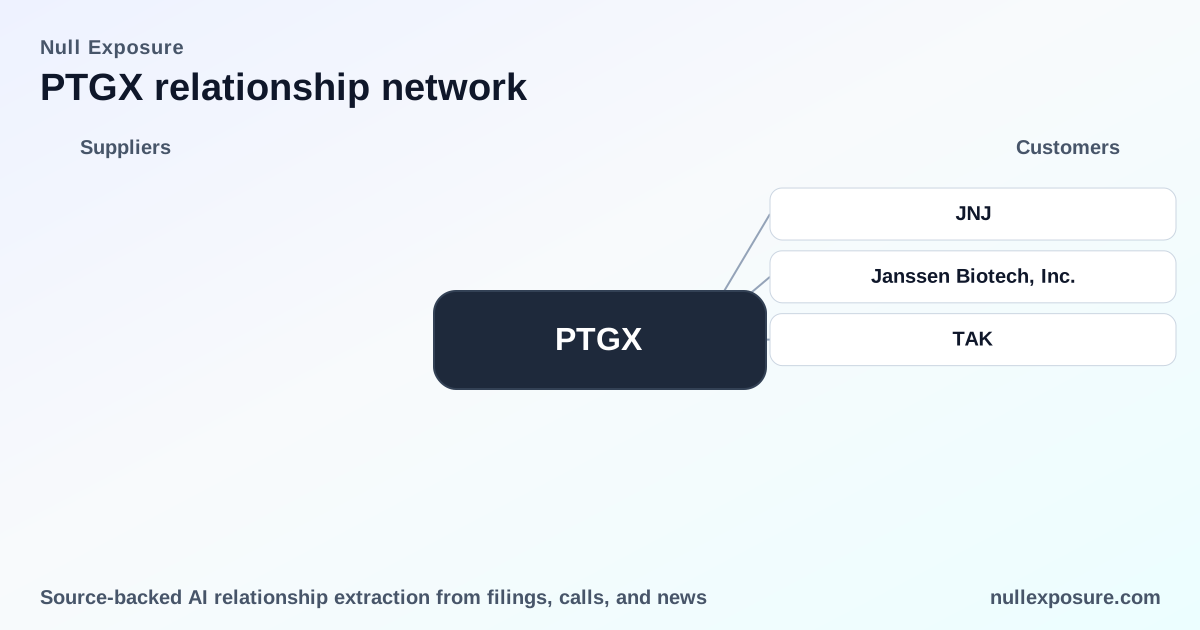
Protagonist operates as a research‑centric licensor. The company funds early development and discovery, then transfers late‑stage development and commercialization to global pharma partners under license and collaboration agreements. According to the company’s FY2024 Form 10‑K, customers are comprised of two collaboration partners: Takeda and JNJ (formerly Janssen Biotech)—this single sentence captures the revenue concentration and strategic posture of the business.
- High concentration: revenue and operating leverage are tied to two counterparties rather than a broad commercial customer base.
- Licensing and milestone economics: PTGX recognizes nonrefundable upfront and milestone payments and cost sharing from its license and collaboration agreements (company filing, FY2024).
- US revenue focus: all reported revenues for 2022–2024 were generated in the United States (company filing, FY2024), which concentrates regulatory and market risk geographically.
This structure produces non‑dilutive, high‑margin revenue streams when milestones and royalties are achieved, while offloading global commercial risk to partners.
The constraint signals that matter for investors
PTGX’s public disclosures generate a consistent set of company‑level signals: licensing is the primary contract type; the firm acts as a licensor for its IP; revenues are U.S.‑centric; and relationships are active with meaningful license revenue recognized ($434.4 million of license and collaboration revenue for the year ended December 31, 2024). These are structural characteristics—they define capital intensity, sensitivity to partner milestones, and the timing of cash inflows.
- Contracting posture: licensing, milestone and cost‑share agreements predominate (company filing, FY2024).
- Concentration risk: two collaboration partners are the customers for PTGX (company filing, FY2024).
- Relationship maturity and activity: long‑standing collaboration with J&J (originating in 2017) and a 2024 global collaboration with Takeda for a late‑stage program; the company recognized substantial license revenue in FY2024 (company filing, FY2024).
If you track PTGX, focus on partner milestone flow, opt‑out windows and profit‑share election mechanics, because these govern the pace and scale of cash generation.
All relationships listed in the public record — line‑by‑line coverage
Below are every counterpart name that appears in the public relationship data, with a plain‑English summary and the cited source for verification.
-
JNJ
Protagonist states that one of its two customers is JNJ (formerly Janssen Biotech), which holds licensed rights to the IL‑23R program (icotrokinra) and will lead commercialization; PTGX has historically led early development while JNJ assumes later‑stage responsibilities (PTGX 2024 10‑K; corporate press releases, 2026). See company Form 10‑K (FY2024) and PTGX press materials in 2026 reporting. -
Janssen Biotech, Inc.
The IL‑23 receptor program (icotrokinra, formerly JNJ‑2113) was discovered jointly and licensed to Janssen Biotech; Janssen holds the operative license for late‑stage development and commercialization (multiple PTGX press releases and conference materials, 2025–2026). Refer to PTGX news releases and investor presentations in early 2026. -
Janssen Biotech, Inc., a Johnson & Johnson company
Under the 2017 license and collaboration agreement, Janssen (a J&J company) licensed icotrokinra and will commercialize it globally, triggering milestone economics to PTGX upon regulatory events (PTGX press releases regarding NDA submission and approval news, 2026). See PTGX announcements from March–May 2026. -
J&J Innovative Medicines
Icotrokinra is referenced as licensed to J&J Innovative Medicines, the Johnson & Johnson affiliate managing commercialization, with PTGX retaining license‑derived upside (conference and press disclosures, 2026). See PTGX press releases and industry coverage in 2026. -
Johnson & Johnson
Johnson & Johnson will lead global commercialization for icotyde under the existing collaboration and made milestone payments to PTGX upon regulatory progress; J&J’s global resources are the commercialization engine behind PTGX’s royalty and milestone income (news coverage and analyst notes, May 2026). See industry press and analyst commentary in May 2026 (multiple outlets). -
Takeda Pharmaceuticals
PTGX entered a worldwide collaboration and license agreement with Takeda in 2024 to co‑develop and co‑commercialize rusfertide, with PTGX remaining primarily responsible for development through NDA filing; the program is in Phase 3 for polycythemia vera (PTGX press releases and conference statements, 2025–2026). See company announcements and conference material in 2025–2026. -
TAK
Public commentary and analyst writeups refer to Takeda (TAK) as the commercial partner on rusfertide; the collaboration includes commercialization and profit‑sharing mechanics and supports milestone and royalty structures that fund PTGX non‑dilutively (press coverage and analyst reports, March 2026). See analyst coverage and press releases in March 2026. -
Takeda
Multiple PTGX press releases reiterate that rusfertide will be co‑developed and co‑commercialized with Takeda under the 2024 agreement, with PTGX retaining development responsibilities through NDA (press releases and investor updates, 2025–2026). See PTGX investor communications in early 2026. -
Takeda Pharmaceuticals USA, Inc.
Under the Takeda license and collaboration agreement PTGX has rights to opt out of the U.S. 50:50 profit and loss sharing arrangement in the U.S. during a defined post‑NDA filing window, a material commercial election that investors should monitor (company 2025/2026 financial filings and press releases). See PTGX investor release and FY2024 Form 10‑K disclosures referencing the Takeda agreement.
(Each relationship summary above is drawn from PTGX filings and company press materials spanning the FY2024 10‑K and multiple PTGX press releases and industry news items between 2025–2026.)
Investment implications: upside drivers and concentrated risks
Protagonist’s model surfaces clear upside and concentrated risk:
-
Upside drivers: milestone payments, royalty streams and profit‑share elections under Takeda; a milestone pipeline tied to J&J commercialization of icotyde—including an immediate $50 million milestone reported upon regulatory approval events by industry coverage in May 2026. These cash flows are high‑margin relative to direct commercialization. (See May 2026 press and analyst coverage.)
-
Concentrated risk: two counterparties supply essentially all customer revenue; regulatory outcomes and partner commercialization execution directly determine cash realization timing and scale (company 10‑K, FY2024). The U.S. revenue concentration adds geographic exposure.
-
Optionality and governance levers: PTGX’s right to opt out of U.S. profit‑share, cost‑share arrangements and license accounting treatment are pivotal operational levers that affect future economics (company disclosures).
Key takeaway: PTGX is a capital‑efficient developer that monetizes discovery through deep partnerships—this creates asymmetric returns when milestones hit, but leaves investors exposed to a small number of counterparty outcomes.
How to monitor next
Track three items weekly to quarter: regulatory milestone calendars for icotyde and rusfertide; partner communications from J&J and Takeda; and PTGX earnings updates that recognize license revenue or disclose opt‑out decisions. For a concise relationship map and ongoing updates, visit https://nullexposure.com/.
If you want a focused brief on upcoming milestone timing or a sensitivity analysis of potential royalty and milestone cash flows, I can prepare a short memo tailored to a valuation scenario.