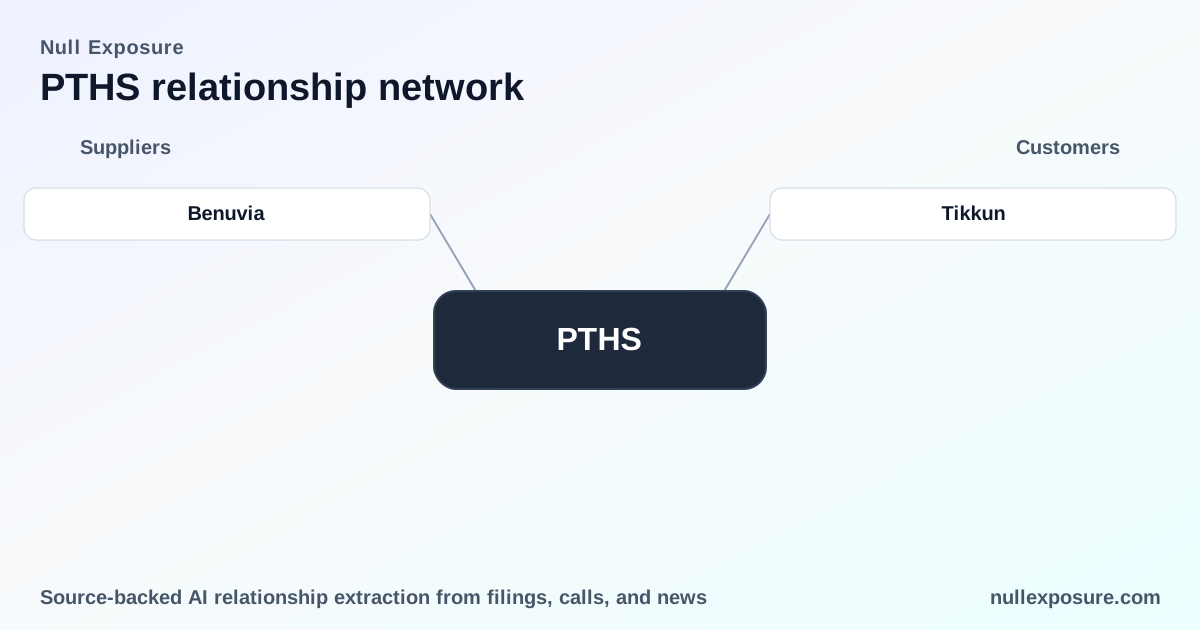
Pelthos Therapeutics: customer counterparty signals from the filings
Pelthos Therapeutics develops and commercializes therapeutic products while supplementing operating cash through structured equity purchase arrangements; the company monetizes both product revenue and capital transactions tied to Purchase Share programs. For investors and operators, the salient signal from public filings is that Pelthos manages capital counterparties with discretionary, seller‑controlled sale mechanics that preserve pricing and timing flexibility while keeping balance‑sheet optionality. Learn more at https://nullexposure.com/.
Quick commercial snapshot investors should keep front of mind
Pelthos reports $16.8M revenue (TTM) with a gross profit of $11.6M, but operating losses and negative EBITDA reflect an early commercial biotech scaling profile. The company carries a modest market capitalization (~$83M) and high insider ownership (56%), which concentrates control and creates alignment between management and early backers. These capital and ownership dynamics increase the importance of financing counterparties in shaping liquidity and runway — not as customers for therapy products, but as purchasers of equity under structured agreements.
What the filing discloses about the Tikkun relationship
Pelthos’s FY2024 Form 10‑K describes a CEF Purchase Agreement under which Pelthos will sell Purchase Shares to Tikkun and retains the right to vary timing, prices, and quantities of those share sales subject to market demand. According to Pelthos’s FY2024 Form 10‑K, the company holds discretion to control the cadence and economics of equity placement to Tikkun under that agreement (FY2024 filing).
Tikkun — plain English takeaway and source
Tikkun is a counterparty to Pelthos under a Purchase Agreement that commits Pelthos to make shares available but allows Pelthos to choose when, at what price, and how many shares to sell depending on market conditions. This arrangement functions as a financing mechanism rather than a product‑sales customer contract. (Source: Pelthos Therapeutics, FY2024 Form 10‑K.)
What this single relationship reveals about Pelthos’s operating posture
- Contracting posture — seller control. The explicit contractual language gives Pelthos discretion over timing, pricing and volume, which is a seller‑friendly structure that preserves strategic optionality when markets are volatile.
- Concentration signal. The reviewed customer relationship set surfaces only one counterparty (Tikkun); this is not a diverse customer list and therefore public disclosures show limited counterparties for equity purchase activity.
- Criticality and role. The Tikkun relationship is financially critical in a capital‑markets sense — it supplies potential liquidity — but it is not described as a commercial buyer of therapeutic products, so its relevance to product revenue is indirect.
- Maturity and formality. The disclosure in the FY2024 10‑K indicates a documented, formal purchase agreement, implying a mature contractual relationship designed for repeated or conditional settlements rather than a one‑off transaction.
Note: the dataset provided no explicit contract constraints to parse; as a company‑level signal, no constraints were identified in the customer dataset, which supports Pelthos’s ability to exercise the discretion embedded in the Purchase Agreement.
Why operators and investors should care
- Revenue predictability vs. financing optionality. The Tikkun facility gives Pelthos the ability to raise equity on a controlled timetable, which reduces the risk of forced placements and preserves valuation discipline. However, because sale timing and pricing are discretionary, any cash drawn from the facility is not a predictable revenue stream for operational budgeting.
- Balance‑sheet management priority. For a company with negative EBITDA, financing counterparties effectively substitute for short‑term customers in importance; their structure and terms shape runway, dilution outcomes, and the company’s ability to invest in commercialization.
- Concentration risk is informational. Only one disclosed counterparty in this dataset means public visibility into the company’s broader financing or customer base is limited; investors should treat the Tikkun disclosure as one clear piece of Pelthos’s capital strategy, not as a comprehensive map of all counterparties.
Practical evaluation checklist for diligence
- Confirm whether the Tikkun agreement has caps, triggers, or volume minimums beyond the discretionary language; those provisions materially affect optionality and dilution profiles (filings review).
- Map the timing of any draws under the CEF Purchase Agreement against clinical and commercial milestones to understand whether equity is likely to be used for operational funding or episodic capital needs.
- Monitor insider and institutional ownership levels alongside the cadence of equity sales, since high insider ownership plus flexible purchase agreements can concentrate dilution decisions in a small governance group.
- Compare Pelthos’s disclosed Purchase Agreement terms to peers’ equity facilities to evaluate whether Pelthos’s structure is relatively protective or permissive for existing shareholders.
Bottom line for investors and operators
The public disclosure identifies Tikkun as an equity purchaser under a CEF Purchase Agreement in which Pelthos retains control over when, how many, and at what price Purchase Shares are sold, per the FY2024 Form 10‑K. That contractual design gives Pelthos strategic flexibility to manage liquidity and valuation outcomes, but it does not convert into predictable operating revenue — instead, it is a governance tool for balance‑sheet management. For actionable diligence, prioritize verification of any undisclosed constraints, volume mechanics, and the frequency of draws under this agreement.
Explore deeper relationship analytics and filing‑level detail at https://nullexposure.com/ to support model updates and capital allocation decisions.