PTL LTD (PTLE) — Customer Map and Commercial Readiness for Investors
PTL LTD generates revenue by contracting industrial services and equipment leases across technology, renewable energy and specialty retail verticals, monetizing through project fees, field service engagements and asset leasing. Revenue is concentrated in project and service contracts rather than recurring subscription streams, and the company operates with thin gross margins and a net loss profile today, which makes counterparty quality and contract cadence central to investment returns. For a concise directory of PTL’s customer relationships and what they imply for credit and equity investors, visit https://nullexposure.com/.
Business model snapshot PTL reports trailing revenue of roughly $71.6 million with very narrow gross profits (about $0.9M) and negative EPS (-8.85), indicating current operations are loss-making at the bottom line. The firm lists a small public market capitalization and low institutional ownership (7.3%), and it reports no dividend activity. Key commercial features are project-based contracting, asset leasing exposure, and a geographically diversified client base with notable Gulf and offshore engineering customers.
How PTL contracts and where risk concentrates PTL’s operating posture is project-driven and counterparty-dependent. Contracts are typically on-field service or equipment-lease arrangements that are:
- Time-bound and concentrated by project, generating lumpy cash flow and revenue recognition volatility.
- Dependent on larger industrial counterparties where contract win/loss and payment timing materially affect cash flow.
- Operationally critical in execution: field joint coating, welding and leased plant are services that incumbent operators cannot easily substitute without schedule impact.
These characteristics signal moderate commercial concentration, elevated cash-flow cyclicality, and operational criticality, while maturity of relationships varies by client and geography.
Customer relationships: the counterparties disclosed Below are every customer relationship surfaced in the available coverage, with concise takeaways and source attribution.
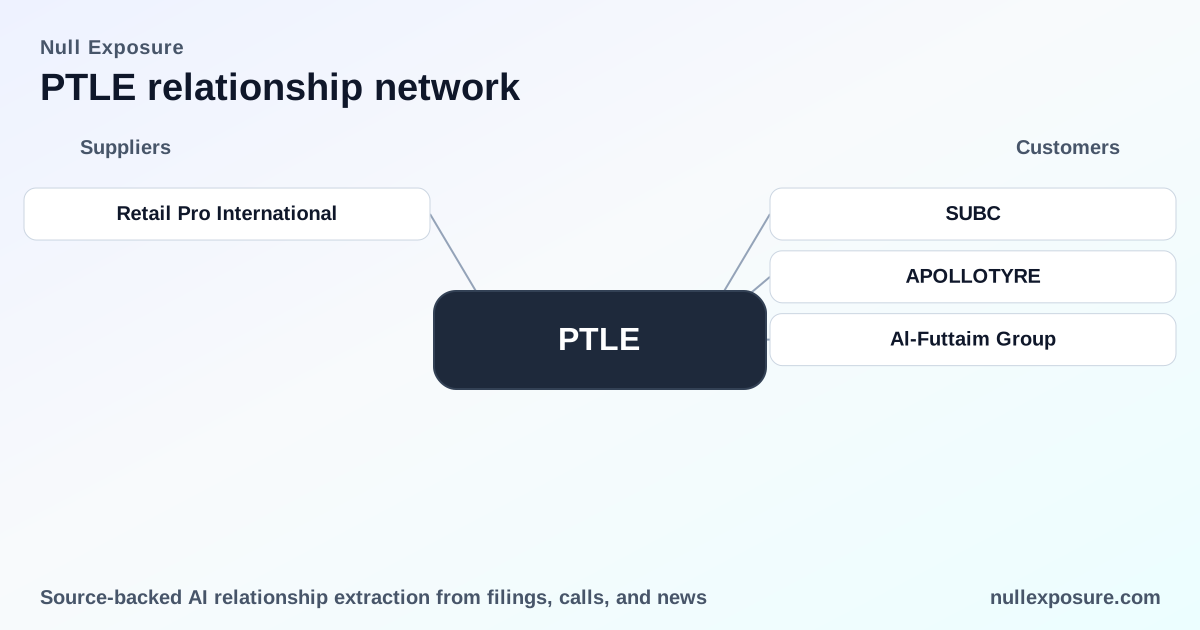
Subsea7 (listed as SUBC)
PTL will provide field joint coating and welding services for Subsea7’s vessels and equipment under a discrete deal, positioning PTL as an on-site supplier for offshore integrity work. According to Grampian Online (March 2026), the contract covers field joint coating and welding services for Subsea7’s vessels and related equipment (https://www.grampianonline.co.uk/news/kintore-firm-pipeline-technique-agrees-deal-with-subsea7-292770/).
Apollo Tyres Limited (listed as APOLLOTYRE)
PTL is engaged in leasing plant equipment to Apollo Tyres, reflecting an asset-leasing revenue stream rather than pure services, which diversifies PTL’s contract types toward equipment finance. Simply Wall St’s company coverage (March 2026) reports that PTL Enterprises engages in the lease of plant to Apollo Tyres Limited (https://simplywall.st/stocks/in/commercial-services/nse-ptl/ptl-enterprises-shares/news/we-wouldnt-be-too-quick-to-buy-ptl-enterprises-limited-nsept).
Al‑Futtaim Group
PTL has historically served large Middle East retail and industrial groups such as Al‑Futtaim out of Dubai, indicating regional commercial reach into Gulf retail and service chains. A profile in the Times of Malta (2011) referenced PTL’s service relationship with the Al‑Futtaim Group and the company’s regional footprint (https://timesofmalta.com/article/Philip-Toledo-goes-multinational-expands-into-the-Middle-East.362601).
What the customer set implies for investors Collectively, these relationships reveal a hybrid revenue model: project services (Subsea7), equipment leasing (Apollo Tyres), and regional B2B retail/industrial relationships (Al‑Futtaim). That mix delivers potential upside when project utilisation is high and leased assets are fully deployed, but it also creates volatility:
- Cash-flow sensitivity: Project timing and payment terms with large engineering firms drive short-term liquidity. Field services are typically billed on completion or milestone, producing lumpiness in collections.
- Counterparty credit is a hedge: Contracts with established companies such as Subsea7 and large regional conglomerates reduce counterparty credit risk relative to small private customers. These relationships enhance revenue credibility when repeat work is secured.
- Revenue concentration risk: A business model dependent on a handful of large contracts translates into revenue concentration and operational leverage—useful when projects run on time, damaging when they do not.
Company-level signals and constraints No explicit contractual constraints were provided in the records, so the following are company-level operational signals extracted from financials and customer composition:
- Contracting posture: Project and lease-centric—contracts tend to be finite and operationally intensive rather than ongoing, subscription-style agreements.
- Concentration: Customer list indicates reliance on a small number of significant counterparties, creating single-client sensitivity in quarters where major projects conclude or payment terms extend.
- Criticality: Services like field joint coating and welding are mission-critical for offshore projects, making PTL strategically important in the delivery chain and improving negotiating leverage on price and access to sites.
- Maturity: Relationships demonstrate mixed maturity—some long-standing regional ties (Al‑Futtaim) and newer, project-based wins (Subsea7), implying variable renewal risk.
- Governance and ownership signals: Reported institutional ownership is low (~7.3%) and insiders aren’t shown as significant holders, which suggests limited sell-side coverage and lower institutional scrutiny.
Risks and triggers to watch
- Revenue volatility and margin compression: Thin gross profit and negative operating margins create sensitivity to small cost overruns or project delays. Watch quarterly revenue recognition closely.
- Counterparty and concentration risk: Loss or delay of a major contract like Subsea7 work would be material to cash flow.
- Balance sheet and liquidity: Asset-leasing is capital intensive; monitor utilization of leased plant and receivable aging for signs of stress.
- Market visibility: Low institutional ownership and limited analyst coverage mean market re-pricing can be abrupt on material news.
Investment read-through and next steps PTL’s model provides strategic exposure to offshore engineering services and asset leasing, with upside when project pipelines are robust and asset utilisation remains high. Conversely, current profitability metrics and narrow gross margin create downside vulnerability to project execution and client payment timing.
For investors and operators evaluating PTL as a counterparty or portfolio holding, prioritize diligence on contract length, payment milestones, security for leased assets, and recent work pipelines for customers like Subsea7 and Apollo Tyres. For further company relationship mapping and comparable commercial intelligence, visit https://nullexposure.com/.
Key takeaway: PTL’s meaningful customer wins anchor revenue potential, but the firm’s project-driven revenue mix and weak margin profile require close monitoring of contract cadence and receivable performance.