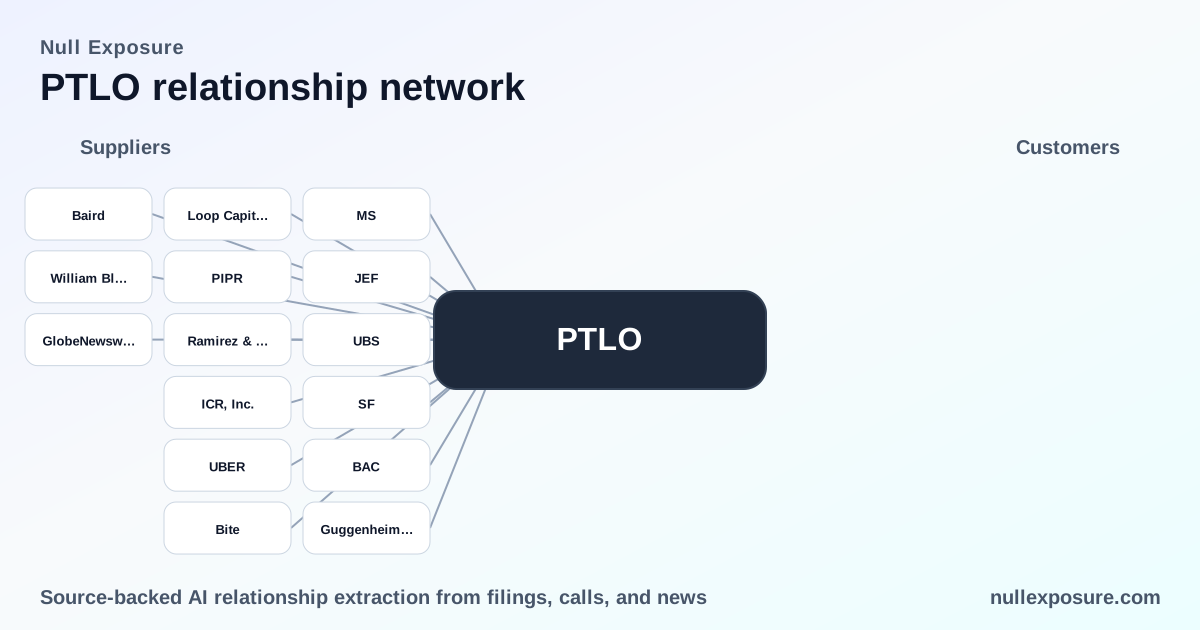
Portillo’s (PTLO) Customer Relationships: Tampa Bay Lightning and What It Signals to Investors
Portillo’s operates and monetizes a dense, brand-driven quick-service restaurant model focused on Chicago-style menu items sold through company-operated restaurants, local events, and branded partnerships. Revenue is generated directly from restaurant sales and local marketing activations that convert foot traffic into repeat customers, supported by a reported $732 million TTM revenue and $80.6 million EBITDA (latest quarter 2025-12-31). For investors evaluating customer-side exposure, the company’s partnerships are tactical marketing levers rather than wholesale distribution channels; they amplify brand presence in targeted local markets. Learn more at https://nullexposure.com/.
A single partnership, clear intent: Tampa Bay Lightning
Portillo’s documents show a concrete local-marketing relationship with a professional sports franchise. According to a company filing in FY2022, Portillo’s runs a vending partnership with the Tampa Bay Lightning and leverages local community events and fundraisers at its restaurants to drive brand awareness and sales (SEC prospectus, FY2022: https://www.sec.gov/Archives/edgar/data/1871509/000119312522221258/d382690d424b4.htm). This is explicitly framed as a marketing activation rather than a large-scale commercial supply agreement.
What the Tampa Bay Lightning relationship means for investors
Portillo’s vending tie to the Tampa Bay Lightning is a brand-awareness and local sales activation that supports restaurant traffic and community engagement, not a material wholesale customer. The SEC filing cites the partnership as one of several local initiatives used to “support brand awareness and drive sales” in new and existing markets (FY2022 SEC prospectus).
How Portillo’s customer posture constrains its operating model
Portillo’s customer relationships and the constraints captured in company disclosures point to several operational characteristics investors must factor into valuation and risk assessments:
- Contracting posture — retail seller: Portillo’s is a direct-to-consumer restaurant operator; its customer role is selling dining experiences and related merchandise. The company’s own description emphasizes in-store, high-energy multichannel restaurants that sell iconic Chicago street food, which signals a seller-facing contracting posture rather than complex B2B supplier agreements.
- Geographic concentration — Midwestern focus: Management notes the restaurant base is geographically concentrated in the Midwestern United States, creating concentrated exposure to regional economic cycles and local labor and supply conditions. This concentration helps drive dense market penetration and operational efficiency but increases sensitivity to local downturns or regulatory changes.
- Concentration vs. diversification: Partnerships such as sports-team activations are supplemental and dispersible—useful for local marketing but not critical single points of failure. Portillo’s business risk is concentrated more in regional store economics and same-store performance than in any single institutional customer.
- Maturity and role of partnerships: The company uses community events, vending partnerships, and local fundraisers as mature marketing tools to accelerate brand adoption in new locations and reinforce loyalty in established markets. These relationships function as high-frequency, short-duration activations rather than long-term revenue contracts.
Financial context that shapes customer risk
Put the customer signals against the financial profile to judge vulnerability:
- Portillo’s reported $732 million TTM revenue and $80.6 million EBITDA (latest quarter 2025-12-31).
- Profitability metrics show thin net margins (2.64%) and an operating margin of 7.22%, indicating limited cushion for margin compression caused by localized demand shocks.
- Volatility is elevated (beta 1.725) and quarterly earnings growth shows recent strain (quarterly earnings growth YOY -51.9%), which heightens sensitivity to execution on local marketing spends and store economics.
These numbers underscore that customer partnerships are important for incremental traffic and brand building, but Portillo’s core earnings resilience hinges on same-store sales and regional operating leverage rather than a single marquee partner.
Relationship-by-relationship coverage (complete list)
- Tampa Bay Lightning — Portillo’s operates a vending partnership with the Tampa Bay Lightning to amplify local brand awareness and drive sales through event-based activations; the engagement is described in the company’s FY2022 SEC filing as a marketing and community initiative (SEC prospectus, FY2022: https://www.sec.gov/Archives/edgar/data/1871509/000119312522221258/d382690d424b4.htm).
Key risks and monitoring checklist for investors
- Regional concentration risk: Because the restaurant footprint is concentrated in the Midwest, track state-level employment trends, wage pressures, and consumer spending in core markets. Management’s own disclosure flags this as a material geographic vulnerability.
- Marketing ROI on local partnerships: Sponsorships and vending deals are discretionary; investors should monitor incremental same-store sales in markets tied to activations and the company’s guidance on marketing ROI.
- Margin sensitivity: Low net margins and recent earnings volatility mean that short-term interruptions (weather, local events, supply constraints) will have outsized impacts; watch quarterly EBITDA and operating margin trends closely.
- Brand execution and expansion cadence: Success depends on consistent guest experience across company-operated locations; any dilution of brand promise during expansion will reduce lifetime value more than a failed single partnership.
For investors seeking a quick reference, note these metrics at a glance:
- TTM revenue: $732M
- EBITDA: $80.6M
- Profit margin: 2.64%
- Geographic concentration: Midwestern U.S.
Explore further relationship mapping and signals at https://nullexposure.com/.
Bottom line: partnerships are strategic, not foundational
Portillo’s customer relationships—exemplified by the Tampa Bay Lightning vending partnership—function as tactical marketing activations that support foot traffic and community engagement. These engagements increase brand density and customer acquisition efficiency but do not constitute foundational revenue contracts. Investor focus should remain on regional same-store sales, margin trajectory, and the company’s ability to convert local activations into durable customer loyalty.