Palatin Technologies (PTN): Partner cashflow, asset monetization, and where revenue actually comes from
Palatin is a small-cap specialty biopharma that monetizes assets through selective asset sales, sublicenses and collaboration agreements that generate upfront payments, cost-reimbursements and milestone receipts rather than through large recurring product revenue. The company has moved from direct product sales toward an IP-and-collaboration-led model — selling its marketed product Vyleesi while retaining milestone upside and funding its pipeline through targeted licensing deals. For a relationship-level map and partner exposure analysis, visit https://nullexposure.com/.
The operating model in one line
Palatin runs a capital-efficient commercialization strategy: concentrate on R&D and selective clinical programs while extracting non-dilutive capital from partners via upfronts and milestones, and reduce operating complexity by selling marketed product lines. That posture changes the revenue mix from stable product receipts to lumpy, partner-driven cashflows.
What that business model implies for investors
- Contracting posture: Palatin has shifted from seller/operator of a marketed product to an IP licensor and collaborator; the December 2023 sale of Vyleesi is the inflection point that illustrates the change in posture.
- Concentration and criticality: Revenue is concentrated in a handful of collaboration and sublicense deals; a small number of counterparties produce most near-term cash. This creates higher volatility in revenues and dependence on milestone/upfront timing.
- Maturity and optionality: Some partnered programs are late-stage (PL9643 reached Phase III for dry eye disease) and therefore provide near-term monetization potential, while other programs retain long-term upside via royalties and downstream milestones.
- Geography: Historical product sales were U.S.-centric prior to the Vyleesi sale, shifting future sales geography to counterparties managing commercialization outside the company itself.
For deeper partner-level maps and to track milestone schedules directly, see https://nullexposure.com/.
Counterparty map — every relationship in the public record (concise, source-backed)
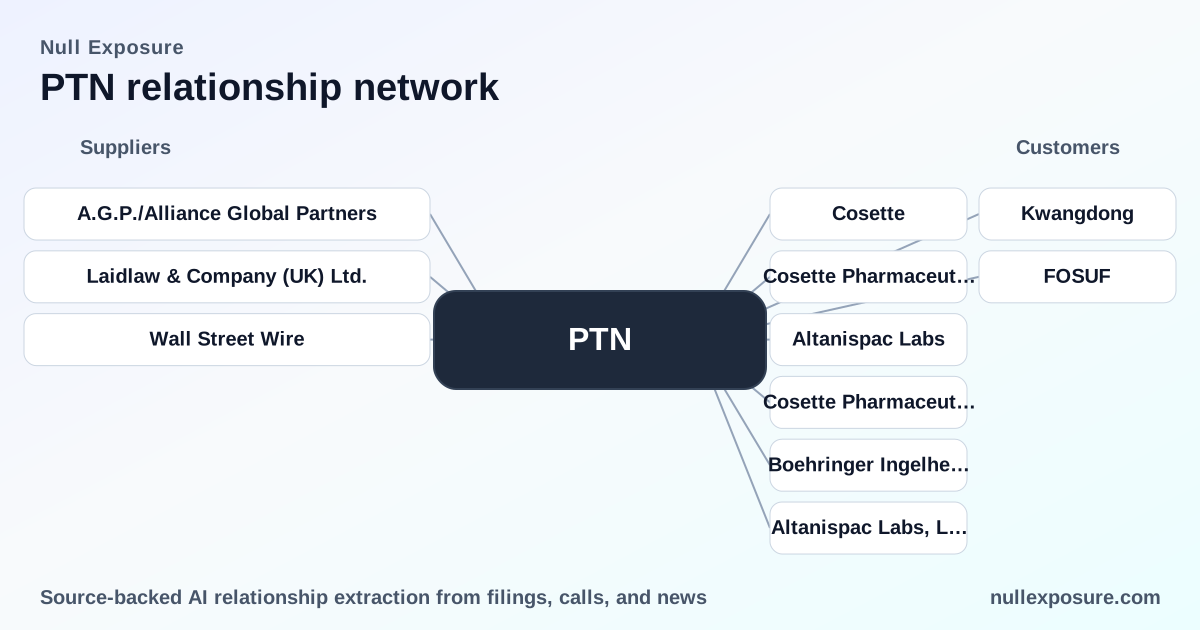
Below are each of the counterparties mentioned in Palatin’s filings and press releases, with the specific commercial arrangement and the source context.
Cosette / Cosette Pharmaceuticals / Cosette Pharmaceuticals, Inc.
Palatin sold the Vyleesi product line to Cosette with an upfront cash payment of $12 million and contingent sales‑based milestone payments of up to $159 million, for aggregate consideration of up to $171 million; the sale transferred commercial responsibility while Palatin retained potential milestone upside. According to Palatin’s December 2023 press release closing the transaction (PR Newswire, FY2023) and discussed in the FY2025 10‑K, Palatin also notes that it may not receive significant milestone payments under the purchase agreement and that prior to the sale it sold Vyleesi into U.S. specialty‑pharmacy channels at WAC with ~30‑day payment terms (PR Newswire FY2023; 10‑K FY2025).
Altanispac Labs / Altanispac Labs, LLC
Palatin executed a sublicense for PL9643 (an MC1R agonist for dry eye disease) to Altanispac that provided ~$3.8 million in upfront consideration in January 2026, with Palatin retaining potential milestone and royalty participation; the transaction included non‑cash debt cancellation elements in the company’s accounting disclosures. This is described in Palatin’s Q2 FY2026 corporate update and related press coverage (PR Newswire / TradingView / Sahm Capital, FY2026).
Boehringer Ingelheim
Palatin’s collaboration on melanocortin receptor (MCR) agonists for retinal disease has delivered non‑dilutive capital via upfront and milestone payments, including an upfront of €2.0 million (reported as $2.3 million) in August 2025 and a €5.5 million (~$6.5M) milestone reported in FY2025. The company states total FY2026 revenues were largely driven by the Boehringer agreement, including upfronts and milestone achievements (PR Newswire FY2026; PR Newswire milestone release FY2025; TradingView / InsiderMonkey coverage FY2026).
Brangel Engelheim
A public transcript notes a research collaboration and license agreement described as delivering ~$2.3 million upfront and a $6.5 million research milestone to Palatin; the note is recorded in a market transcript summary. (GuruFocus transcript summary, May 2026.) The reporting is consistent with the company’s disclosures about milestone receipts under collaboration agreements.
Kwangdong
Palatin’s earlier licensing history for Vyleesi includes potential regulatory approval milestone receipts tied to South Korea, enumerated as $3.0 million associated with Kwangdong in connection with prior licensing arrangements. This milestone allocation was disclosed in Palatin’s press release about the Vyleesi sale (PR Newswire, FY2023).
Fosun / FOSUF
Related to the Vyleesi licensing history, Palatin is eligible for regulatory approval milestones of $7.5 million tied to Fosun for China, disclosed alongside the Vyleesi sale terms to Cosette; the entry also appears under the ticker FOSUF in market summaries. The allocation and milestone amounts were described in the PR Newswire announcement of the Vyleesi transaction (PR Newswire, FY2023).
What the relationship map reveals about revenue quality
- Revenue is lumpy and event‑driven. Recent quarters show revenue recognition driven by upfronts and milestones (Boehringer, Altanispac), not steady prescription sales. Palatin reported FY2026 revenue of $8.96 million driven by the Boehringer commercial agreement (TradingView / company Q report, FY2026).
- Decreased operational complexity, increased milestone dependence. The sale of Vyleesi reduces direct commercialization risk and operating overhead but replaces recurring product receipts with contingent and timing‑sensitive payments. The 10‑K explicitly documents the prior U.S. product revenue model and the December 2023 sale to Cosette (10‑K FY2025).
- Partner selection matters. Cash generation depends on a small set of counterparties executing development and commercialization plans (Boehringer, Altanispac/ Cosette), so counterparty execution risk translates directly into Palatin’s liquidity profile.
Investment takeaways and risk checklist
- Positive: The company has demonstrable ability to convert assets to near‑term cash — e.g., $3.8M from the PL9643 sublicense and €2.0M upfront from Boehringer — which materially strengthens the balance sheet and de-risks near-term funding needs. (PR Newswire FY2026; PR Newswire Aug 2025.)
- Negative: Future upside on Vyleesi is contingent on Cosette’s commercial performance and milestone triggers; Palatin’s direct exposure to product geography shrank when it sold the U.S. product business. (10‑K FY2025; PR Newswire FY2023.)
- Monitor: Timing and probability of milestone triggers, partner cadence on regulatory filings and commercialization, and any re‑allocation of rights that could affect royalty flows.
For subscribers and analysts tracking partner timelines and milestone schedules for small biotechs, our partner‑level exposure pages aggregate these events into a single view — see https://nullexposure.com/ for the live map.
Conclusion: Palatin’s transition to an asset‑monetization and partner‑funded development model reduces operating burden and creates clearer, if lumpy, cash pathways, but it also concentrates execution risk in a small number of counterparties and milestone events. Investors should underwrite counterparty execution and milestone timing when modeling revenue and cash runway.