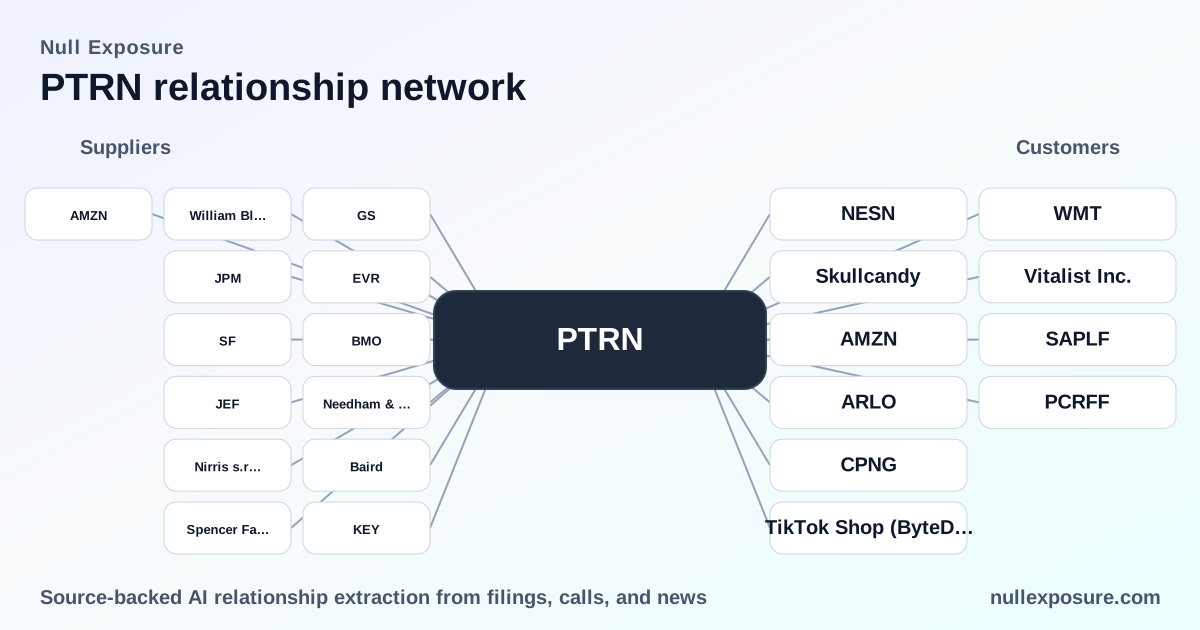
Pattern Group (PTRN) — customer map and what it means for investors
Pattern Group operates global e-commerce marketplaces and sells consumer goods across dozens of channels, monetizing primarily by purchasing and reselling inventory and by managing marketplace distribution for brand partners; the business captures margin on goods sold and scales by broadening channel reach and brand relationships. For an investor, the key trade-off is rapid top-line expansion off a highly concentrated 2024 revenue base versus the operational and legal risks that come from marketplace dependence and third‑party brand arrangements. Learn more at https://nullexposure.com/.
How Pattern’s commercial model actually works in practice
Pattern sources inventory and partner contracts, lists and optimizes products across more than 60 marketplaces worldwide, and recognizes revenue when goods are sold. The company reported $2.5 billion trailing twelve‑month revenue and $1.09 billion gross profit, which demonstrates scale; operating margin and profitability remain modest, reflecting reinvestment into channel expansion and logistics (operating margin ~3.6%, profit margin ~0.65%). Pattern’s model is transaction-driven and marketplace-dependent: scale comes from volume and channel diversification, while gross margin depends on pricing execution, promotional cadence, and fulfillment efficiency.
- Concentration is a fundamental underwriting variable: public reporting and media coverage identify Amazon as the dominant channel historically, while management emphasizes non‑Amazon growth to reduce platform concentration.
- Customer mix is two-layered: direct consumer marketplaces (Amazon, Walmart, eBay, TikTok Shop, etc.) and brand partners whose products Pattern distributes globally (Nestlé, Panasonic, Skullcandy, etc.).
- Operational posture is asset-light on retail storefronts but asset‑intensive on inventory and logistics: that structural mix shapes cash flow timing and working capital requirements.
Relationship snapshots — what every named partner in the results signals
Below are plain-English, 1–2 sentence summaries for each relationship referenced in the coverage, with source attribution.
- Nestlé / NESN — Pattern lists Nestlé among its notable brand partners, indicating Pattern works with legacy consumer packaged-goods brands to distribute products through its channel network (TradingCalendar, IPO coverage, Mar 10, 2026: https://www.tradingcalendar.com/post/pattern-group-ptrn-ipo).
- Skullcandy — Skullcandy is cited as a brand partner, showing Pattern’s reach into consumer electronics and lifestyle categories (TradingCalendar, Mar 10, 2026: https://www.tradingcalendar.com/post/pattern-group-ptrn-ipo).
- Panasonic — Panasonic appears in Pattern’s partner list, reflecting relationships with established electronics brands that need global e-commerce distribution (TradingCalendar, Mar 10, 2026: https://www.tradingcalendar.com/post/pattern-group-ptrn-ipo).
- Sylvania — Sylvania is named among brand partners, further confirming Pattern’s engagement with multi‑category consumer brands for marketplace distribution (TradingCalendar, Mar 10, 2026: https://www.tradingcalendar.com/post/pattern-group-ptrn-ipo).
- Amazon / AMZN — Reuters reporting cited in market articles states Amazon accounted for more than 90% of Pattern’s 2024 revenue, underscoring extreme channel concentration and platform policy risk (reported via TS2.Tech referencing Reuters, FY2025 coverage, Mar 2026: https://ts2.tech/en/pattern-group-inc-ptrn-stock-weekend-market-close-latest-news-analyst-targets-and-what-to-watch-before-mondays-open/).
- Coupang / CPNG — Management highlighted triple‑digit growth from Coupang in Q4, signaling successful expansion into high-growth regional marketplaces beyond Amazon (Q4 2025 earnings transcript coverage, The Globe and Mail, FY2026 press release: https://www.theglobeandmail.com/investing/markets/stocks/AMZN/pressreleases/597065/pattern-group-ptrn-q4-2025-earnings-transcript/).
- TikTok Shop (ByteDance, private) — Pattern listed TikTok Shop as a source of double‑digit and triple‑digit growth in Q4, showing the company’s strategy to exploit emerging social-commerce channels (Q4 2025 earnings transcript, The Globe and Mail, FY2026: https://www.theglobeandmail.com/investing/markets/stocks/AMZN/pressreleases/597065/pattern-group-ptrn-q4-2025-earnings-transcript/).
- Walmart / WMT — Walmart was cited as one of the marketplaces contributing to non‑Amazon growth, indicating Pattern’s distribution extends into large retail platforms (Q4 2025 earnings transcript, The Globe and Mail, FY2026: https://www.theglobeandmail.com/investing/markets/stocks/AMZN/pressreleases/597065/pattern-group-ptrn-q4-2025-earnings-transcript/).
- Walmart.com — Coverage listing marketplaces explicitly includes Walmart.com among the channels Pattern uses to sell inventory, reiterating its omnichannel marketplace strategy (TS2.Tech summary, May 3, 2026: https://ts2.tech/en/pattern-group-stock-nasdaq-ptrn-tanks-after-bear-cave-short-report-latest-price-news-and-2026-forecasts/).
- eBay / EBAY — eBay is cited as another global channel in Pattern’s marketplace roster, contributing to geographic and channel diversification (TS2.Tech coverage, May 3, 2026: https://ts2.tech/en/pattern-group-stock-nasdaq-ptrn-tanks-after-bear-cave-short-report-latest-price-news-and-2026-forecasts/).
- JD — JD (China) is listed as one of the global marketplaces where Pattern sells inventory, supporting presence in Asian e-commerce ecosystems (TS2.Tech coverage, May 3, 2026: https://ts2.tech/en/pattern-group-stock-nasdaq-ptrn-tanks-after-bear-cave-short-report-latest-price-news-and-2026-forecasts/).
- Mercado Libre / MELI — Mercado Libre appears on Pattern’s marketplace list, confirming Latin American channel expansion (TS2.Tech coverage, May 3, 2026: https://ts2.tech/en/pattern-group-stock-nasdaq-ptrn-tanks-after-bear-cave-short-report-latest-price-news-and-2026-forecasts/).
- Tmall / BABA — Tmall is included among the marketplaces Pattern uses, signaling engagement with Alibaba’s China e-commerce ecosystem (TS2.Tech coverage, May 3, 2026: https://ts2.tech/en/pattern-group-stock-nasdaq-ptrn-tanks-after-bear-cave-short-report-latest-price-news-and-2026-forecasts/).
- Target.com / TGT — Target.com is listed as a distribution channel, illustrating Pattern’s presence on major U.S. retailer platforms (TS2.Tech coverage, May 3, 2026: https://ts2.tech/en/pattern-group-stock-nasdaq-ptrn-tanks-after-bear-cave-short-report-latest-price-news-and-2026-forecasts/).
- TikTok Shop (separate listing) — Multiple mentions of TikTok Shop emphasize it as a distinct growth channel outside traditional marketplaces (TS2.Tech and Globe and Mail Q4 2025 coverage, May 2026/March 2026).
- Vitalist Inc. — Market commentary and initiation notes reference a Vitalist partnership to accelerate e-commerce for Reebok smartwatches, indicating Pattern pursues white‑label or partner-led initiatives for brand expansion (MarketScreener/JPMorgan/Stifel coverage, FY2025 press notes, Mar 2026: https://www.marketscreener.com/news/stifel-nicolaus-initiates-coverage-on-pattern-group-with-buy-rating-18-price-target-ce7d5ad9df8df523).
- Arlo Technologies / ARLO — Media flagged litigation from Arlo Technologies alleging Pattern failed to deliver promised sales growth, a disclosed legal and commercial risk that Pattern has publicly disputed (SahmCapital coverage referencing litigation, Dec 4, 2025 reporting: https://www.sahmcapital.com/news/content/pattern-group-ptrn-stock-drops-as-bear-cave-takes-aim-what-to-know-2025-12-04).
What the relationships collectively tell an investor
Pattern’s partner list and channel roster reveal a two‑front growth strategy: (1) defending and monetizing a historically Amazon‑centric base, and (2) diversifying revenue by scaling across regional marketplaces and social-commerce platforms. The critical underwriting variables are platform concentration, brand partner dependency, and legal/contractual performance risk.
Key risk and operational signals:
- Extreme marketplace concentration historically (Amazon >90% in 2024) creates platform-policy and pricing risk (Reuters/TS2.Tech reporting, FY2025).
- Rapid non‑Amazon growth (triple‑digit Q4 growth cited for Coupang, TikTok Shop, Walmart) reduces single‑channel exposure but increases operational complexity (earnings transcript, Q4 2025).
- Active litigation with a brand partner (Arlo) introduces legal tail risk and reputational exposure (SahmCapital, Dec 2025).
- Brand roster breadth (Nestlé, Panasonic, Skullcandy, Sylvania, Vitalist partnership) suggests Pattern can attract both legacy and emerging brands, helping margin mix and scale (TradingCalendar, MarketScreener, Mar 2026).
Constraints and company‑level signals
The relationships data contains no explicit, machine‑extracted contractual constraints; that absence is itself signal: public coverage highlights commercial relationships and litigation but does not surface restrictive long‑term supply contracts or exclusivity clauses. Company-level signals available in filings and market coverage — high insider ownership (≈69.6%), $2.5bn revenue TTM, modest profitability, and meaningful top-line growth — define the governance and capital posture investors should weigh when modeling downside scenarios.
Investment takeaway and next step
For investors, Pattern is a high-growth e‑commerce operator whose upside is tied to successful de‑risking of Amazon concentration and execution across many marketplaces; downside is concentrated platform and legal risk. Track the pace of non‑Amazon revenue expansion, outcomes of the Arlo dispute, and any public disclosures about contractual terms with major marketplaces.
For a deeper relationship and risk map on Pattern and comparable e-commerce operators, visit https://nullexposure.com/ for our full intelligence and analysis.