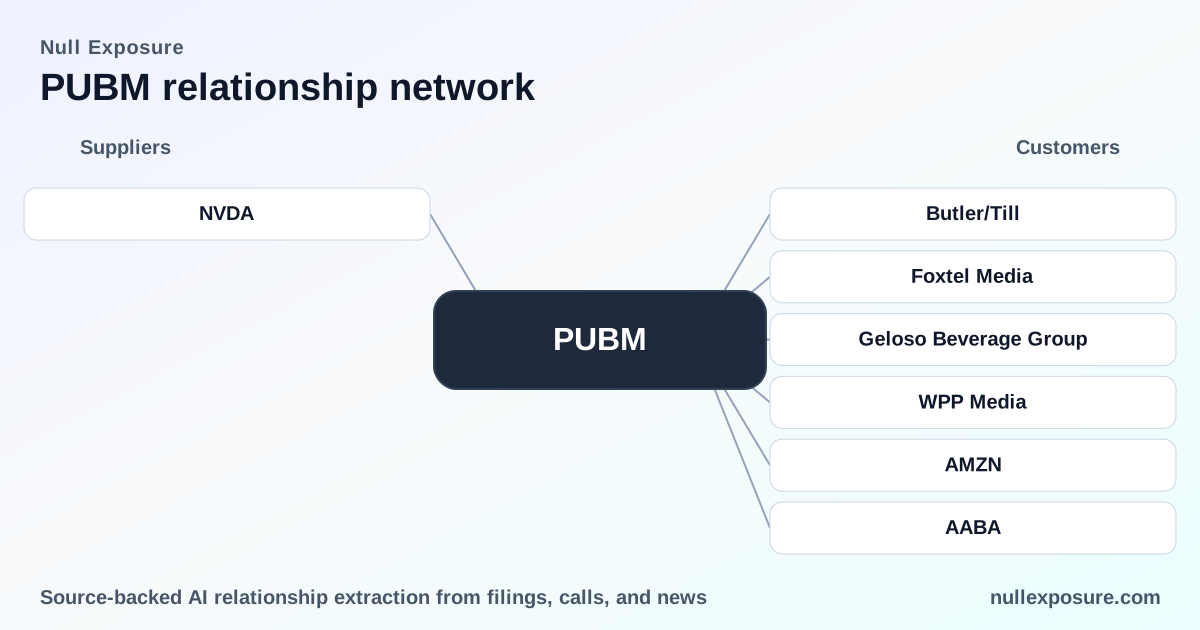
PubMatic’s customer map: commercial partners, product traction, and contract dynamics
PubMatic operates a real-time ad infrastructure platform that connects digital publishers and buyers, monetizing by charging fees—typically a percentage of ad impression value—on transactions executed through its proprietary software and hardware. The company’s growth narrative now centers on agent-driven advertising tools (AgenticOS) and expanded connected-TV and live-sports supply, which convert publisher inventory and partner integrations into recurring usage-based revenue. For an at-a-glance service view and additional research, visit https://nullexposure.com/.
How PubMatic captures value and what that says to investors
PubMatic sells infrastructure and services that enable publishers to monetize ad inventory and buyers to purchase inventory with transparency and control. Revenue is usage-based and invoiced monthly, which produces direct correlation between impression volume/pricing and top-line performance. Contracting posture is oriented to short-term, renewable agreements with termination flexibility; infrastructure ownership (software + hardware) reduces reliance on public cloud but increases capital intensity and operational responsibility. Concentration in large DSP relationships drives materiality of counterparties and amplifies revenue sensitivity to a few buyers' strategies.
The customer relationships that matter (what PubMatic said and what it means)
Below I cover each relationship documented in PubMatic's recent disclosures and reporting. Each entry is a concise, plain-English description with source context.
Foxtel Media
PubMatic named Foxtel Media as a launch partner for AgenticOS at CES, signaling publisher-level adoption of PubMatic’s agent-driven ad orchestration features. This positioning links Foxtel’s premium inventory with PubMatic’s automation product roadmap (PubMatic 2025 Q4 earnings call, first seen Mar 7, 2026).
Geloso Beverage Group
PubMatic partnered with Butler/Till and Geloso Beverage Group to run the industry’s first fully autonomous, end-to-end agentic campaign, demonstrating the platform’s ability to execute and optimize advertiser media plans without manual intervention (PubMatic 2025 Q4 earnings call, first seen Mar 7, 2026).
WPP Media
WPP Media was listed among AgenticOS launch partners at CES, reflecting agency-level endorsement and potential scale-through media-buying channels that feed PubMatic’s buyer-side usage (PubMatic 2025 Q4 earnings call, first seen Mar 7, 2026).
Butler/Till
Butler/Till served as the agency partner on the Geloso Beverage Group agentic campaign, illustrating how independent agencies are using PubMatic’s automation to run advertiser campaigns end-to-end (PubMatic 2025 Q4 earnings call, first seen Mar 7, 2026).
MNTN (Globe and Mail report)
MNTN announced a partnership with PubMatic to expand its Connected TV supply, which positions PubMatic as a supply partner in growing CTV monetization channels for advertisers seeking video and TV-style inventory (The Globe and Mail press release on MNTN, reporting FY2025 initiatives, reported Mar 2026).
Amazon / AMZN (earnings call references)
PubMatic stated it is one of three SSPs in Amazon’s Certified Supply Exchange program, a selective position that provides privileged access to Amazon buyer-seller flows and validates PubMatic’s role in large-scale supply chains (PubMatic 2025 Q4 earnings call, first seen Mar 7, 2026).
AMZN (duplicate entry)
The company reiterated the Certified Supply Exchange participation in the same earnings discussion, reinforcing that PubMatic holds an explicit, limited-supply placement alongside two other SSPs in Amazon’s program (PubMatic 2025 Q4 earnings call, first seen Mar 7, 2026).
MNTN (Investing.com transcript)
Separately, MNTN’s earnings discussion referenced the PubMatic partnership, confirming advertiser-side acknowledgment of the supply arrangement and underscoring PubMatic’s role in CTV inventory expansion (Investing.com earnings transcript on MNTN, noted May 2026).
Fubo (FUBO)
PubMatic’s Live Sports Marketplace, launched July 2025, included Fubo among publisher partners along with MLB, DirecTV, Spectrum Reach, and Roku, demonstrating traction in live-sports inventory where ad pricing and engagement metrics are premium (ppc.land coverage of Fubo app rebuild and PubMatic partnership, FY2026 reporting).
AABA
PubMatic cited co-founding the Ad Context Protocol with partners including Yahoo and LG Ad Solutions, establishing industry standards for safe agent-to-agent interaction—an interoperability and safety initiative that affects identity, context, and trust across buyer and publisher ecosystems (PubMatic 2025 Q4 earnings call, first seen Mar 7, 2026).
Yahoo
PubMatic explicitly named Yahoo as a co-founder of the Ad Context Protocol, signaling cross-industry governance alignment with a major publisher and platform player on agent interaction standards (PubMatic 2025 Q4 earnings call, first seen Mar 7, 2026).
Operating constraints and investor implications
The company-level signals embedded in PubMatic’s disclosures describe a predictable yet high-variance operating model:
- Short-term contracting posture: Agreements automatically renew on one-year cycles with short termination windows, which produces flexibility to reprice or reallocate inventory but also introduces revenue churn risk on annual renewal cadence.
- Usage-based monetization: Fees are a percentage of monetized impressions and invoices are monthly, producing tight linkage between ad volumes/pricing and cash flows—growth scales profitably but declines transmit quickly to the P&L.
- Counterparty concentration: Dependence on a limited set of large DSPs for a large share of purchased impressions creates material concentration risk; large buyers have bargaining power that can pressure pricing and volume.
- Counterparty breadth: Channel partners aggregate thousands of smaller publishers, insulating PubMatic from single-site exposure while diversifying inventory sources.
- Global footprint and omnichannel reach: PubMatic serves roughly 1,900 publishers worldwide (outside China) across mobile, desktop, video, OTT/CTV and more, creating geographic diversification but also operational complexity.
- Role duality: PubMatic functions as both an infrastructure service provider and a platform that gives buyers control and transparency—this duality increases product stickiness but requires continuous product investment.
- Active-stage relationships: The company generates revenue from ongoing platform usage rather than one-off projects, pointing to recurring, usage-tied cash flows.
- Infrastructure ownership: Owning software and hardware globally reduces reliance on public cloud but increases capital and maintenance demands; the business sits at the intersection of software margins and hardware operational scaling.
Investor takeaway: PubMatic’s model combines high operating leverage on impressions with concentrated buyer dependencies; success depends on continued traffic growth, CTV/live-sports monetization, and retention of large DSP relationships.
Bottom line and next steps for diligence
PubMatic has converted product innovation (AgenticOS, Live Sports Marketplace) into named launch partners across publishers, agencies, and platforms, validating commercial traction. However, usage-based invoicing and buyer concentration are principal risk drivers that require monitoring in quarterly results and partner announcements. For deeper signals on customer expansion or churn and to track new partner formations, continue to follow PubMatic’s earnings commentary and industry press—our platform aggregates these shifts for active investors. Learn more at https://nullexposure.com/.
If you want an investor-focused briefing that ties these relationship disclosures to revenue scenarios and risk-adjusted valuation drivers, reach out through the site and we’ll prepare a targeted note.