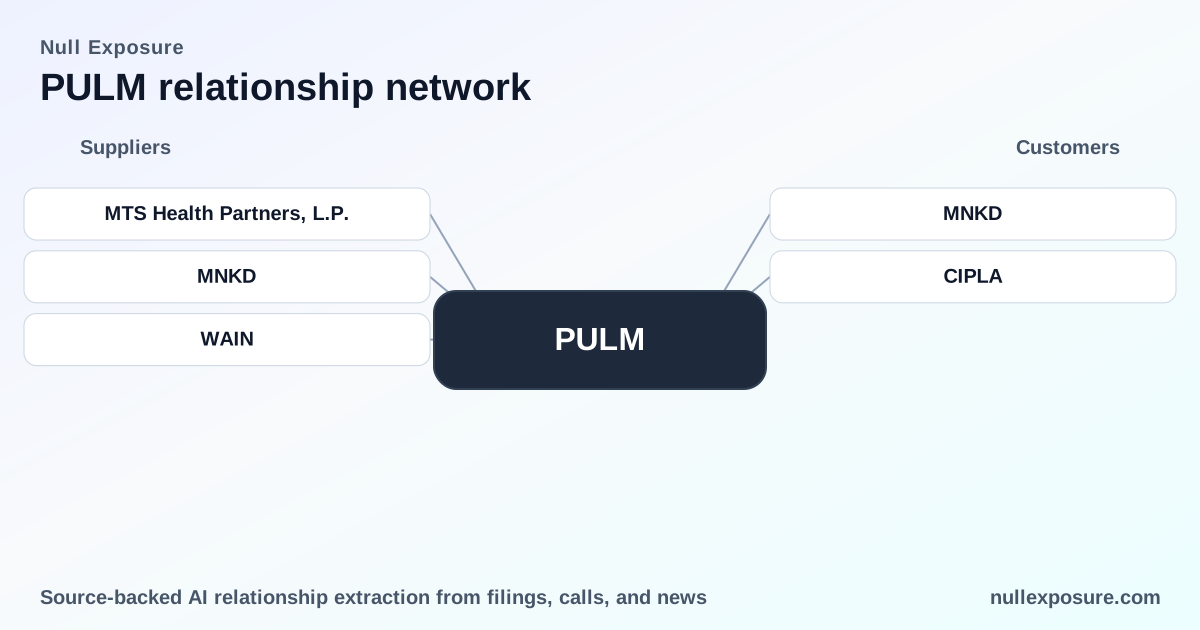
Pulmatrix (PULM): Licensing relationships are the company’s primary value pipeline
Pulmatrix is a clinical-stage biopharmaceutical company that monetizes chiefly by licensing its inhaled delivery technology (iSPERSE™) and partnering product rights (notably PUR1900). With negligible product revenue and a market capitalization in the single-digit millions, Pulmatrix’s near-term value depends on upfront payments, milestone receipts and low-percentage royalties from partner commercialization outside the United States. For investors and operators, the core question is whether partner execution — and Pulmatrix’s retained control over its iSPERSE platform — can convert contingent royalties into material cash flow. Learn more at https://nullexposure.com/.
Short investor thesis: licensing, royalties and concentration drive outcomes
Pulmatrix controls an engineered dry-powder inhalation platform (iSPERSE) and has contracted out development and commercialization of specific product candidates. Revenue today is essentially partner-derived or contingent; the firm recorded minimal TTM revenue and negative profitability metrics, so license economics and partner progress determine the value trajectory. Management has pursued asset divestments and strategic alternatives to preserve cash while preserving the iSPERSE core.
Who Pulmatrix is working with — concise relationship ledger
Cipla (CIPLA)
Pulmatrix granted Cipla exclusive rights to develop and commercialize PUR1900 in territories outside the United States and received a non‑refundable upfront payment (documented at $22.0 million under the Cipla Agreement); in addition, Pulmatrix is entitled to 2% royalties on any future net sales by Cipla outside the U.S. Source: company filings and disclosures summarized in the company’s PR release and FY2026 reporting (PR Newswire, Mar 2, 2026; Finviz FY2026 report, Mar 10, 2026).
MannKind Corporation (MNKD)
Pulmatrix has out‑licensed its iSPERSE™ platform to MannKind for specified fields of use, including exclusive and non‑exclusive licenses across formulations such as clofazimine and insulin and for certain pulmonary and endocrine indications. The agreement positions MannKind to develop iSPERSE-enabled products while Pulmatrix retains the core technology rights outside those assigned fields. Source: company statements in FY2026 press materials and the PR Newswire release (Mar 2, 2026).
What the relationships mean for Pulmatrix’s operating model
- Contracting posture: licensing-first. Pulmatrix’s business model is built on granting targeted licenses of technology and product rights rather than vertically integrating commercialization. The Cipla Agreement included a substantial upfront assignment of pulmonary-related assets in exchange for cash and royalties, demonstrating an explicit trade of near-term capital for downstream contingent upside (company filing, Marketscreener / 10‑Q disclosures, FY2025/FY2026).
- Counterparty concentration is high. The company’s commercial exposure is concentrated across a very small set of large partners — Cipla and MannKind are the visible counterparties — which compresses diversification and increases reliance on each partner’s development and regulatory success.
- Criticality of the iSPERSE platform. Pulmatrix has deliberately retained core iSPERSE™ IP while assigning product-specific regulatory dossiers and assets for pulmonary indications, preserving the technology as its primary monetizable asset and allowing repeated licensing across molecules and partners.
- Maturity and cash profile: partner-driven. Pulmatrix is clinical-stage with minimal product revenue and negative operating margins; upfront payments, royalty rates and milestone timing are the principal levers for short- to medium-term cash generation, not internal product sales. This posture explains recent strategic actions to divest or restructure assets and to pursue mergers or alternatives (PR Newswire, Mar 2026).
Constraints and explicit contract signals (what’s documented)
- Contract type: licensing — Company disclosures record a non‑refundable upfront payment under the Cipla Agreement and assignment of pulmonary assets to Cipla while excluding most specifically the iSPERSE technology; this is a direct signal that Pulmatrix’s monetization is license‑driven and structured to deliver immediate cash in exchange for territory and asset rights (evidence cited in company filings: Cipla Agreement disclosure).
- Relationship role: licensee / out‑license arrangements — Pulmatrix has granted MannKind exclusive and non‑exclusive licenses to develop, manufacture and commercialize certain iSPERSE formulations across indicated fields, identifying MannKind as an out-licensee for specific assets and fields of use (Cross License Agreement excerpts).
Both constraints are explicit in public disclosures and underline a deliberate, asset-light commercial model: Pulmatrix trades geography- and product-specific rights for immediate capital while keeping the platform IP to license further.
Explore detailed partner disclosures and structured summaries at https://nullexposure.com/.
Risk / reward profile for investors
- Upside:
- Low-cost optionality via royalties: contracts include downstream royalty percentages—though modest (e.g., 2% on Cipla sales outside the U.S.)—that can scale if a partner achieves commercial success.
- Platform leverage: retaining iSPERSE allows recurring licensing opportunities across molecules and partners, offering multiple future value paths beyond a single product.
- Key risks:
- Execution dependency on partners. With limited internal commercial capability and negligible current revenue, Pulmatrix’s valuation hinges on partner clinical progress and regulatory approvals outside the U.S.
- Concentration and low royalty rates. Reliance on a small number of partners and single-digit royalties compresses upside and increases binary outcome risk.
- Financial fragility. Public filings show minimal TTM revenue and negative profitability, necessitating continued strategic transactions or partner receipts to fund operations.
Bottom line — what investors and operators should watch next
Pulmatrix is not a traditional product commercialization company today; it is a platform licensor whose near-term value is contingent on partner execution and the timing of milestone/royalty receipts. Key catalysts include phase‑3 execution by Cipla in sanctioned territories, any licensing expansion of iSPERSE into new molecules or fields through MannKind or others, and management’s success in monetizing non-core assets while protecting platform IP. For investors focused on asymmetric upside, the combination of a retained platform and partner-funded development is attractive, but counterparty concentration and modest royalty economics make investment outcomes binary.
For an operator or corporate development professional, the takeaway is clear: acquiring or partnering for platform rights like iSPERSE requires a disciplined structuring of upfront, milestone and royalty terms to balance near-term funding against long-term platform value.
If you want structured, relationship‑level intelligence and repeatable reports on Pulmatrix’s partner economics, visit https://nullexposure.com/ for full coverage and next‑step research.