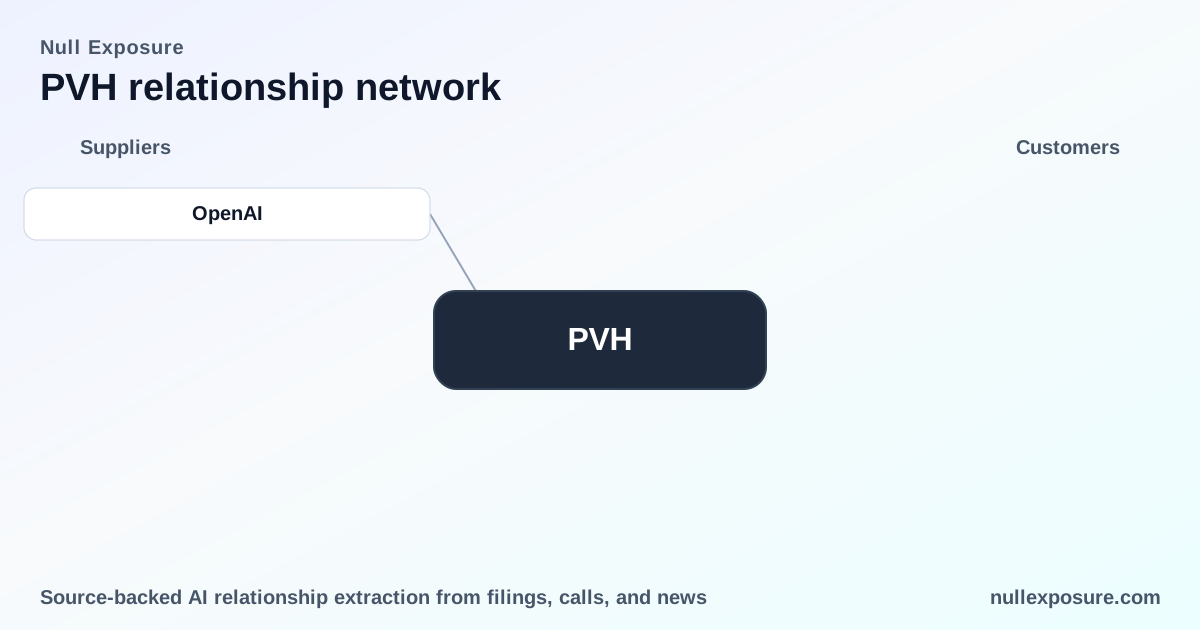
PVH’s customer footprint: licensing, wholesale and the practical implications for investors
PVH Corp. runs two global lifestyle powerbrands — Tommy Hilfiger and Calvin Klein — and monetizes through retail, wholesale distribution and trademark licensing, generating revenue from goods sold and royalties on licensed uses of its trademarks. Investors should evaluate PVH not just on brand strength but on the commercial relationships that govern distribution and licensing revenue, where long‑term license agreements and a globally diversified wholesale footprint shape growth, margin and risk. For a concise data-driven view of PVH customer linkages, visit https://nullexposure.com/.
The operating model that drives customer economics
PVH’s commercial model is hybrid: core product sales through company‑operated stores and wholesale channels sit alongside royalty and advertising income from licenses. Wholesale revenues are recognized when control of goods transfers to the customer; licensing revenues are recognized over time as trademarks are exploited. The company operates globally — North America, EMEA, APAC and LATAM — and reported more than 65% of revenue outside the U.S. in recent years, which makes its customer base geographically diversified.
Key business model characteristics you should treat as structural signals:
- Contracting posture: Licensing relationships are typically long‑term, exclusive to territory or product category, and include renewal options — PVH recognizes royalties and advertising revenue over time under these agreements.
- Concentration and criticality: No single customer accounted for more than 5% of PVH revenue, but the five largest customers represented roughly 15% of sales in 2024; that pattern creates moderate concentration risk without single‑counterparty dependency.
- Channel mix and role: PVH sells as a seller/producer to a broad set of buyers, distributors and licensees; wholesale distribution and distributor networks are important routes to market, particularly outside North America.
Who’s buying and licensing PVH brands right now
Below I cover every counterparty flagged in the available intelligence and what each relationship concretely signifies for PVH’s revenue and risk profile.
G‑III Apparel Group (GIII)
G‑III historically licensed Calvin Klein and Tommy Hilfiger product lines; the recent contractual transition reversed that flow and drove an estimated $254 million sales impact for G‑III in FY2026 as PVH reclaimed those licenses and G‑III shifted emphasis to owned brands. According to G‑III’s FY2026 results and related press releases, the loss of PVH licenses is a material near‑term headwind to G‑III’s wholesale volumes and revenue mix. (See G‑III FY2026 press release via GlobeNewswire, March 12, 2026: https://www.globenewswire.com/news-release/2026/03/12/3254455/0/en/g-iii-apparel-group-ltd-reports-fourth-quarter-and-full-year-fiscal-2026-results-provides-fiscal-2027-outlook.html)
Movado Group Inc. (MOV)
Movado operates watch and accessories divisions and holds licenses for multiple fashion names, including Calvin Klein; recent reporting indicates Movado extended its Calvin Klein license, signaling continuity in market access for PVH’s trademark as a royalty source. Movado’s license extension underscores PVH’s ability to monetize trademarks through third‑party licensees in accessory categories. (See coverage noting Movado’s extension of the Calvin Klein license and related analyst commentary, MarketBeat / TipRanks summary, January–April 2026: https://www.marketbeat.com/instant-alerts/movado-group-nysemov-upgraded-to-hold-at-zacks-research-2026-01-28/)
How to read these relationships collectively
The G‑III and Movado items in the coverage illustrate two distinct commercial truths for PVH:
- Licensing is a meaningful but managed revenue stream. License roll‑offs such as the transition of Calvin Klein and Tommy Hilfiger back from third parties to PVH change the mix between lower‑margin licensed revenue and higher‑margin owned/retail sales. G‑III’s reported $254 million impact demonstrates that license transitions have measurable P&L effects on counterparties and on PVH’s royalty pipeline.
- PVH controls brand access and can redeploy channels. By reclaiming licenses or renewing third‑party deals, PVH can shift where and how its trademarks are monetized — directly through company stores or indirectly via licensees and distributors — allowing the company to manage margin and brand positioning at scale.
Operational constraints investors must model (company‑level signals)
Use these constraints as part of scenario design when modeling PVH customer exposure and cash flow sensitivity:
- Licensing contracts are typically long‑term and exclusive to territories or categories and usually include renewal options, which implies predictable royalty streams but also contractual inflexibility when strategic pivots are required.
- Revenue recognition and contract maturity: PVH recognizes licensing revenue over time — this produces steady royalty cash flow but makes near‑term P&L sensitive to contract renewals and terminations.
- Global channel exposure: PVH operates hundreds of company stores and thousands of distribution and concession points across NA, EMEA, APAC and LATAM; geographic diversification reduces single‑market risk but increases exposure to currency and regional retail cycles.
- Customer concentration is moderate: No single customer exceeds 5% of revenue (an immaterial single‑customer profile), yet the top five customers collectively represent a meaningful share (~15%), which can influence negotiating leverage and working capital dynamics.
Risks that directly affect the customer ledger
- License roll‑offs compress short‑term wholesale sales for former licensees and require PVH to manage channel substitution without diluting brand value.
- Distribution dependency in particular markets means payables, receivables and inventory flow decisions at large wholesale partners will affect PVH’s cash conversion cycle.
- Geographic exposure means macro shocks in Europe, APAC or LATAM can materially move reported revenue given that >65% of sales occur outside the U.S.
What to watch next and investor actions
Monitor PVH’s public disclosures and partner notices for: (1) license renewal cadence and terms, (2) channel migration plans when licenses are repatriated, and (3) changes in the composition of the top five customers. These items will determine whether license recapture translates into higher margin owned sales or simply redeploys revenue to lower‑margin channels.
For a structured view of PVH customer linkages and to integrate these relationship signals into portfolio models, visit https://nullexposure.com/ for the full analytical toolkit.
Bold takeaway: PVH’s customer relationships are strategically controllable — licensing gives the company levers to shape margins and distribution — but transitions create measurable near‑term revenue volatility that investors must model explicitly.