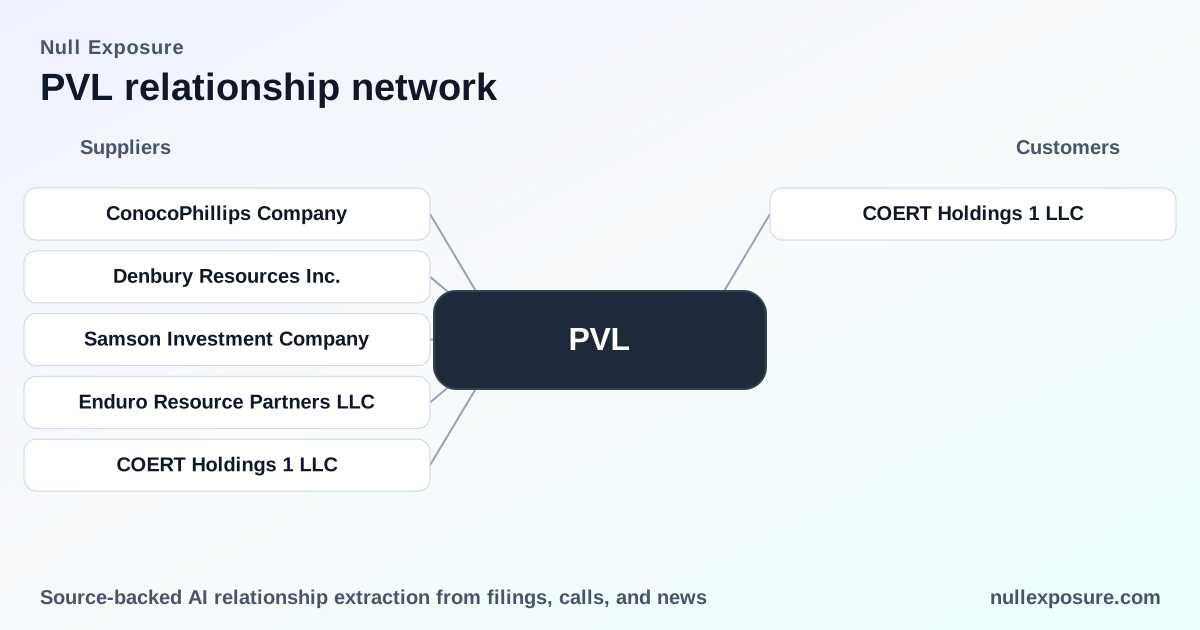
Permianville Royalty Trust (PVL): a compact royalty vehicle with concentrated cash-flow drivers
Permianville Royalty Trust collects royalty and net-profits interests from oil and gas production in the Permian Basin, receives cash from producing operators and third‑party purchasers, and distributes that cash to unitholders on a monthly basis. The trust’s monetization is straightforward: it does not operate wells — it relies on sponsor receipts and downstream purchasers for cash, and those receipts directly determine monthly distributions to investors. For investors and operators evaluating PVL customer relationships, the key questions are concentration of receivables, short-term contracting on commodity offtake, and sponsor‑to‑trust cash transfer mechanics.
Learn more about how we catalogue commercial relationships at Null Exposure: https://nullexposure.com/
How PVL’s business model works in practice — a pass‑through royalty with concentrated counterparty exposure
PVL is a legal trust that captures production economics without upstream operating risk, but that structure creates a different form of counterparty risk: the trust’s revenue depends on cash flows actually received from the sponsor and the third‑party purchasers who buy oil and gas from the underlying properties. The company’s filings and public distributions make this explicit: monthly cash distributions are calculated largely on the cash the trust receives or expects to receive from the sponsor for the period, so the trust is effectively a cash‑flow pass‑through vehicle whose payout mechanics are driven by operator and purchaser behavior (press releases, March 2026).
Key high‑level investors’ takeaways:
- High payout leverage: Distributions track receipts rather than accruals, so volatility in receipts translates directly into distributions.
- Concentrated counterparty risk: A small number of purchasers account for material portions of revenue (company disclosures).
- Limited contractual insulation: Sales are conducted on short‑term terms (month‑to‑month for natural gas), which increases exposure to near‑term market and operational shocks.
The relationship evidence — what the sources show
COERT Holdings 1 LLC — press release (March 2026, entry 1)
Permianville’s disclosure states that the anticipated monthly distribution is based in large part on cash received or expected to be received by the Trust from the Sponsor with respect to the period, a construct that connects PVL’s distribution to sponsor cash transfers rather than an independent receivable ledger. (Press release on The Globe and Mail, March 10, 2026: https://www.theglobeandmail.com/investing/markets/stocks/PVL-N/pressreleases/36168788/permianville-royalty-trust-announces-monthly-cash-distribution/)
COERT Holdings 1 LLC — press release (March 2026, entry 2)
A second PVL press release reiterates the mechanics: monthly distributions reflect the cash the trust has received or expects from the sponsor for the relevant period, reinforcing that sponsor cash flows are the proximate determinant of investor payouts. (Press release on The Globe and Mail, March 2026: https://www.theglobeandmail.com/investing/markets/stocks/PVL/pressreleases/34901423/permianville-royalty-trust-announces-monthly-cash-distribution/)
Operational constraints and what they signal for future cash flow durability
The disclosures include three explicit constraint signals that describe PVL’s operating posture and commercial risk profile:
- Contracting posture — short‑term: Natural gas sales are executed under month‑to‑month secondary terms. This low contract tenure increases cash‑flow volatility and gives purchasers significant short‑term leverage over pricing and acceptance. (Company disclosure excerpt on monthly terms.)
- Geography — U.S. centric: The trust’s operators sell oil and gas to third‑party purchasers in the United States, meaning market, regulatory and takeaway constraints are domestic and concentrated in U.S. midstream and Permian logistics. (Company disclosure excerpt.)
- Materiality — concentrated purchasers: Disclosures identify purchasers that individually accounted for 10% or more of sales included in trust income calculations, indicating meaningful counterparty concentration that can swing trust income if a major purchaser alters volumes or payment timing.
Taken together, these constraints describe a mature, pass‑through royalty business with concentrated counterparties and short contracting windows, where the trust’s payout profile is governed more by counterparties’ commercial behavior than by operational control.
What the ownership and capital structure data add to the picture
PVL is a small‑cap trust (market capitalization roughly $63 million) with material insider ownership (27.6%) and limited institutional participation (14.4%), signaling a concentrated ownership base and potentially lower institutional liquidity. The trust yields roughly 6.3% on reported dividends and reports high operating margin metrics, consistent with a royalty vehicle that retains minimal operating costs while passing most cash through to holders. Use these data points to calibrate liquidity and governance expectations when assessing counterparty risk or negotiating commercial terms. (Company overview, latest reported metrics through FY2025/2026.)
Investment implications — what operators and investors should prioritize
- Counterparty concentration is the single largest commercial risk. If one or more purchasers that historically represented ≥10% of sales reduce volumes or delay payments, distributions will be reduced immediately because of PVL’s cash‑receipt distribution rule.
- Short‑term offtake contracts increase sensitivity to price and logistics swings. Operators should evaluate midstream and local pricing spreads that could compress cash flows in months with adverse transport or pricing events.
- Sponsor transfer mechanics are critical. Because distributions are based on cash received or expected from the sponsor, governance around sponsor remittance timing and any intercompany prioritization will determine realized yield for unitholders.
- Concentrated ownership can be a mixed signal. High insider ownership aligns management incentives with distributions, but limited institutional ownership can reduce oversight and secondary liquidity.
Practical next steps for investors and operators
- Review the sponsor’s cash‑remittance history and any published timing commitments before underwriting yield expectations.
- Stress‑test distributions under scenarios where one large purchaser reduces volumes by 25–50% for a multi‑month period.
- Monitor monthly distribution press releases and purchaser tables closely for shifts in concentration.
For a deeper view of PVL’s commercial links and how we structure customer intelligence for investors, visit Null Exposure: https://nullexposure.com/
Bottom line
Permianville Royalty Trust delivers a transparent, high‑leverage income profile tied to third‑party purchaser behavior and sponsor cash transfers. The trust’s short‑term contracting and concentrated purchaser base are the dominant commercial risks that will determine distribution volatility and yield reliability. Investors and operators should prioritize counterparty monitoring and sponsor remittance practices when assessing PVL’s cash‑flow durability.