Power REIT (PW): Tenant Concentration Defines the Investment Case
Power REIT operates as a small, specialized REIT that monetizes ownership of infrastructure-linked real estate through long-term net leases and rental agreements across transportation, renewable energy, and controlled-environment agriculture (CEA) properties. The firm's cash flow profile is highly concentrated — three tenants generated roughly 88% of consolidated revenue in FY2024 — and the business model depends on durable lease contracts (including century-scale arrangements) and a portfolio-level strategy of monetizing real assets. For a concise, investor-focused view of Power REIT’s customer relationships, see NullExposure’s coverage: https://nullexposure.com/.
Big-picture thesis: concentrated, contract-heavy revenues with operational fragility
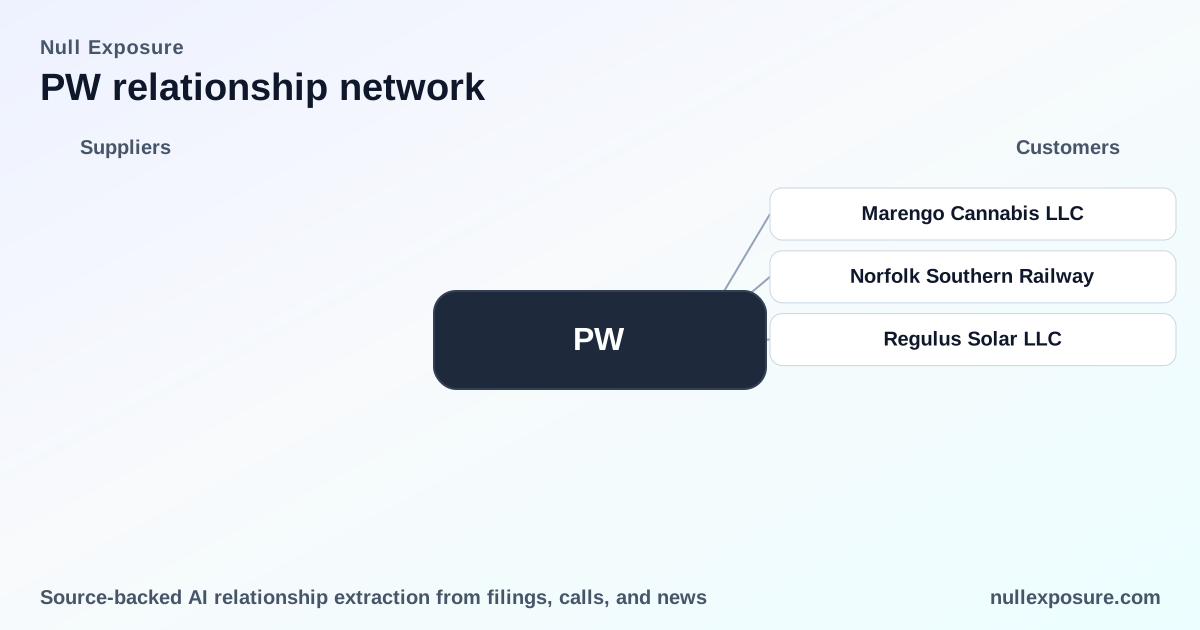
Power REIT’s operating model is defined by high revenue concentration, long-duration contracts, and infrastructure-oriented assets located in the U.S. According to Power REIT’s 2024 Form 10‑K, three tenants — Norfolk Southern Railway, Regulus Solar LLC, and Marengo Cannabis LLC — accounted for approximately 32%, 28% and 28% of consolidated revenue, respectively, representing ~88% of the year’s revenue (FY2024 Form 10‑K). This concentration converts asset ownership into a single counterparty exposure: the REIT collects lease and rental income from a handful of counterparties rather than a broad tenant base.
Contract posture is structurally defensive but concentrated. The company’s disclosures show long-term leases: the Railroad Lease with Norfolk Southern originated as a 99-year lease (with automatic renewal options) and the company’s renewable-energy and CEA properties include multi-decade agreements and a 20-year triple-net lease for a Nebraska asset that starts at roughly $1.0 million annually after a deferred period (10‑K excerpts). Those long-duration contracts underpin stable cash-flow assumptions when tenants perform, but they also amplify counterparty risk if a major tenant defaults.
Power REIT’s footprint is U.S.-centric, focused on transportation and energy infrastructure plus CEA, which concentrates idiosyncratic operational risk into a few property types and geographies (10‑K, FY2024).
Customer relationships — who the company names and what that tells investors
Below I list every named relationship from the public results and summarize what each means in plain English, with source context.
Marengo Cannabis LLC
Marengo Cannabis accounted for approximately 28% of Power REIT’s consolidated revenue in FY2024, representing a material revenue stream concentrated on a single CEA tenant. According to Power REIT’s 2024 Form 10‑K, Marengo is one of the three tenants producing the bulk of revenue (FY2024 10‑K).
Norfolk Southern Railway (Railroad Lease)
Norfolk Southern provided roughly 32% of consolidated revenue in FY2024 and occupies railroad assets under an historical long-term lease arrangement; the company still collects substantial annual base rent (FY2024 10‑K). The 10‑K describes a 99‑year Railroad Lease originally effective in 1964, renewable in perpetuity under the same terms.
Regulus Solar LLC
Regulus Solar represented roughly 28% of revenue in FY2024 through an approximately 82 MW utility-scale solar farm lease on ~447 acres in Kern County, California; the entity is a wholly owned subsidiary (PWRS) that produces stable, contracted rental income tied to energy infrastructure (FY2024 10‑K).
Canndescent
Canndescent leased a greenhouse asset and paid just over $1 million annually under that arrangement, according to a media report at the time of the acquisition in 2021; this tenant is an example of the CEA strategy Power REIT pursued (MJBizDaily, 2021 news report on Power REIT acquisition).
Norfolk Southern (TradingView news note)
A TradingView news summary (May 2026) reiterated that rental and lease income were primarily derived from Norfolk Southern and Regulus Solar, underscoring the prominence of the railroad tenant in subsequent commentary (TradingView news, May 2026). This entry mirrors the 10‑K disclosure and was captured as a separate news-sentiment mention.
Regulus Solar (TradingView news note)
A parallel TradingView summary (May 2026) highlighted Regulus Solar as a primary rent source alongside Norfolk Southern, reflecting public market reporting of the same concentration captured in the 10‑K (TradingView news, May 2026).
Constraints and what they reveal about the operating model
Power REIT’s public disclosures and extracted constraints point to several structural signals investors must weigh:
- Contracting posture — predominantly long-term: The portfolio includes multi-decade to century-length leases (for example, the Railroad Lease’s 99‑year term and a 20‑year triple-net lease cited in the 10‑K). These contracts create durable cash flow when performing but concentrate counterparty dependency.
- Concentration — extremely high: Roughly 88% of revenue from three tenants signals severe single-counterparty risk; loss or nonpayment from one tenant meaningfully moves top-line performance (10‑K, FY2024).
- Criticality and materiality — revenue-critical tenants: The three tenants are material to consolidated performance, a classification the company itself supports in filing language.
- Maturity and stability — mixed: Leases are long-dated on paper, but CEA operations show operational stress — filings disclose vacancies and tenant defaults in the CEA portfolio that have materially impaired income from those assets.
- Geography and segment concentration — U.S. infrastructure focus: The company’s assets are domestic and concentrated in transportation, energy infrastructure, and CEA (10‑K).
- Spend-band signal — meaningful single-tenant cashflows: Norfolk Southern’s base rent for the railroad assets is disclosed at $915,000 per year, while other leases (e.g., regulated solar and CEA rents) fall in the mid-six- to low-seven-figure band, indicating material single-tenant revenue lines.
Note: where a constraint excerpt names a specific tenant (for example Norfolk Southern or PWRS/Regulus), that linkage is reported directly from the filing.
Operational risks and strategic implications for investors and operators
- Tenant concentration is the primary risk: With three tenants delivering ~88% of revenue, Power REIT’s valuation and liquidity profile are tightly coupled to these counterparties’ payment performance and operational continuity (FY2024 10‑K).
- CEA portfolio fragility reduces diversification benefits: Filings document vacant and defaulted CEA properties, which means the theoretical diversification across segments has not translated into cash diversification in practice.
- Lease terms are both a strength and a vulnerability: Long-term, fixed or inflation-indexed cash flows from railroad and solar leases support valuation stability, yet long-term contracts lock in revenue to a few counterparties and reduce the company’s ability to reprice or redeploy assets quickly.
- Size and market profile amplify execution risk: Power REIT’s small market capitalization and low institutional ownership heighten sensitivity to idiosyncratic shocks and limit capital market access during stress.
What to watch next — catalysts and monitoring checklist
- Lease payment trends and any missed payments from the three largest tenants, especially Norfolk Southern and Regulus Solar.
- Progress on re-leasing or monetizing vacant CEA properties and any updates on tenant defaults or cures disclosed in quarterly filings.
- Asset sales, recapitalizations, or opportunistic transactions intended to de‑risk the tenant concentration.
- Any change in the long-term Railroad Lease terms or material legal developments related to P&WV’s historic lease.
For a focused investor view and ongoing updates on these tenant exposures, see NullExposure’s dedicated coverage: https://nullexposure.com/.
Conclusion Power REIT’s investment thesis is simple and binary: durable, contract-backed cash flow from infrastructure assets vs. very high counterparty concentration and operational risk in CEA. Valuation and downside are dominated by tenant performance and the company’s ability to remediate vacant CEA assets or diversify its rent roll. Investors and operators should evaluate contractual protections, covenant strength, and the pace at which management can replace or rectify underperforming tenants when assessing risk-adjusted upside.