Power REIT (PW‑P‑A): Preferred Income Backed by Cannabis Greenhouse Leases
Power REIT monetizes a niche real‑estate strategy by acquiring greenhouse and cultivation properties and leasing them to commercial growers; the PW‑P‑A security is a 7.75% cumulative perpetual preferred that delivers predictable cash yield to investors while gaining indirect exposure to the legal cannabis cultivation sector. Power REIT’s model is cash‑flow driven — acquire or recapitalize specialized properties, sign long‑duration leases with operating tenants, and distribute stable preferred dividends to holders.
If you want a concise dossier for institutional due diligence, start with the tenant map and lease cadence below. For an on‑demand briefing and ongoing relationship monitoring, visit https://nullexposure.com/.
Why the revenue model is straightforward and what underpins the yield
Power REIT’s revenue comes from rental income on purpose‑built cultivation assets. The preferred certificate PW‑P‑A converts that operating cash flow profile into a fixed income instrument: fixed 7.75% coupon, cumulative, perpetual structure. That combination targets investors who prioritize steady dividends over appreciation upside.
- Driver: Long‑term leases on specialized assets create durable cash flow streams that underwrite preferred dividends.
- Risk: Tenant concentration and the regulatory profile of cannabis cultivation amplify counterparty and legal/regulatory risk relative to a diversified office or industrial REIT.
- Transparency gap: Public financial metrics are sparse for this security (many headline fields are blank), increasing the importance of tenant‑level due diligence and lease docs when sizing exposure.
For a regular pipeline of tenant and lease intelligence tailored to preferred‑security investors, see https://nullexposure.com/.
What we know about tenant relationships — the concrete leasing evidence
Below are every customer relationship surfaced in the source collection, each summarized in plain English with its originating citation.
Canndescent — paying roughly $1.0M+ in annual rent for a greenhouse
Canndescent leases a greenhouse in Santa Barbara and pays a little more than $1 million in annual rent to use the facility, an explicit rent figure cited in press coverage. According to MJBizDaily (May 3, 2026), this tenancy is an active commercial lease generating seven‑figure annual rent. Source: MJBizDaily article on Power REIT’s greenhouse acquisition (May 3, 2026) — https://mjbizdaily.com/news/power-reit-acquires-canndescent-cannabis-greenhouse-for-7-7-million/240269/.
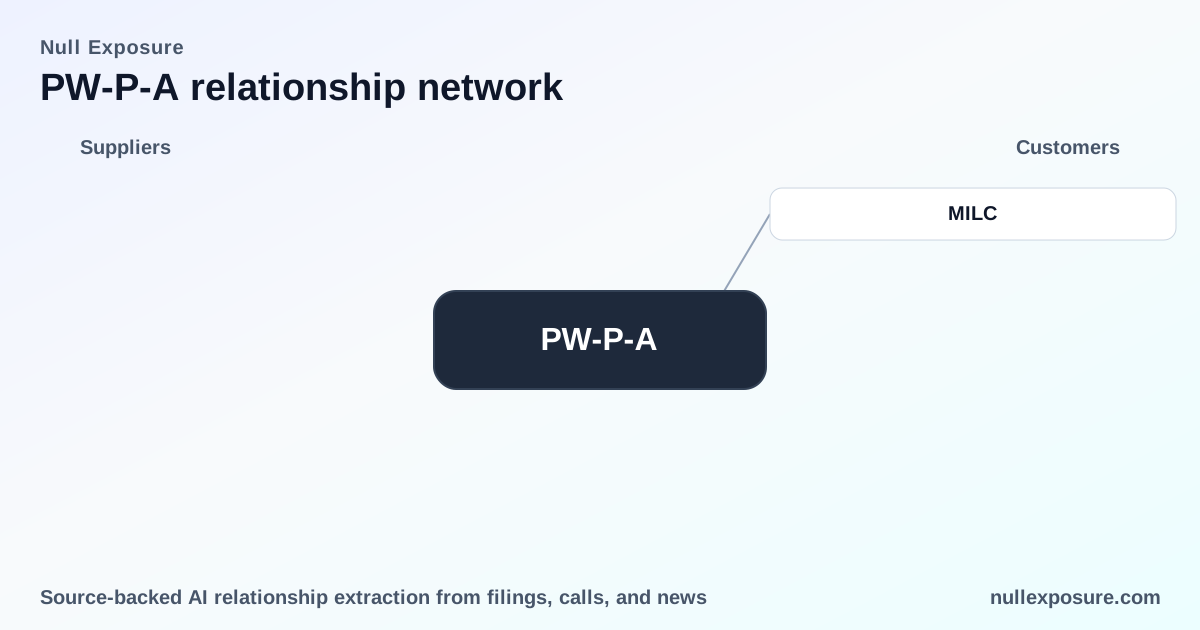
MILC (Millennium Sustainable Ventures Corp) — tenant entity tied to a 1.1 million sq ft greenhouse lease
A subsidiary of Millennium Sustainable Ventures Corp executed a long‑term lease for an approximately 1.1 million square foot greenhouse in O’Neill, Nebraska that Power REIT acquired; the release frames the lease as part of the property’s handover to an operating tenant. GlobeNewswire reported on April 1, 2022 that Millennium Produce of Nebraska LLC entered into the lease upon acquisition by Power REIT. Source: GlobeNewswire press release (April 1, 2022) — https://www.globenewswire.com/news-release/2022/04/01/2415045/0/en/Millennium-Sustainable-Ventures-Corp-Announces-Expansion-of-its-Footprint-with-a-1-1-million-square-foot-Greenhouse-Facility.html.
Millennium Produce of Nebraska LLC — the operating lessee for the O’Neill facility
Millennium Produce of Nebraska LLC, a subsidiary referenced in the GlobeNewswire release, is the named lessee that executed the long‑term lease for the O’Neill greenhouse facility following Power REIT’s acquisition of the property. This identifies the operator that will generate the lease cash flows tied to that asset. Source: GlobeNewswire press release (April 1, 2022) — https://www.globenewswire.com/news-release/2022/04/01/2415045/0/en/Millennium-Sustainable-Ventures-Corp-Announces-Expansion-of-its-Footprint-with-a-1-1-million-square-foot-Greenhouse-Facility.html.
Company‑level operating and business model signals (constraints and characteristics)
The source set does not include a formal constraint log, so treat these as company‑level operational signals derived from the available lease disclosures and public commentary:
- Contracting posture — long‑dated lease emphasis. Public filings and press releases reference long‑term leases for specialized greenhouse properties, indicating Power REIT’s preference for durable contractual cash flows rather than short‑term tenancy turnover.
- Concentration — small number of large, specialized tenants. The identified customer list is concentrated (few named tenants), which concentrates counterparty risk but also simplifies lessee monitoring.
- Criticality — tenants are operationally essential to asset value. Tenants are commercial cultivators operating the greenhouse; their operational success is critical to property cash flows and, by extension, to preferred dividend coverage.
- Maturity — portfolio growth through targeted acquisitions. The O’Neill acquisition and related long‑term lease point to an acquisitive posture and portfolio maturation through large greenhouse additions in FY2022.
These signals collectively define a high‑income, asset‑specialized REIT posture: stable but concentrated cash flows that depend on a regulated end‑market’s continuity.
Investment implications investors and operators should prioritize
Power REIT’s PW‑P‑A preferred provides high current yield with the dividend structure designed for income investors. Key considerations:
- Yield profile: The fixed 7.75% coupon is the core investment rationale for preferred holders seeking income.
- Cash‑flow underwriters: Lease terms and tenant credit are the primary underwriters of dividend stability — documented long‑term leases increase reliability.
- Counterparty concentration: A short list of large tenants elevates counterparty risk; investors should require lease files, rent rolls, and tenant financials to size exposure.
- Sector/regulatory risk: Tenants operate in the regulated cannabis market, which imposes jurisdictional and compliance complexity that affects valuation and exit options.
- Market price dispersion: The preferred’s trading range (52‑week high/low: 9.90 / 3.15) shows meaningful volatility; preferred income investors should assess total return vs. yield capture. (Source: company overview fields.)
Top‑line decision drivers for investors: lease duration and tenant credit, regulatory jurisdiction, and concentration control. Operators evaluating counterparty risk should focus on operational KPIs from the lessees and covenant strength in lease agreements.
Bottom line and next steps
Power REIT packages specialized cultivation real estate cash flows into a high‑coupon, cumulative preferred security that suits income‑oriented portfolios seeking cannabis exposure through real estate. The asset base is lease‑driven and concentrated, which creates both yield attraction and single‑tenant sensitivity. For institutional investors, the priority is granular lease and tenant diligence — rent amounts, lease length, security, and tenant operating performance determine dividend resilience.
For a focused monitoring playbook and ongoing tenant‑level intelligence, visit https://nullexposure.com/ to subscribe to updates and research.