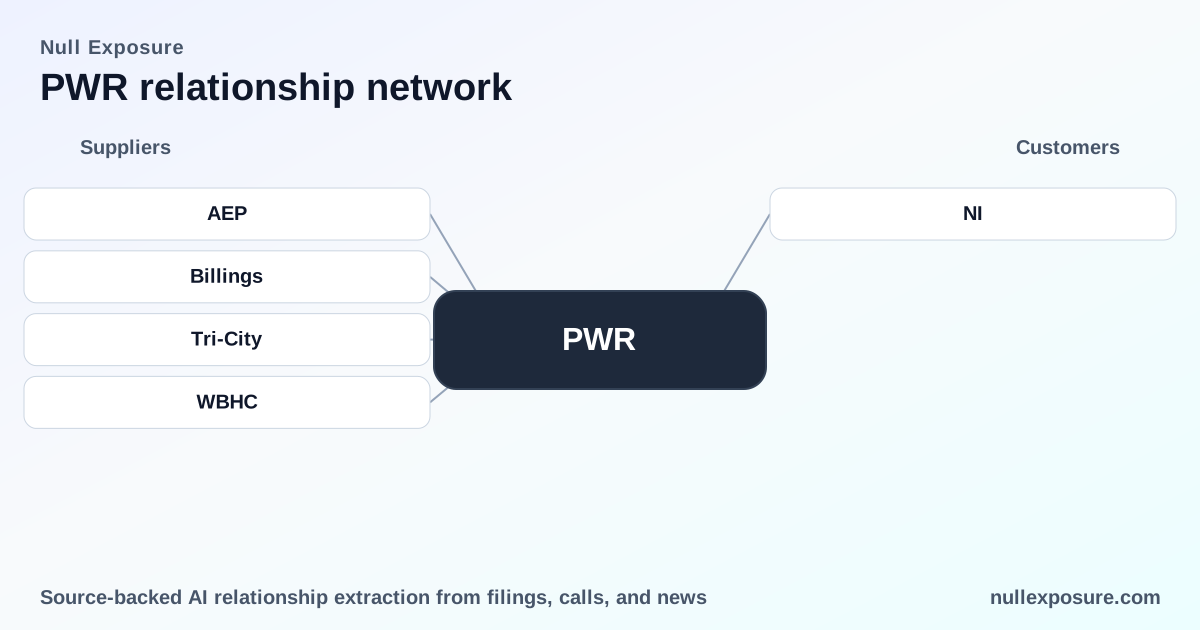
Quanta Services (PWR): Utility partnerships building multi‑year revenue visibility
Quanta Services is a project‑execution and maintenance specialist that monetizes by executing engineering, procurement and construction (EPC) and long‑term service contracts for electric power, pipeline, communications and industrial customers. The company wins a mix of master service agreements (MSAs), fixed‑price and variable construction contracts, and long‑dated strategic alliances that convert backlog into multi‑year revenue streams and maintenance cash flow. Learn more about how we surface customer relationships at https://nullexposure.com/.
Why investors should care now: demand, backlog and valuation intersect
Quanta sits at the intersection of rising utility and data‑centre power demand and a market that prizes long‑dated revenue visibility. Recent wins tied to grid build‑out and large data‑centre campuses give Quanta backloaded visibility into multi‑year work flows, supporting a premium multiple (trailing P/E ~102, forward ~56). At the same time, its exposure is concentrated in services and infrastructure execution rather than recurring subscription revenue, which keeps execution risk front and center for investors.
- Growth driver: large, utility‑scale transmission and generation projects tied to electrification and AI‑grade power demand.
- Earnings sensitivity: project mix and contract type (fixed‑price vs. time & materials) will materially affect margins.
- Valuation caveat: premium multiples reflect strong market expectations; execution and backlog realization are the key catalysts to justify them.
Customer relationships that matter today
Below I cover every customer relationship surfaced in the available results and provide a concise plain‑English takeaway for each, with source references for verification.
American Electric Power (AEP)
Quanta has established a long‑term strategic partnership with AEP to accelerate 765 kV transmission build‑out, positioning Quanta as a preferred execution partner for utility‑scale high‑voltage projects. According to AEP’s 2025 Q4 earnings remarks (March 7, 2026), AEP described the relationship as a long‑term strategic alliance to strengthen and speed 765 kV infrastructure delivery, and market coverage (Finviz/TD Cowen commentary, March 2026) also highlighted the partnership in the context of execution improvements.
Sources: AEP 2025 Q4 earnings call (March 7, 2026); Finviz/TD Cowen article referencing the AEP–Quanta partnership (March 9, 2026).
NiSource (NI)
Quanta was selected by NiSource to design, procure and construct generation and infrastructure capable of producing roughly 3 gigawatts of power for a major Indiana data‑centre campus, a landmark project illustrating Quanta’s role in the AI‑related power build‑out. This selection was highlighted on Quanta’s Q4 2025 earnings call (March 7, 2026) and picked up in multiple industry write‑ups (TradingView/Zacks March 10, 2026; Investing.com May 3, 2026) as evidence of Quanta capturing large, multi‑GW opportunities tied to data‑centre demand.
Sources: Quanta Services Q4 2025 earnings call (March 7, 2026); TradingView/Zacks coverage (March 10, 2026); Investing.com analysis (May 3, 2026).
What the documented constraints tell you about the operating model
The disclosure‑level constraints in Quanta’s reporting paint a coherent picture of how the business is structured and how its customer relationships function in practice.
- Contracting posture is hybrid and framework‑driven. Quanta commonly executes under MSAs, long‑term maintenance agreements and a mix of fixed‑price and variable construction contracts. That structure provides repeatability via framework agreements while preserving project‑level bidding economics.
- Long‑dated relationships coexist with short assignments. Management calls out both long‑term MSAs (with price adjustment mechanisms) and short‑term, non‑fixed price orders — a model that smooths revenue but leaves some projects exposed to commodity and fuel cost pressures.
- Geographic concentration in North America. The business operates primarily in the U.S., with the majority of revenue generated domestically; international operations are secondary. That concentration aligns revenue drivers closely with U.S. utility capex cycles.
- Client concentration is manageable but not irrelevant. No single customer exceeded 10% of revenue in the most recent years, signaling limited single‑counterparty dependency; however, management also acknowledges that losing significant customers could be material — a dual signal that customers are dispersed but some contracts are strategically important.
- Service‑centric, project execution business. Quanta is a seller and service provider focused on infrastructure delivery rather than product resale; core competencies are engineering, construction and long‑term maintenance.
- Mature relationship stage. The company emphasizes long‑standing customer ties and strategic alliances, which supports predictable backlog conversion when project timing aligns.
These signals together imply a company with repeatable framework agreements and meaningful backlog visibility, balanced by execution risk on large fixed‑price projects and sensitivity to U.S. utility investment cycles.
Risks and upside to weigh
- Execution risk is the primary operational risk. Large transmission and generation projects are schedule‑critical; overruns or scope shifts compress margins given the company’s mix of fixed‑price work.
- Valuation depends on backlog conversion. With premium multiples, market expectations assume successful delivery of long‑dated wins like NiSource and continued wins with utilities such as AEP. Failure to convert backlog into profitably executed work would decompress multiples rapidly.
- Revenue concentration vs. diversification trade‑off. No single customer meets the 10% threshold, which reduces immediate counterparty risk, but the prominence of a handful of strategic deals increases sensitivity to a small number of large projects.
- Macroeconomic and policy tailwinds are favorable. U.S. electrification, grid modernization and data‑centre power demand create a powerful addressable market for Quanta’s services.
Bottom line and investor action
Quanta’s recent wins with AEP and NiSource are evidence that management is converting strategic utility relationships into multi‑year project pipelines, improving visibility into future revenue. Investors should monitor project‑level margin trends, backlog conversion rates and timeline execution as the primary catalysts for re‑rating or de‑rating the stock. For a concise repository of customer and counterparty intelligence, visit https://nullexposure.com/ to see how these relationships map into financial risk and opportunity.
Bold takeaway: Quanta is positioned to capture large, utility‑scale projects that underpin growth, but the stock’s premium valuation makes execution the central investment risk.