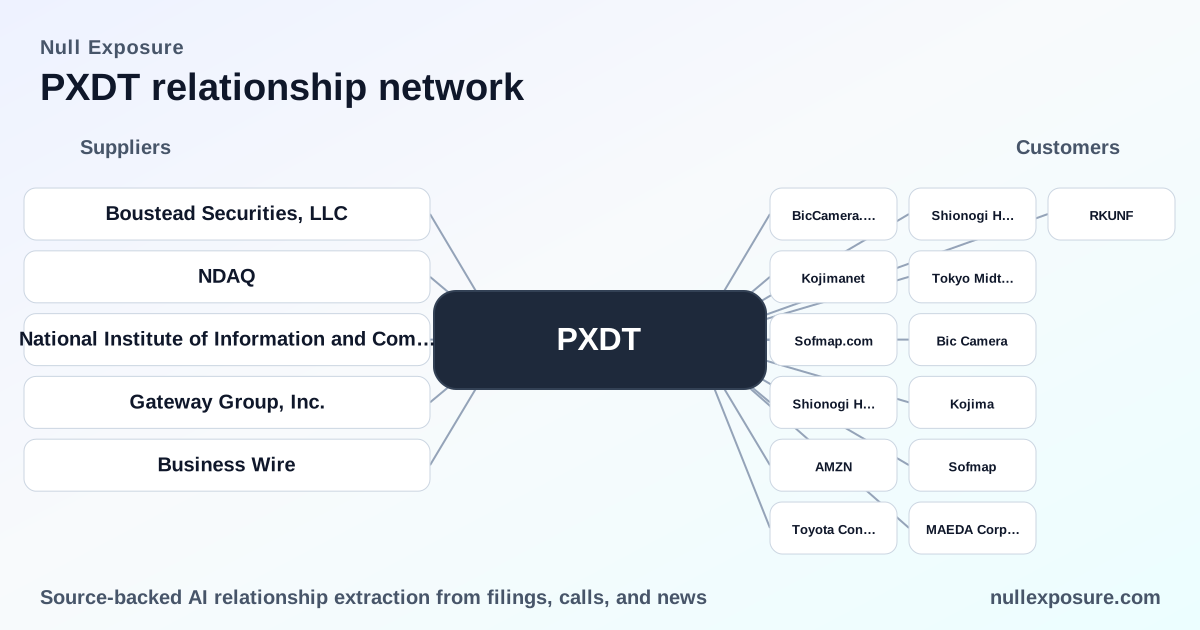
PXDT customer map: distribution, co‑branding and what it signals for revenue durability
Pixie Dust Technologies (PXDT) sells consumer electronics and health‑adjacent devices primarily in Japan, monetizing through product sales, branded partnerships and channel distribution agreements. The company commercializes hardware such as the TV speaker “kikippa” and workspace audio products by partnering with healthcare brands and national retailers; revenues flow from B2B commercial rollouts, wholesale distribution, and marketplace listings. For investors, the combination of national retail placements and marketplace distribution signals a go‑to‑market built on scalable channels rather than bespoke enterprise contracts. For a concise companion view of relationship maps, visit https://nullexposure.com/.
Market posture in one paragraph
- Channel diversification is the dominant theme: PXDT leverages major ecommerce platforms (Amazon, Rakuten) and national electronics retailers (Bic Camera, Kojima, Sofmap) alongside branded healthcare partners (Shionogi Healthcare) and corporate pilots (Toyota Connected, MAEDA). This mix reduces single‑customer concentration while exposing gross margins to retail positioning, promotional cadence and partner co‑branding decisions.
Key business model constraints (company-level signals)
- No explicit contractual constraints were flagged in the materials reviewed; present signals are derived from observed go‑to‑market activity rather than disclosed exclusivity terms.
- Contracting posture: The prevalence of marketplace and retail listings implies reseller and distribution agreements rather than exclusive long‑term procurement contracts.
- Customer concentration: Distribution across multiple national retailers and platforms points to low single‑account concentration at the sales channel level.
- Criticality and maturity: Partnerships with established healthcare brands (Shionogi) and national retailers indicate commercial maturity for consumer rollouts, while corporate pilots (Toyota Connected, MAEDA) show use‑case validation in workplace and institutional settings.
A mid‑report note If you want a systematic relationship map for due diligence or investor reports, Null Exposure provides structured relationship intelligence at scale: https://nullexposure.com/.
What each relationship tells investors Below I summarize every customer relationship captured in PXDT’s public announcements and press placements. Each entry is one or two plain‑English sentences with a source citation.
-
Sofmap.com — PxDT lists Sofmap.com among the online retail channels distributing the “kikippa” speaker, indicating presence on a national electronics ecommerce portal. Source: Pixie Dust Technologies press release (news_20240326_2, FY2024) available at https://pixiedusttech.com/en/news/news_20240326_2.
-
Shionogi Healthcare Online — Shionogi Healthcare Online is named as the online seller for the co‑branded “kikippa”, reflecting a white‑label or co‑marketing distribution under Shionogi’s health brand. Source: Pixie Dust Technologies press release (news_20240326_2, FY2024) and PR materials (PR Newswire, May 2026) available at https://pixiedusttech.com/en/news/news_20240326_2 and https://www.prnewswire.com/news-releases/pixie-dust-technologies-kikippa-speaker-ranked-first-on-the-rakuten-sound-bar-ranking-302103460.html.
-
Amazon (AMZN) — PXDT’s “kikippa” is listed on Amazon’s marketplace, giving the product broad national reach and access to Amazon’s promotional ecosystem. Source: Pixie Dust Technologies press release (news_20240326_2, FY2024) and PR Newswire (May 2026) at https://pixiedusttech.com/en/news/news_20240326_2 and https://www.prnewswire.com/news-releases/pixie-dust-technologies-kikippa-speaker-ranked-first-on-the-rakuten-sound-bar-ranking-302103460.html.
-
BicCamera.com — BicCamera.com is cited as an online outlet carrying the “kikippa”, and Bic Camera is listed for in‑store availability at ten locations, signaling brick‑and‑mortar distribution alongside ecommerce. Source: Pixie Dust Technologies announcement (news_0240227, Feb 2024) at https://pixiedusttech.com/en/news/news_0240227 and related PR notices.
-
Kojimanet — The Kojimanet online store is listed among PXDT distribution partners for “kikippa”, reinforcing multi‑channel retail placement across major consumer electronics sellers. Source: Pixie Dust Technologies announcements (news_0240227, news_20240326_2) at https://pixiedusttech.com/en/news/news_0240227 and https://pixiedusttech.com/en/news/news_20240326_2.
-
Toyota Connected Corporation — PXDT cited Toyota Connected in a case example for installation of the iwasemi™ RC‑α series, which signals corporate piloting and systems integration opportunities in automotive or workplace connected environments. Source: Pixie Dust Technologies press release (news_20240117_01, FY2024) at https://pixiedusttech.com/en/news/news_20240117_01.
-
Tokyo Midtown Yaesu — Tokyo Midtown Yaesu is referenced as a venue that installed PXDT’s iwasemi in an innovation lounge meeting room, demonstrating a commercial use case in premium workspace spaces. Source: PxDT press release (news_20240117_01, FY2024) at https://pixiedusttech.com/en/news/news_20240117_01.
-
Rakuten Group — Rakuten is listed among the major ecommerce platforms distributing the “kikippa”, adding another large marketplace channel for consumer reach and ranking visibility. Source: Pixie Dust Technologies press release (news_20240326_2, FY2024) at https://pixiedusttech.com/en/news/news_20240326_2.
-
RKUNF — The ticker RKUNF appears in the PXDT release as an inferred identifier for Rakuten in distribution listings, underscoring that the company views Rakuten-level exposure as material to product availability. Source: Pixie Dust Technologies press materials (news_20240326_2, FY2024) at https://pixiedusttech.com/en/news/news_20240326_2.
-
Shionogi Healthcare Co., Ltd. — Shionogi Healthcare is a named strategic partner selling the “kikippa” and serving as a brand collaborator; PXDT explicitly references selling the speaker through Shionogi’s channels and co‑ambassador programs. Source: Pixie Dust Technologies announcement (news_0240227, Feb 2024) and Shionogi corporate release (Sep 2022) at https://pixiedusttech.com/en/news/news_0240227 and https://www.shionogi.com/global/en/news/2022/09/e-20220921.html.
-
Bic Camera — Bic Camera (in‑store) is listed for rollout of the “kikippa” at ten stores nationwide, indicating physical retail placement that complements online channels. Source: PxDT press release (news_0240227, Feb 2024) at https://pixiedusttech.com/en/news/news_0240227.
-
Kojima — Kojima appears as an in‑store and online retail partner for the “kikippa”, consistent with PXDT’s national electronics channel strategy. Source: PxDT press release (news_0240227, Feb 2024) at https://pixiedusttech.com/en/news/news_0240227.
-
Sofmap — Sofmap is included in both online and in‑store distribution listings for the “kikippa”, rounding out the major electronics retailers carrying the product. Source: PxDT press release (news_0240227, Feb 2024) at https://pixiedusttech.com/en/news/news_0240227 and related PR materials.
-
MAEDA Corporation — MAEDA Corporation is referenced in PXDT materials as a development partner with an objective of nationwide rollout within MAEDA by April 2024, reflecting institutional pilot and scaling activity in non‑retail settings. Source: PxDT press release (news_20240219, FY2024) at https://pixiedusttech.com/en/news/news_20240219.
-
Shionogi Healthcare & Co., Ltd. — This variant of Shionogi Healthcare appears in the PXDT communications noting collaboration and brand ambassador appointments for “kikippa”, emphasizing the co‑branding dimension of the relationship. Source: PxDT press release (news_20240612, FY2024) at https://pixiedusttech.com/en/news/news_20240612.
Operational implications for investors
- Revenue mix bias: PXDT’s visibility in major marketplaces and electronics retailers suggests topline growth driven by product unit sales and promotions rather than long‑term subscription revenue. Investors should model revenue volatility around promotion cycles and retail shelf life.
- Margin dynamics: Distribution through resellers reduces direct control over retail pricing; expect compressed gross margins relative to direct enterprise procurement unless PXDT secures favorable wholesale pricing or branded co‑sell arrangements.
- Commercial runway: Partnerships with Shionogi and pilot projects at Toyota Connected and MAEDA demonstrate an ability to translate R&D into commercial pilots and co‑branded products—this supports medium‑term scaling beyond pure consumer SKUs.
- Concentration and risk: While channel breadth reduces single‑customer concentration, PXDT’s dependence on retail and marketplace discoverability is a commercial risk if platform algorithms or retailer prioritization change.
Bottom line Pixie Dust has constructed a channel‑heavy commercialization strategy: broad marketplace distribution and national retail placements, augmented by co‑brand deals with established healthcare and enterprise partners. That mix supports scalable unit sales but transfers pricing power to channel partners and creates dependence on retail promotion dynamics. For investors focused on customer relationships and channel risk, PXDT’s public disclosures show diversification across major platforms and retailers, plus selective strategic partnerships that lift go‑to‑market credibility.
For a deeper, structured relationship dossier and historical timeline for PXDT, visit https://nullexposure.com/.