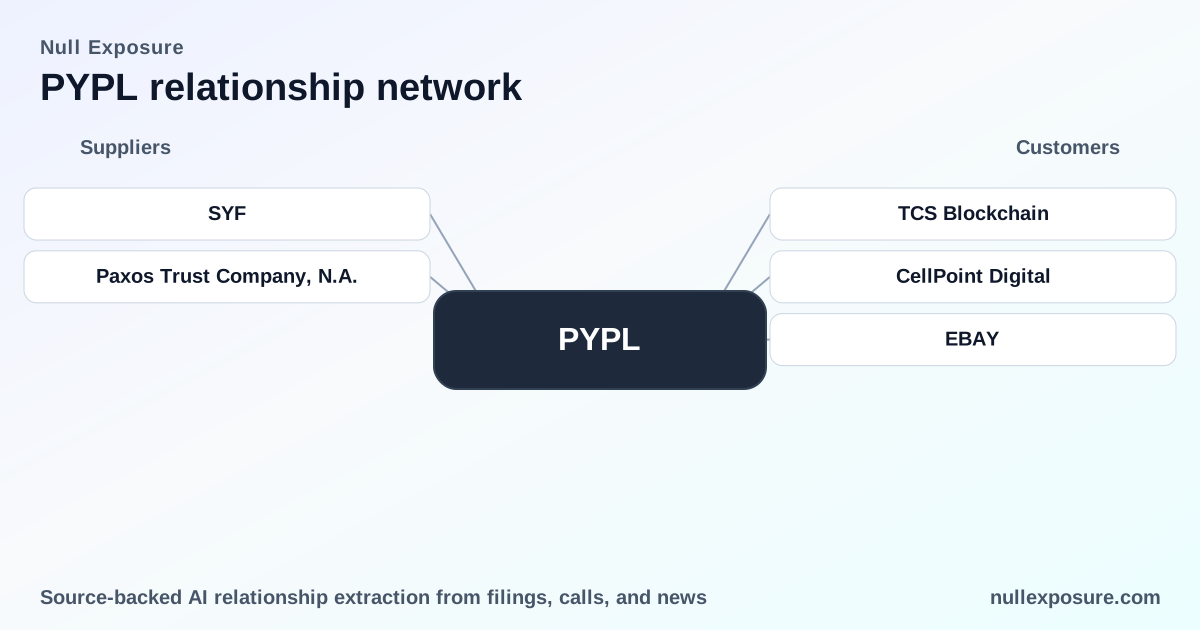
PayPal’s customer map: commercial links that shape revenue and risk
PayPal is a high-velocity, transaction-fee engine: it monetizes a global two‑sided payments network by charging usage‑based fees on transactions and selling value‑added services (checkout, BNPL, payouts, wallets, stablecoins and merchant tools) to consumers, small businesses and large enterprises. Revenue scales with payments volume, platform acceptance and embedded partnerships that route flows through PayPal and Venmo; strategic integrations with commerce platforms and fintechs expand addressable volume while keeping contract economics largely transaction‑level and cancellable. For investors, the thesis is straightforward: growth depends on share of checkout, merchant integrations, and continued consumer engagement with PayPal/Venmo products.
Explore PayPal customer signals and partner links in depth at https://nullexposure.com/.
How PayPal contracts and where commercial risk lives
PayPal’s operating model is defined by usage‑based, open‑ended commercial relationships and a global counterparty mix. Public filings show PayPal primarily charges fees tied to transaction volumes and retains principal responsibility where it controls payment completion, making it a service provider and principal for many merchant flows. Contracts typically renew automatically, are cancellable after notice, and therefore revenue is concentrated at the transaction level rather than locked into long‑term fixed fees. PayPal’s network spans individual consumers, small and mid‑market merchants, and large enterprises, which diversifies demand but also creates exposure to macro spending trends and merchant platform concentration. Finally, PayPal is a global platform with foreign‑exchange exposure and sizeable international revenue streams, so geopolitical and FX volatility are ongoing considerations.
Key operating signals:
- Contracting posture: usage‑based, open‑ended, transaction-level economics.
- Counterparty mix: consumers plus merchants across SMB, mid‑market and large enterprise tiers.
- Role: principal service provider for payment completion; also acts as seller/buyer in certain settlement products.
- Maturity/criticality: broad, active relationships (439M active accounts as of 2025) with high acceptance in many commerce stacks.
Commercial relationships: concise summaries and sources
Below are every partner or customer relationship listed in the provided results, with a short plain‑English summary and the source cited naturally.
- America’s Car-Mart (CRMT) — CRMT reported customers are increasingly choosing PayPal and Venmo for recurring payments, shifting volume away from legacy ACH billing. According to an earnings call transcript cited by InsiderMonkey (March 2026), PayPal and Venmo are being adopted for recurring customer billing.
- OLB Group (OLB) — OLB announced a global partnership to integrate PayPal‑branded checkout, Venmo and related wallet services into its SecurePay gateway and commerce platforms, with phased rollout beginning in Q1 2026; the tie-up has driven strong market reactions for OLB. Multiple press releases and news stories (Investing.com, Globe and Mail, Finance Yahoo and QuiverQuant, March 2026) describe the partnership.
- Commerce.com / BigCommerce (CMRC) — Commerce introduced “BigCommerce Payments powered by PayPal” and integrated PayPal Fastlane and Store Sync for AI‑driven discovery and checkout, embedding PayPal into storefront and multi‑storefront flows. This was announced via GlobeNewswire and discussed on CMRC earnings calls and MarketBeat (April–May 2026).
- Microsoft (MSFT) — PayPal teamed with Microsoft to power Copilot Checkout for Copilot, integrating PayPal’s checkout into Microsoft’s AI consumer surfaces; reported by TradingView/Zacks commentary (May 2026).
- DoJiggy — DoJiggy, a fundraising platform, added PayPal as a payment processing option for campaign organizers, expanding PayPal acceptance in charitable and fundraising workflows (OpenPR notice, May 2026).
- Victoria Plumb — The UK retailer announced adding PayPal to its checkout historically (reported in the press item cited by OpenPR); the example illustrates ongoing merchant adoption across retail verticals (May 2026 reference).
- Sabre (SABRP) — Sabre is partnering with PayPal and Mindtrip to create an agentic, AI‑powered travel booking experience that integrates PayPal’s agentic‑commerce services for payments and servicing on travel itineraries (Digital Transactions and Finviz coverage, March–May 2026).
- Staples Canada (SPLS) — Staples Canada added PayPal at checkout on Staples.ca to simplify online purchases for consumers and small businesses (press coverage on wifihifi, March 2026).
- Newegg (NEGG) — Newegg added Venmo as a checkout option and plans to leverage PayPal’s agentic commerce services for AI shopping features, extending PayPal/Venmo acceptance across technology retail checkout (01net.it and MarketScreener, March–May 2026).
- eBay (EBAY) — eBay’s managed payments system accepts PayPal among other payment methods and eBay sellers continue to rely on PayPal for buyer payment flows, per market coverage (Ad‑Hoc News and other March 2026 reporting).
- Canva — Canva integrated PayPal Payment Links into its platform to let creators convert designs to sales with embedded PayPal checkout (TradingView/Zacks commentary, May 2026).
- OpenAI — PayPal partnered with OpenAI to enable payments and agentic commerce experiences inside ChatGPT, embedding payments within conversational commerce flows (TradingView/Zacks commentary, May 2026).
- Perplexity — Perplexity Pro integrated PayPal for agentic commerce capabilities, extending PayPal into AI research/productivity platforms (TradingView/Zacks commentary, May 2026).
- TCS Blockchain — PayPal and TCS Blockchain are collaborating to scale PayPal USD stablecoin use cases for trucking and transportation invoice settlement, aiming to accelerate carrier settlements and reduce costs (PayPal investor release and Finviz reporting, March 2026).
- Lee Enterprises (LEE) — Lee’s settlement process lists PayPal and Venmo among payout options, showing PayPal’s role in publisher/legal settlement disbursements (ClaimDepot listing, May 2026).
- Fiserv (FISV) — Fiserv will work with PayPal to link FIUSD and PayPal’s PYUSD stablecoin to enable global transactions between systems, signaling PayPal’s integration into broader payments infrastructure (Digital Transactions report, March 2026).
- Fondex (FBGL) — Fondex lists PayPal among accepted payment types on its broker platform, reflecting PayPal’s role as a merchant payment option in fintech onboarding (Investing.com broker review, March 2026).
- CellPoint Digital — CellPoint integrated PayPal into its payment orchestration platform to simplify enabling PayPal for travel and retail merchants globally, which can boost PayPal volume and acceptance (MarketBeat alert, March 2026).
- Interactive Brokers (IBKR) — Interactive Brokers plans to support PayPal’s stablecoin among digital funding options, expanding PayPal USD’s distribution into broker funding rails (Sahm Capital coverage, January–March 2026).
- i3 Verticals (IIIV) — i3 Verticals’ payments platform supports PayPal and Venmo as accepted payment methods for its customers and vertical solutions (TradingView summary of SEC filing, March 2026).
- QVC (QVCC) — QVC’s Easy Pay accepts PayPal as a payment method for installment and checkout flows, demonstrating PayPal’s presence in televised and direct‑to‑consumer retail payment options (Reviewed.com explainer, 2021 reference cited in March 2026 collection).
- Bullish (BLSH) — Bullish accepted proceeds in PayPal USD (PYUSD) in the context of stablecoin settlement reporting, showing institutional use of PYUSD in capital markets contexts (Bullish news item, March 2026).
- Angel Studios (ANGX) — Reporting noted PayPal’s checkout language in donation/ticket flows for Angel Studios campaigns, illustrating PayPal’s role in crowdfunding and independent film distribution payments (Rolling Stone feature, March 2026).
What this network means for investors
- Scale and optionality drive revenue: integrations with commerce platforms (BigCommerce, Newegg, Canva), gateways (OLB, CellPoint), and AI/consumer platforms (Microsoft, OpenAI, Perplexity) push incremental checkout volume into PayPal’s fee stream.
- Revenue is transaction‑dependent, not contract‑locked: the usage‑based, cancellable nature of contracts limits revenue visibility but preserves upside when share of checkout grows. This is a company‑level signal drawn from PayPal’s disclosures about transaction pricing and open‑ended contracts.
- Risk is multi‑dimensional but dispersed: counterparty mix reduces single‑customer concentration risk, but merchant platform relationships (commerce platforms and gateways) are critical distribution nodes—loss of placement on one large platform would be meaningful.
- New rails and stablecoin use increase optionality and regulatory exposure: partnerships around PYUSD and stablecoin rails (TCS, Fiserv, broker funding) expand settlement products while adding regulatory and settlement‑risk considerations.
For a deeper walkthrough of PayPal’s partner map and automated signals, visit https://nullexposure.com/ — the platform surfaces relationship detail, source context and change signals for investor due diligence.
Bottom line
PayPal’s commercial footprint is broad and transactionally levered: merchant integrations and platform partnerships are the primary vectors for growth, while the open‑ended, usage‑based contracts produce variable revenue that directly tracks platform acceptance. Investors should weigh accelerated distribution through AI and commerce partners against the inherent revenue volatility of transaction pricing and evolving regulatory exposure tied to stablecoins and settlement rails.