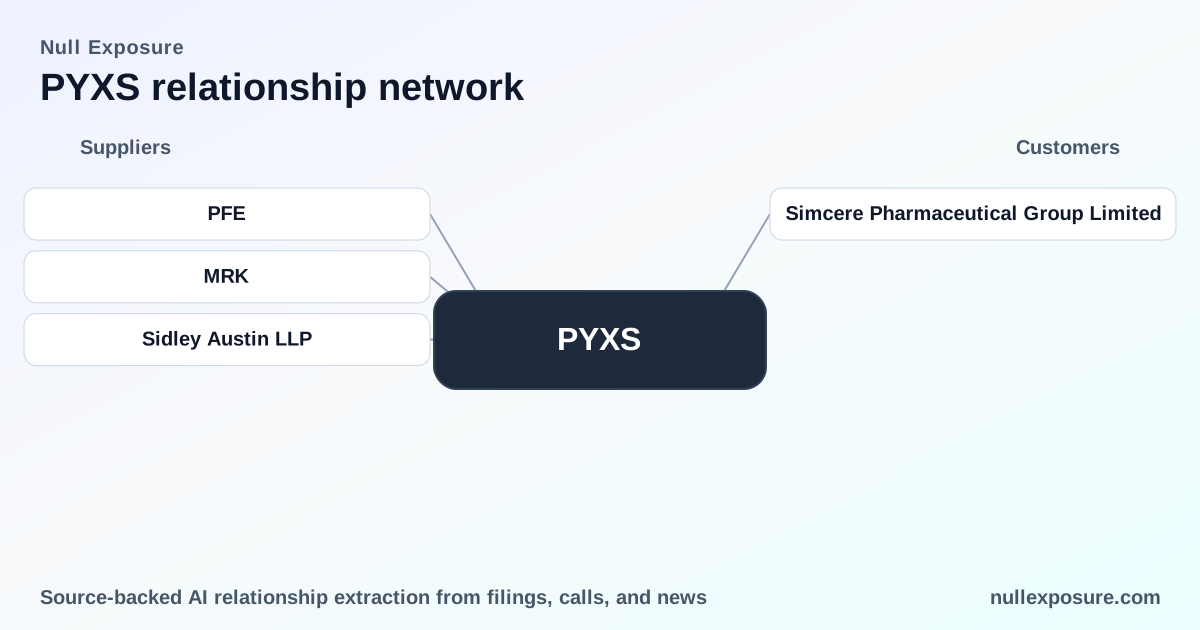
Pyxis Oncology (PYXS): Revenue driven by partnership payouts and royalty sales
Pyxis Oncology develops antibody-drug conjugates and monoclonal antibody therapeutics and monetizes primarily through out-licensing, milestone payments, and discrete royalty-rights transactions rather than product sales. For investors evaluating customer relationships, the company’s economics are partner-dependent and lumpy — revenue recognition is dominated by milestone receipts and one-off royalty sales to large pharma and regional partners.
If you want a concise dossier on Pyxis’ customer ties and what they imply for near-term cash flow and concentration risk, this note compiles every reported relationship and translates it into investor-relevant implications. For a deeper set of relationship analytics, visit https://nullexposure.com/.
How Pyxis’ customers generate cashflow for the company
Pyxis is a preclinical biotech that derives commercial value by granting development and commercialization rights to third parties and capturing milestone and royalty proceeds. The latest reported year’s revenue mix confirms this strategy: Pyxis’ top-line for the period was driven by a regulatory milestone tied to suvemcitug in China and the sale of royalty interests (including a Beovu® royalty sale). According to Pyxis’ March 23, 2026 business update and full-year 2025 results, those discrete transactions accounted for the bulk of recognized revenue for the period. A TradingView summary of the company’s Form 10‑K described the year as “$13.9 million in revenues… driven by a Simcere milestone and sale of royalty rights.” (GlobeNewswire, March 23, 2026; TradingView, May 2026).
Key monetization characteristics: partner-controlled commercialization, milestone-driven cash inflows, and potential for opportunistic royalty monetizations that create earnings spikes but limited recurring revenue.
Customer relationship roll call: Novartis and Simcere
Below are plain-English summaries of each customer relationship reported in the company’s filings and press coverage, with source context for verification.
Novartis
Pyxis recorded revenue recognition connected to a settlement and sale of royalty rights for Beovu® to Novartis, which the company reported as part of its revenue mix for the relevant year. This sale was disclosed in Pyxis’ business update and 2025 results that were published on March 23, 2026. (GlobeNewswire, March 23, 2026).
- The company’s disclosures also characterize the Settlement Agreement with Novartis as a contract that constitutes a customer relationship, indicating a buyer-type interaction in which Pyxis transferred royalty interests in exchange for consideration recorded as revenue. (Company release cited March 23, 2026).
Simcere Pharmaceutical Group Limited (Simcere)
Pyxis received a regulatory milestone payment tied to the approval of suvemcitug (BD0801) in China, specifically a $2.8 million cash payment (structured as $3.0 million less approximately $0.2 million of tax in China). The company reported this payment in its August 14, 2025 business update and again summarized milestones and royalty sales in its March 2026 filing. (GlobeNewswire, August 14, 2025; GlobeNewswire, March 23, 2026).
- Pyxis also reported the sale of royalty rights for Enzeshu® to Simcere as a revenue component for 2025, confirming that Simcere is both a licensing counterparty and a source of discrete cash receipts for Pyxis. (GlobeNewswire, March 23, 2026; TradingView, May 2026).
What the reported relationships signal about Pyxis’ operating model
The relationship evidence supports several structural characteristics that investors should treat as persistent elements of Pyxis’ business model:
-
Contracting posture — partner-first commercialization. Company disclosures state Pyxis has an exclusive, royalty-bearing license (without the right to sublicense) to rights in certain IP to develop and commercialize suvemcitug in China, which signals Pyxis places commercial execution in the hands of licensees while retaining royalty/milestone economics as its core revenue lever. This is a company-level operating signal drawn from Pyxis’ disclosures.
-
Revenue concentration and lumpy receipts. The 2025 and 2024 results show revenue dominated by one-off royalty sales and milestone payments to/from large pharma and regional partners, rather than recurring product revenue. That structure produces episodic cash inflows tied to regulatory events and negotiated sales of royalty streams.
-
Buyer dynamics with large pharma. The company has documented agreements (for example, a Settlement Agreement and related contracts) where Novartis acted as a counterparty in a buyer role for royalty interests; Pyxis recognized revenue when those assets were sold or settled. (GlobeNewswire, March 23, 2026).
-
Commercial maturity and criticality. The relationships are commercially meaningful for near-term liquidity but are not evidence of broad market penetration; these are contractual monetizations rather than evidence of self-sustaining product sales.
Financial context and investor implications
-
Short-term cash support but limited recurrence. The Simcere milestone ($2.8M) and the royalty sales to Novartis and Simcere produced the bulk of reported revenue for the year; these transactions support cash flow but do not establish recurring top-line streams. (GlobeNewswire, August 14, 2025; March 23, 2026).
-
Capital structure and valuation signals. Pyxis’ public profile shows a market capitalization in the low hundreds of millions and negative operating metrics (reported EBITDA and EPS loss), which means milestone and royalty monetizations materially influence headline financials and investor sentiment. (Company disclosures and recent filings).
-
Concentration risk. A small set of counterparties drives the majority of recognized revenue in the reported periods, creating exposure to contract timing and one-off transactions.
If you would like a consolidated investor report that maps these relationships to cashflow timing and scenario modeling, start here: https://nullexposure.com/.
Bottom line: what investors should watch next
- Monitor the cadence of regulatory milestones and royalty-asset trades, as these events will continue to dominate reported revenue and liquidity inflections.
- Track the performance and commercialization updates from Simcere (suvemcitug/BD0801 in China) and any subsequent monetization decisions for existing royalties. (GlobeNewswire, August 14, 2025; March 23, 2026).
- Watch for additional licensing activity or secondary royalty sales, because these moves materially alter near-term cash flow without changing the underlying R&D program risk profile.
For investors focused on partner-driven biotech cash dynamics, Pyxis represents a company where value realization is achieved through negotiated, partner-led events rather than internal product rollout. This creates both opportunity for episodic upside and risk from revenue concentration and timing.