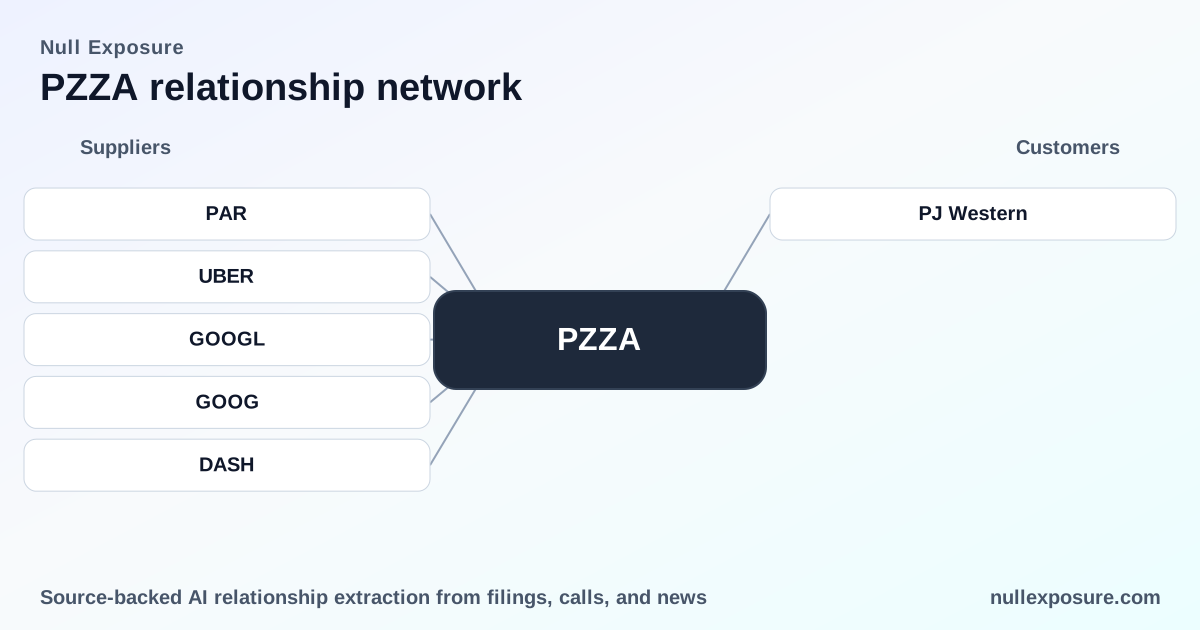
Papa John’s (PZZA) — Customer Relationships and Commercial Signals that Drive Royalty Streams
Papa John’s generates cash primarily as a franchisor and distributor: retail sales from company-owned restaurants, usage‑based royalties (5% of franchise sales), initial franchise and development fees, and distribution income from regional Quality Control Centers (QC Centers). This hybrid model turns store-level sales into predictable franchisor cash flow while retaining operating leverage through distribution and company-owned retail. For investors assessing customer relationships, the company's contract design, global footprint, and supply‑chain interlocks are the principal drivers of revenue stability and geopolitical exposure. If you want a consolidated view of Papa John’s customer dynamics, visit https://nullexposure.com/.
How Papa John’s structures its customer contracts and why that matters
Papa John’s operates under a clear licensing-first posture. The standard franchise agreement establishes a 5% royalty on sales, is usage‑based, and is long-term—an initial 10‑year term with a 10‑year renewal option. These characteristics create a revenue mix that is highly correlated with system-wide restaurant sales but anchored by contractual renewal cadence.
- Contracting posture: The franchising model is licensing-focused; royalties are collected as sales occur and initial license fees are recognized at restaurant opening, which aligns Papa John’s incentives with franchisee sales performance (company filings; disclosures through Dec 29, 2024).
- Revenue mechanics: Usage‑based royalties create a direct pass-through of demand to corporate top line—strong same-store sales lift royalties rapidly; conversely, downturns compress royalty inflows.
- Contract maturity and stickiness: Ten‑year initial terms with renewal options provide long horizon visibility into the franchised base and raise switching costs for large multi-unit operators.
These features make the royalty stream stable yet cyclical: contract terms provide durability, while usage dependence transmits retail volatility.
Distribution and reseller economics are integral, not incidental
Papa John’s operates 11 QC Centers in North America that supply dough, sauce, paper goods and smallwares to both company-owned and franchised restaurants. Domestic franchisees are required to buy certain inputs from QC Centers or approved suppliers, creating a recurring distribution revenue line that supplements royalties and retail receipts (company filings).
- Criticality: QC Centers are a strategic asset that link the franchisor to restaurant operations and provide an ancillary, margin-enhancing revenue stream.
- Concentration: Distribution is geographically concentrated in North America through the QC network, while franchising drives international scale.
Global footprint and region-level dynamics investors should track
Papa John’s is a global franchisor: as of Dec 29, 2024 there were 6,030 restaurants (552 company-owned and 5,478 franchised) in 51 countries and territories. North America remains the primary domestic market, while the International segment includes the UK and other EMEA markets where Papa John’s derives royalties and distribution sales (company filings).
- EMEA exposure: International operations include the UK and broader EMEA distribution and franchise support activities; these markets drive development fees and ongoing royalties.
- North America exposure: Domestic retail and QC distribution dominate the company-owned and commissary economics.
Relationship inventory — who Papa John’s counts as customers (complete list from results)
This section covers every customer relationship identified in the provided results.
PJ Western (operator of Papa John’s stores in Russia)
Christopher Wynne’s PJ Western oversees 190 Papa John’s stores in Russia and stated he would keep them open for the sake of franchisees and employees, indicating operational continuity despite geopolitical tensions. A news article in PMQ from March 10, 2026 reported this development and cited PJ Western’s decision to continue operations. (PMQ, March 10, 2026)
Constraints and company-level signals that shape customer economics
The source excerpts reveal several company-level operational constraints and characteristics that affect how Papa John’s captures value from customers:
- Licensing-focused contract_type: Royalty model is explicit and standardized at 5% of sales, which underpins franchise revenue predictability (company filings).
- Long-term contracts: Franchise agreements generally have 10-year initial terms with 10-year renewal options, delivering contractual longevity and renewal optionality that support valuation multiples.
- Usage-based recognition: Royalties are recognized as sales occur, tying corporate revenue to real-time restaurant performance.
- Global scale but regional concentration: The system spans 51 countries, with meaningful operations in North America and EMEA, so geographic diversification is real but not uniform.
- Distributor role: QC Centers operate as distribution partners to restaurants, creating a core distribution segment that supplies crucial inputs and generates recurring sales.
- Segment mix: Core product (retail pizza and food), distribution (QC Centers), and franchising services make up the commercial architecture; each segment contributes to cash flow with different margin profiles.
These constraints signal a business that is contractually durable, operationally integrated through distribution, and sensitive to same-store sales and regional disruptions.
Investment implications — what to watch and why it matters
- Revenue sensitivity: Usage-based royalties make Papa John’s top line highly sensitive to same-store sales and promotional dynamics; strong retail momentum converts efficiently into franchisor revenue.
- Durability vs. cyclicality: 10-year franchise terms provide durability, but the usage-based royalty link injects cyclicality tied to consumer demand and labor/food inflation.
- Supply-chain leverage: QC Centers provide margin diversification but also operational concentration risk—any disruption to QC operations can have asymmetric effects on product consistency and franchisee performance.
- Geopolitical tail risk: The PJ Western relationship in Russia—190 stores continuing operations—creates exposure to sanctions, currency, and reputational risk not fully mitigated by long-term contracts or royalties.
- Valuation context: With trailing revenue of roughly $2.05B and EBITDA of $201.8M, investors should weigh royalty stability and distribution margins against execution risk and international exposures (company financials).
Practical monitoring checklist for investors
- Track same-store sales and system-wide sales trends (impact on royalties).
- Monitor franchise development pipeline and initial franchise fees (signals of growth).
- Watch QC Center performance and any supply interruptions in North America.
- Follow geopolitical developments in markets with multi-unit franchisees, especially Russia and EMEA.
- Review renewal and litigation trends that could affect franchise economics.
If you want deeper, relationship-level signals and continuous monitoring of Papa John’s customer exposures, visit https://nullexposure.com/ to see how these inputs are tracked and surfaced in investment-grade reports.
Bottom line
Papa John’s monetizes a global restaurant system through long-term licensing, usage-based royalties, and a captive distribution network. That structure produces durable recurring revenue with pronounced sensitivity to retail performance and concentrated operational dependencies (QC Centers) plus geopolitical exposures in select markets such as Russia. For investors, the calculus is straightforward: reward for stable contractual economics against the risk of demand volatility and international operating risk.