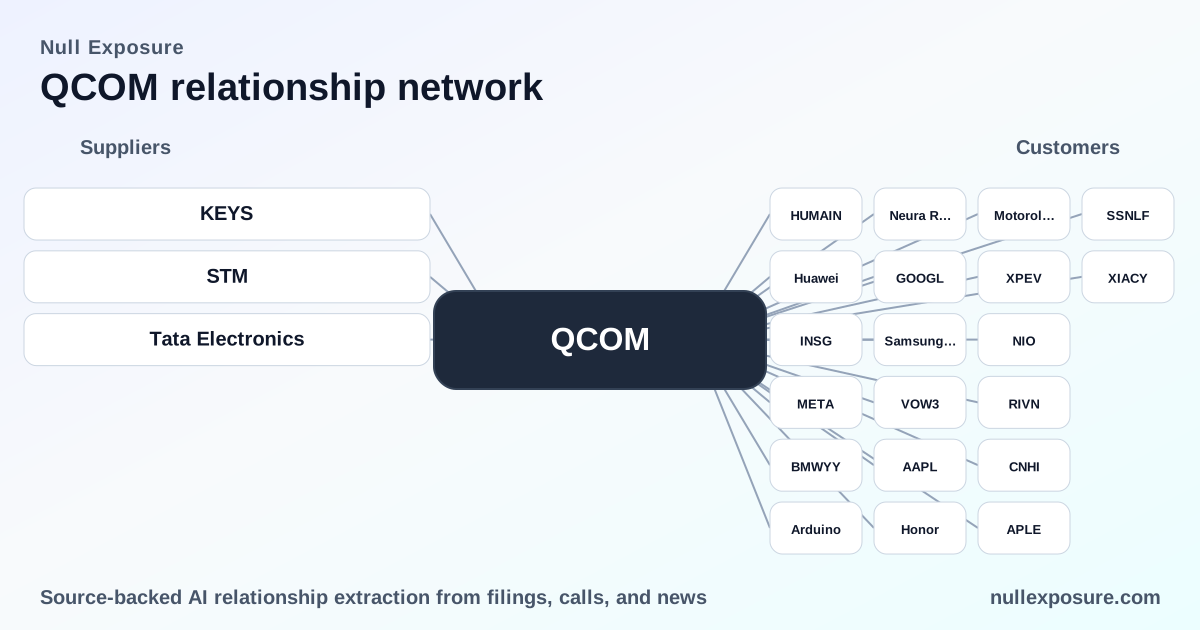
Qualcomm customer map: who pays for the Snapdragon ecosystem and why it matters
Qualcomm earns revenue by selling integrated circuit products and licensing its wireless patents and software stacks to device makers and system integrators; the business combines per‑unit hardware sales with recurring, often long‑term licensing royalties, producing a mix of cyclical hardware exposure and higher‑margin licensing cash flow. For investors, the customer map is both a revenue driver and a strategic moat: broad OEM adoption drives scale for chips, while license agreements lock in royalties across regions. For more context and raw relationship tracking, see https://nullexposure.com/.
How Qualcomm contracts and where risks concentrate
Qualcomm’s public disclosures and recent press coverage deliver a consistent picture of the operating model: the company acts as both supplier (QCT hardware and system software) and licensor (QTL patent licenses), with a material customer base concentrated in APAC and North America. The company disclosed execution of new long‑term license agreements with key Chinese OEMs in fiscal 2025, and reports country revenue splits that show China (including Hong Kong) and the United States as large revenue centers. Indemnification claims historically have been immaterial to consolidated results. (Sources: Qualcomm FY2025 10‑K; Qualcomm press releases, FY2025–FY2026.)
- Contracting posture: mix of per‑unit sales and quarterly royalty licensing; evidence of long‑term renewals for Chinese OEMs (FY2025 10‑K).
- Concentration: revenue materially derived from China and the U.S., supporting both scale and geopolitical exposure.
- Role diversity: Qualcomm operates as licensor, manufacturer supplier and seller of silicon and system software across hardware and software segments.
- Maturity and criticality: many relationships are multi‑year and product‑embedded, making Qualcomm technology critical to device OEM roadmaps.
If you want a data‑driven view of these partner linkages, visit https://nullexposure.com/ for deeper signals and sourcing.
Customer snapshots — concise, source‑backed summaries
Below are one‑to‑two sentence plain‑English summaries for each customer relationship mentioned in the source set. Each line includes the cited source.
-
Huawei — Qualcomm notes U.S. export controls affected prior sales of 4G and certain integrated circuit products to Huawei; the company named Huawei as one of China’s largest smartphone OEMs. (Source: Qualcomm FY2025 10‑K, FY2025.)
-
HUMAIN — Qualcomm stated HUMAIN is its first customer for a planned solution with a target deployment of 200 megawatts starting in 2026, signaling a utility‑scale relationship. (Source: QCOM 2025 Q4 earnings call, 2025Q4.)
-
Inseego (INSG) — Inseego’s MiFi PRO M4 was announced as built on Qualcomm’s Dragonwing MBB Gen 3 platform, showing Inseego’s adoption of Qualcomm modem‑to‑antenna solutions. (Source: GlobeNewswire/Inseego release, Mobile World Congress 2026.)
-
Meta — Qualcomm cited very strong demand for smart glasses from Meta and placed Meta among early adopters driving an AR/XR inflection. (Source: QCOM 2025 Q4 earnings call, 2025Q4.)
-
BMW — Qualcomm developed Snapdragon Ride Pilot in close collaboration with BMW, which debuted in the BMW iX3 EV SUV, marking a production automotive systems milestone. (Source: QCOM 2025 Q4 earnings call, 2025Q4.)
-
Arduino — Arduino announced a product line powered by Qualcomm Dragonwing IQ8 Series, indicating Qualcomm’s footprint in developer and embedded platforms. (Source: Arduino press release, FY2026.)
-
Visteon (VC) — Visteon showcased high‑performance compute built on Qualcomm’s Snapdragon Cockpit Elite platform, confirming Tier‑1 supplier integration into automotive OEMs. (Source: Visteon press coverage at Auto Shanghai / FY2026 news.)
-
Lantronix (LTRX) — Multiple product announcements reference Lantronix SOMs and gateways powered by Qualcomm Dragonwing QCS processors (QCS6490 and QCS8550), showing Lantronix’s edge and drone platform dependency. (Source: GlobeNewswire and multiple press releases, FY2026.)
-
Franklin Access / Franklin Wireless (FKWL) — Franklin’s RG350 and earlier hotspots are described as powered by Qualcomm Snapdragon modem‑RF systems (X35, X62), indicating ongoing modem supply to hotspot OEMs. (Source: GlobeNewswire and Finance Yahoo press releases, FY2025–FY2023.)
-
Dolby (DLB) — Qualcomm Technologies and Dolby collaborated to simplify integration of Dolby Atmos in vehicles, highlighting Qualcomm’s role in in‑car multimedia stacks. (Source: Dolby press release, FY2025.)
-
Snap (SNAP) — Snap’s Specs/Spectacles unit signed a multi‑year deal to use Snapdragon XR chips in next‑gen standalone AR glasses, targeting a consumer launch and developer platform. (Source: StockstoTrade reporting, FY2026.)
-
Neura Robotics — Neura will use Qualcomm Dragonwing Robotics IQ10 processors as reference designs, integrating Qualcomm robotics processors into scalable robot platforms. (Source: TechCrunch and The AI Insider coverage, FY2026.)
-
iQiyi (IQ) — iQiyi’s Qiyu VR headset is powered by Qualcomm’s Snapdragon XR2 platform, demonstrating Qualcomm’s presence in Chinese VR devices. (Source: Auganix / product release reporting, FY2021.)
-
Anterix (ATEX) — Anterix and Qualcomm announced Snapdragon SDX35‑3 and SDX32‑3 IoT modems for Anterix’s 900 MHz utility broadband, enabling smart grid edge solutions. (Source: Anterix press release / Bitget reporting, FY2026.)
-
Sonim (SONM) — Sonim’s rugged H700 and XP series devices ship with Qualcomm Snapdragon modem‑RF and chipset solutions (X75, SM4450, Snapdragon 7 Gen 3), showing Qualcomm’s role in rugged comms devices. (Source: Sonim press releases and industry coverage, FY2024–FY2025.)
-
HP (HPQ) — HP’s OmniBook X and EliteBook Ultra are reported to use Qualcomm’s Snapdragon X processors for AI PC performance claims, indicating PC OEM chip adoption. (Source: CRN reporting, FY2026.)
-
Gogoro (GGR) — Qualcomm’s Snapdragon Digital Chassis SoC is used in Gogoro’s Smartscooter, illustrating Qualcomm’s automotive/city mobility silicon reach. (Source: Gogoro product announcement, FY2024.)
-
Google (GOOGL) — Google is listed among companies adopting Snapdragon Wear Elite, reflecting Qualcomm’s wearable platform partnerships. (Source: TheLec news reporting, FY2026.)
-
Samsung Electronics — Samsung is cited as a partner with a Galaxy XR device and as a Snapdragon Wear Elite adopter, indicating collaboration in premium mobile and XR devices. (Source: QCOM 2025 Q4 earnings call and TheLec reporting, 2025Q4–FY2026.)
-
Volkswagen Group (VOW3) — Volkswagen signed an LOI with Qualcomm Technologies to develop next‑generation zonal SDV architectures for Western markets, signaling strategic automotive platform deals. (Source: TorqueNews reporting, FY2026.)
-
Rivian (RIVN) — Qualcomm is embedding Snapdragon Digital Chassis technology into the VW‑Rivian ecosystem to scale its vehicle brain across millions of vehicles (per coverage of the alliance). (Source: TorqueNews reporting, FY2026.)
-
Apple (APLE / AAPL) — Qualcomm disclosed Apple purchases thin modem (MDM) products that exclude Qualcomm’s integrated application processors, confirming a defined modem supply relationship. (Source: Qualcomm FY2025 10‑K, FY2025.)
-
MetroPCS / PCS — Historical reporting references Qualcomm’s influence on LTE handset ecosystems and carrier‑band designs, illustrating longstanding carrier‑level relationships. (Source: RCR Wireless interview archive, FY2010.)
-
Xiaomi (XIACY) — Qualcomm lists Xiaomi among major handset customers that develop integrated circuits, indicating both collaboration and competitive dynamics with OEM‑designed silicon. (Source: Qualcomm FY2025 10‑K and market coverage, FY2025–FY2026.)
-
Honor — Market coverage places Honor alongside Chinese OEMs that rely on Qualcomm chips, signaling ongoing commercial supply into Chinese smartphone channels. (Source: FinViz / TradingView reporting, FY2026.)
-
Li Auto (LI) — Li Auto plans to transition a cockpit chip to Qualcomm’s next‑generation Snapdragon 8797, showing OEM selection of Qualcomm silicon for vehicle cockpits. (Source: CNEVPost reporting, FY2026.)
-
NIU — NIU cited in‑depth collaboration with Qualcomm among other tech partners, reflecting Qualcomm’s role in connected two‑wheel mobility. (Source: 36Kr coverage, FY2026.)
-
NIO — Reporting notes NIO among Chinese EVs using zonal architectures powered by Qualcomm or competitors, acknowledging Qualcomm’s presence in EV software‑defined vehicles. (Source: TorqueNews reporting, FY2026.)
-
XPeng (XPEV) — XPeng referenced for using zonal architectures sometimes powered by Qualcomm chips, indicating product‑level adoption in Chinese EVs. (Source: TorqueNews reporting, FY2026.)
-
WeRide (WRD) — WeRide announced multi‑chip compatibility for its ADAS solution, including integration with Qualcomm platforms for mass‑production ADAS deployments. (Source: SahmCapital / Finance Yahoo coverage, FY2026.)
-
Vuzix (VUZI) — Vuzix Blade 2 smart glasses use Qualcomm processors and Android support in commercial enterprise configurations. (Source: LedInside product reporting, FY2026.)
-
Movado (MOV) — Movado’s Wear OS watch products historically referenced Qualcomm Snapdragon 3100 processors, showing long‑standing wearable supplier relationships. (Source: PR Newswire, FY2019.)
-
Netgear (NTGR) — Netgear’s Nighthawk M7 hotspot pre‑orders noted adoption of Qualcomm Dragonwing SDX72 chipset, confirming modem supply to premium router OEMs. (Source: MarketScreener / product announcement, FY2026.)
-
Viasat (VSAT) — A demo integrated Viasat’s satellite network with Qualcomm’s Snapdragon Auto 5G Modem‑RF Gen 2, signaling cross‑sector connectivity solutions. (Source: StockTITAN / demo reporting, FY2026.)
-
Case New Holland (CNHI) — CNH endorsed Qualcomm’s GlobalTRACS equipment management system for construction equipment, reflecting industrial telematics adoption. (Source: TruckingInfo report, FY2026.)
-
Motorola Mobility LLC — Motorola is named among companies adopting Snapdragon Wear Elite, confirming wearables and mobile partnerships. (Source: TheLec reporting, FY2026.)
Investment takeaways
- Diversified customer base across mobile, automotive, XR and edge compute reduces reliance on any single product class while preserving high‑margin licensing revenue.
- Geographic concentration in China and the U.S. delivers scale but creates geopolitical exposure; long‑term license renewals with Chinese OEMs are a strategic stabilizer (FY2025 disclosures).
- Embedded, product‑level relationships (automotive SDV, XR glasses, hotspots, edge SOMs) increase stickiness: chips and licensed patents become integrated into OEM roadmaps and vehicle platforms.
For an analyst‑grade view of partner signals and to trace sourcing behind these summaries, see https://nullexposure.com/.
(Reported company mentions and press coverage cited inline above; primary sources include Qualcomm FY2025 10‑K and Q4 2025 earnings call, plus vendor press releases and industry news across FY2024–FY2026.)