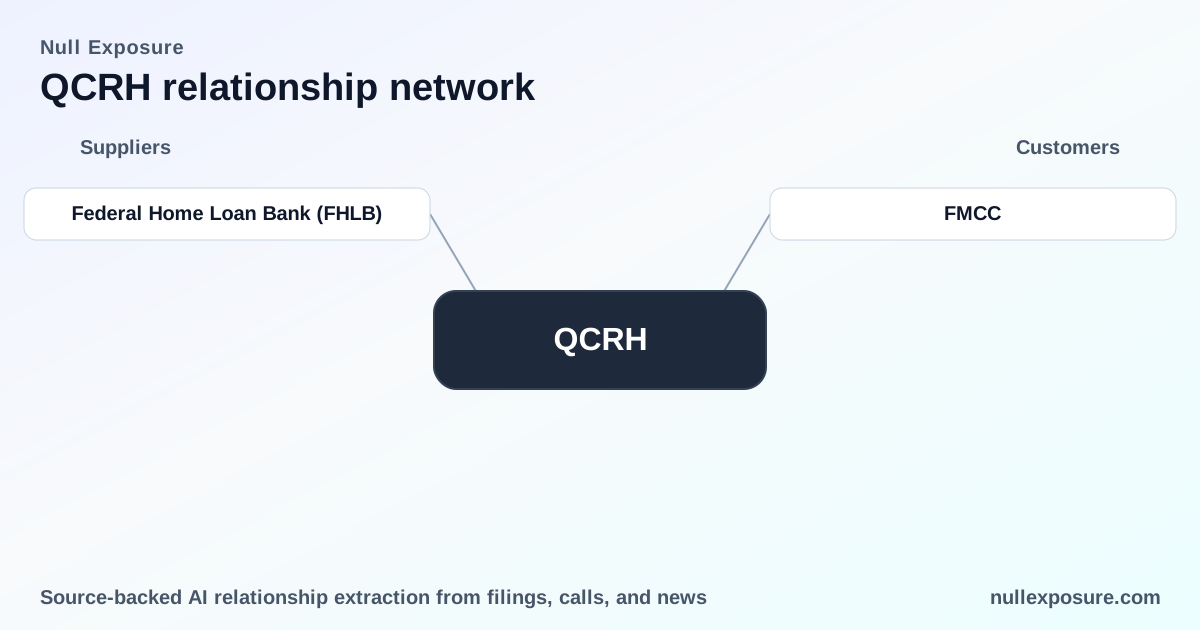
QCR Holdings (QCRH): How customer relationships — and a Freddie Mac pipeline — shape near-term credit and deposit dynamics
QCR Holdings operates as a multi-bank regional bank holding company that monetizes through net interest margin on loans and leases, fee income from correspondent and cash-management services, and loan sale/securitization activity tied to affordable housing programs. The company leverages its community banking footprint in the American Midwest to originate commercial, consumer and low-income housing tax credit (LIHTC) loans, then executes structured sales or Freddie Mac securitizations to convert balance-sheet exposure into fee and spread income. For a quick institutional view, visit https://nullexposure.com/.
Why customers and counterparties matter to QCR's P&L
QCRH’s operating model is dual: traditional retail/commercial banking plus a correspondent and specialty-lending channel that feeds larger secondary-market transactions. That combination creates several finance-relevant characteristics:
- Contracting posture: QCR uses a mix of short-term guarantees (standby letters of credit) and active loan sale/sponsorship structures, which concentrates liquidity and execution risk into discrete securitization windows rather than into long, amortizing exposures.
- Concentration and spend: Correspondent banking and LIHTC pipelines are material drivers — the firm reports $688.1 million in correspondent deposits across 189 relationships, making correspondent services a non-trivial source of low-cost funding and fee income.
- Criticality and role diversity: QCR acts as lender, servicer/intermediary, licensor (equipment leasing), and seller — so counterparties rely on QCR for both deposit and origination services, and QCR relies on secondary-market counterparties to convert originated loans to capital and fee revenue.
- Maturity and lifecycle: Core correspondent banking is a mature, active line; specialty channels (e.g., m2 loan origination) are being wound down — QCR discontinued new loans/leases via m2 in September 2024 — so the book composition is actively evolving toward core deposit growth and securitization-enabled loan originations.
Collectively these signals position QCR as a regional originator that intentionally uses market channels to manage balance-sheet capacity while preserving deposit-led funding advantages.
Every Freddie Mac relationship mention in the public record (FY2026 period)
Below are the specific public mentions tied to Freddie Mac in the FY2026 reporting window. Each line is a concise, plain-English summary with the source noted.
- QCRH told investors it expects to close a Freddie Mac LIHTC tax-exempt permanent loan securitization of $315.6 million during Q2 2026, indicating an imminent large-capital conversion of LIHTC loans. (GlobeNewswire press release, Apr 22, 2026.)
- The Quad Cities Business report on Q1 2026 results stated QCRH anticipates closing a second LIHTC construction loan sale of approximately $207.3 million in funded balances and the Freddie Mac $315.6 million securitization, reflecting parallel sale and securitization channels. (QuadCitiesBusiness Q1 2026 coverage.)
- In the firm’s Apr 22, 2026 press release to GlobeNewswire, management repeated the plan to close the $315.6 million Freddie Mac LIHTC securitization in the second quarter, reinforcing the company’s timeline for balance-sheet reduction. (GlobeNewswire press release, Apr 22, 2026.)
- An earnings-call transcript captured by Investing.com described the loans as “a $207 million pool of LIHTC construction loans identified for sale to a new private investor and a $316 million Freddie Mac LIHTC tax-exempt permanent loan pool securitization,” showing how QCR segments pools for distinct buyer types. (Earnings-call transcript, Investing.com, Q1 2026.)
- An InsiderMonkey transcript of Q4/2025 commentary quoted management succinctly: “We do that with Freddie Mac,” signaling an ongoing operational relationship with Freddie Mac for LIHTC permanent loan execution. (Earnings-call transcript, InsiderMonkey, Mar 10, 2026.)
- Another InsiderMonkey Q4/2025 transcript instance reiterated the same point—management’s reference to Freddie Mac as the vehicle for permanent LIHTC placements—underscoring continuity across reporting periods. (Earnings-call transcript, InsiderMonkey, Mar 10, 2026.)
- A separate InsiderMonkey transcript covering the Q1/2026 earnings call repeated the breakdown of a $207 million construction pool and a $316 million Freddie Mac LIHTC permanent pool, showing consistency in portfolio structuring across quarters. (Earnings-call transcript, InsiderMonkey, Q1 2026.)
Key takeaway: multiple contemporaneous public filings and call transcripts consistently show QCR is converting large LIHTC origination pools through both private-sale and Freddie Mac securitization channels in FY2026.
What the relationship activity implies for investors
- Near-term balance-sheet impact is measurable and concentrated. The two large transactions cited — a ~ $207 million construction-sale and a ~ $316 million Freddie Mac securitization — will materially reduce on-balance LIHTC exposure when executed and generate immediate fee income and capital relief. This directly supports QCR’s return-on-assets and return-on-equity profile for FY2026.
- Funding and liquidity behavior is strategic. With correspondent deposits of $688.1 million and an explicit management focus on growing core deposits over brokered funding, securitizations function as a deliberate tool to free lending capacity without increasing funding costs.
- Operational dependency on market execution. The monetization model depends on successful sale and securitization windows; timing and pricing execution are therefore material risk levers for quarterly earnings variability.
Constraints and company-level signals investors should weight
These constraints are company-level operating characteristics drawn from filings and disclosures, and they frame how counterparty relationships translate into risk and opportunity:
- Contract tenor skew—short-term guarantees: standby letters of credit are typically issued for one year or less, concentrating guarantee renewal and liquidity management on a short cycle.
- Counterparty mix—diversified but regionally concentrated: QCR serves government entities, small businesses, mid-market companies, and individuals, with a geographic concentration in the Midwest (Iowa, Illinois, Missouri, Wisconsin), which limits national diversification but preserves local market penetration.
- Business segment emphasis—services and core deposits: the firm’s revenue mix emphasizes banking services (commercial and consumer), trust/asset management and leasing, while management is explicitly focused on growing lower-cost core deposits as a primary strategic lever.
- Materiality of correspondent banking: correspondent services are a core and material line, providing noninterest-bearing and interest-bearing deposits as well as fee income and loan participations.
- Relationship roles and lifecycle: QCR operates as seller, licensor, and service provider; most relationships are active/mature, while some originated channels (e.g., m2) are being wound down, shifting future revenue composition.
- Spend band signal: an aggregate correspondent-deposit base in the high hundreds of millions signals institutional funding scale — a $100m+ spend-band behavior relevant to counterparties and investors.
Investment implications and final read
For investors and operators evaluating QCRH’s customer relationships, the core investment thesis is clear: QCR monetizes local origination strength through deposit-rich correspondent banking and targeted securitization/sale channels (including Freddie Mac LIHTC facilities) to manage capital and amplify returns. Execution on the FY2026 LIHTC transactions will materially influence reported capital ratios and fee revenue in the near term. Monitor securitization close dates, pricing, and any disclosure around the buyer of the $207m construction pool for signals on execution risk and spread capture.
For additional corporate relationship intelligence and to track these transactions against broader market activity, review the comprehensive coverage at https://nullexposure.com/.
Bold, balance-sheet-focused monitoring of QCR’s securitization pipeline and correspondent deposit trends provides the clearest route to anticipating earnings variability and capital flexibility over the next 12 months.