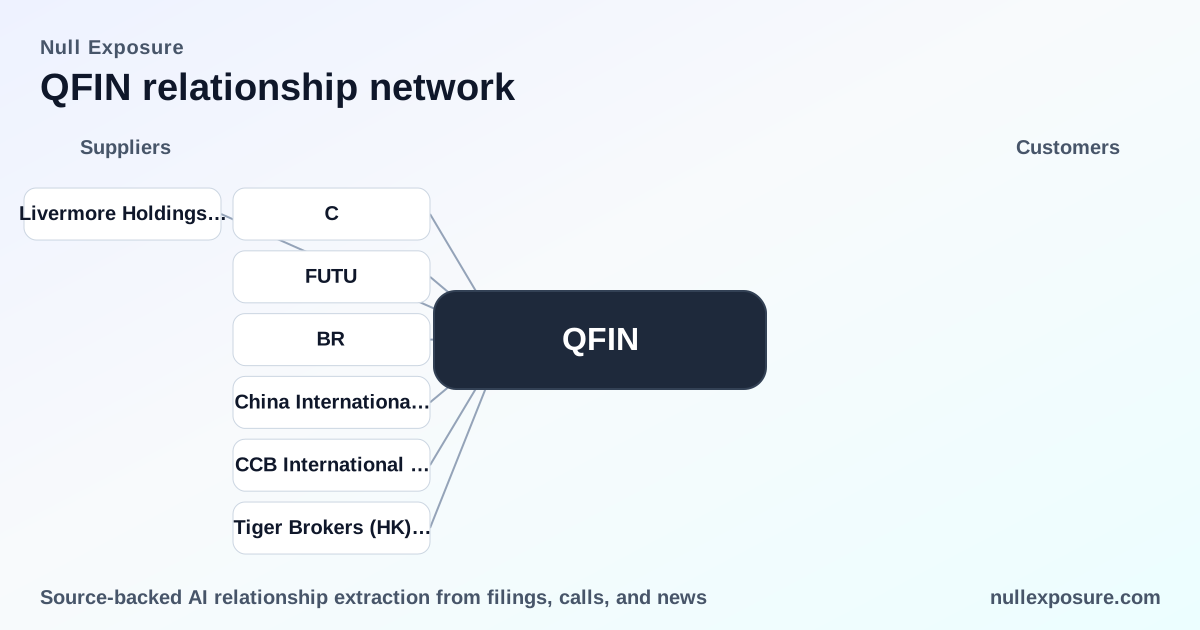
360 DigiTech (QFIN): distribution partnerships and what they mean for investors
360 DigiTech operates a digital consumer finance platform under the 360 Jietiao brand in China, monetizing through point-of-sale and consumer lending, servicing and risk-management fees, and by licensing its credit intelligence and bank-facing technology to financial institutions. The company's revenue engine is twofold: consumer loan originations distributed through large internet channels, and technology partnerships that position 360 as a vendor to regulated banks. Learn more at https://nullexposure.com/.
What drives value for an investor in QFIN
For investors, QFIN is a fintech-platform play where distribution breadth and bank partnerships determine growth and capital access. Embedded lending integrations with major consumer Internet companies deliver low-cost customer acquisition and scale; bank collaborations supply funding, compliance cover and market credibility. Regulatory exposure in China, partner-platform dependence and the durability of bank relationships are the principal operational risk vectors. Financial metrics show a large revenue base and strong margins, underscoring the leverage in the business model, but the stock’s valuation will track partner health and funding stability as much as loan economics.
Customer relationships that shape distribution and funding
Below I profile every partner relationship reported in the available coverage and what each implies for QFIN’s commercial footprint.
Meituan — embedded consumer flows, mass distribution
360’s financing product is embedded into Meituan’s consumer workflows, giving Jietiao access to Meituan’s tens-of-millions user base for scenarios such as food delivery and local services. According to a TradingView idea page dated May 3, 2026, Meituan is one of several Internet platforms embedding QFIN’s lending services (TradingView, May 3, 2026: https://www.tradingview.com/symbols/BMV-QFIN/N/ideas/page-2/).
DidiChuxing — transport use-case distribution
DidiChuxing integrates third‑party credit and payment options into ride-hailing and mobility payments, and QFIN’s lending capability is reported as embedded into Didi’s user journey, expanding consumer touchpoints beyond traditional e‑commerce. This relationship is cited in the same TradingView coverage (TradingView, May 3, 2026: https://www.tradingview.com/symbols/BMV-QFIN/N/ideas/page-2/).
Du Xiaoman Financial — digital finance channel partner
Du Xiaoman Financial is listed among Internet finance platforms that embed QFIN services, representing another strategic distribution channel that connects Jietiao to large consumer cohorts across online shopping and payments. The TradingView note references Du Xiaoman as part of QFIN’s embedded integrations (TradingView, May 3, 2026: https://www.tradingview.com/symbols/BMV-QFIN/N/ideas/page-2/).
JD Digits — e-commerce and payments linkage
JD Digits’ inclusion signals access into JD’s e‑commerce and payments ecosystem, where consumer credit products can be offered at checkout and across JD-managed financial services; QFIN’s embedding into JD Digits is referenced in the same news snippet (TradingView, May 3, 2026: https://www.tradingview.com/symbols/BMV-QFIN/N/ideas/page-2/).
Xiaomi Finance — device and consumer ecosystem distribution
Xiaomi Finance is noted as one of the Internet partners embedding QFIN’s product suite, providing exposure to Xiaomi’s device and consumer ecosystem and widening distribution to mobile-first users (TradingView, May 3, 2026: https://www.tradingview.com/symbols/BMV-QFIN/N/ideas/page-2/).
Kincheng Bank (KCB) — technology partnership with banks
360 DigiTech lists multiple in‑house platforms (Argus RM Model, Intelligence Credit Engine, Cloud Bank System, Cosmic Cube, Apollo Platform and AI Robots) and is described as a technology partner to commercial banks, with Kincheng Bank (KCB) cited as a strategic collaboration example. This indicates QFIN’s role as a vendor providing risk models and bank systems alongside its consumer-facing lending (TradingView, May 3, 2026: https://www.tradingview.com/symbols/BMV-QFIN/N/ideas/page-2/).
Company-level operating signals and constraints for investors
No explicit contractual constraints were extracted in the available coverage; as a company-level signal, the relationship mix communicates several operational characteristics investors must price into QFIN’s risk/return profile:
-
Contracting posture: QFIN operates both as a consumer lending originator and as a technology vendor to banks, meaning contracts are a mix of distribution arrangements with Internet platforms and technology/service agreements with regulated banks. This dual posture reduces pure originator risk but increases commercial complexity.
-
Concentration and diversification: Embedding across multiple major Internet platforms (Meituan, Didi, JD, Xiaomi, Du Xiaoman) suggests diversified distribution channels rather than dependence on a single merchant, which is positive for customer acquisition costs. Simultaneously, the presence of large platforms introduces systemic counterparty exposure—loss of a major embedder would materially affect origination volume.
-
Criticality of relationships: For partners, QFIN supplies a replaceable credit product but for QFIN the partners are critical distribution gateways; this asymmetry makes partner commercial terms and retention metrics central to revenue stability.
-
Maturity and commoditization: The technology stack and bank partnerships reflect institutional maturation of QFIN’s product set; however, bank technology can commoditize over time and competition from incumbents or local fintechs will pressure pricing for bank services.
-
Regulatory and funding risk: Operating in China’s consumer finance sector requires ongoing regulatory alignment; bank partnerships such as with KCB anchor funding and compliance, but shifts in regulatory capital or bank willingness to fund consumer credit change underwriting economics quickly.
If you want a concise dashboard-style view of these relationships and their investor implications, visit https://nullexposure.com/ for an at-a-glance briefing.
Investment takeaway
360 DigiTech’s commercial value is driven by embedded distribution and bank partnerships. The network of internet embeds gives the company scalable, low-cost customer acquisition, while technology ties to banks supply funding and regulatory legitimacy. Investors should favor QFIN when partner integration metrics (conversion, retention, co‑branded product volume) are strong and bank funding lines are stable. Conversely, watch for shifts in platform economics, bank counterparty risk, and China’s regulatory stance, as those are the levers that will move QFIN’s earnings more than standalone loan yields.
For deeper relationship maps and ongoing monitoring of partner disclosures, visit https://nullexposure.com/.