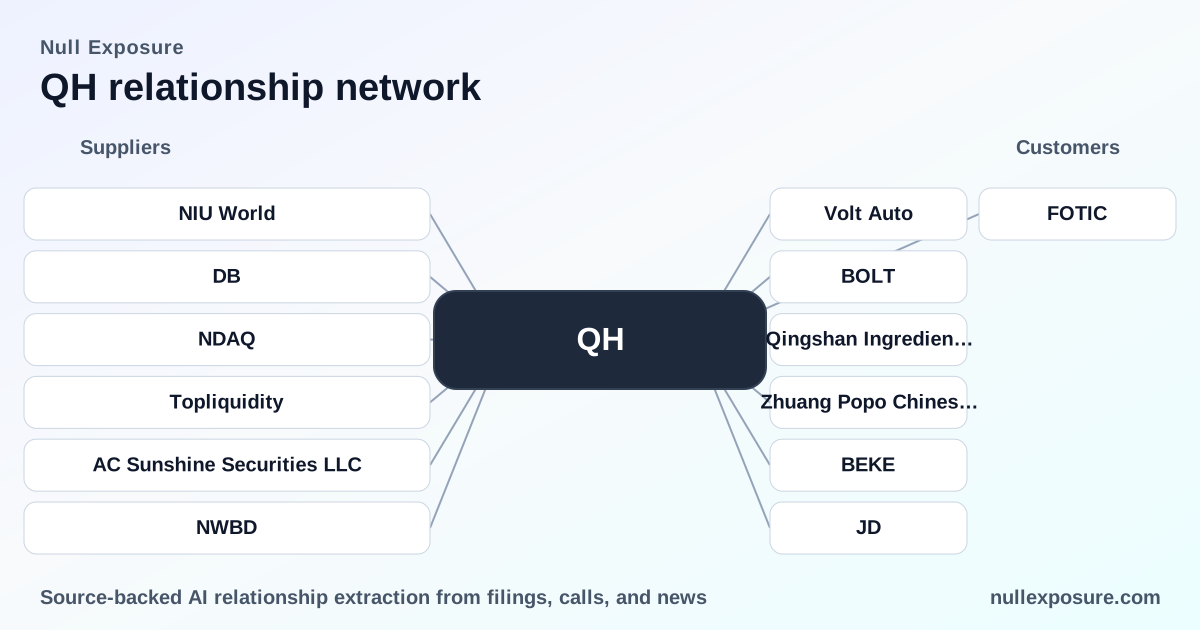
QH’s partner map: revenue levers, strategic posture, and what investors should price in
QH monetizes a multi‑service platform by contracting with local mobility, delivery, property and food brands to feed its Lailai accommodation and incubation businesses; revenue comes from service fees, revenue‑sharing on deliveries and accommodation, and recurring property‑management and asset‑upgrade contracts. Partnerships are the growth engine—the company scales by signing distribution and service agreements rather than heavy asset builds, converting platform reach into fee income and predictable monthly streams.
For a fuller view of how these customer ties translate to monetization and risk, see Null Exposure’s analysis: https://nullexposure.com/
How QH operates in practice: a concise operating model read
QH runs a composite operating model that blends platform orchestration, third‑party service integration, and branded incubation. Contracting posture is cooperative and low‑capex: QH emphasizes partnerships with local players (delivery apps, real estate platforms, food brands and mobility providers) rather than vertical integration. The commercial mix implies low single‑counterparty concentration across the set of disclosed relationships, while reliance on these partners is operationally critical for distribution and demand generation for Lailai and incubation offerings. Given the mix of nascent incubation brands and larger platform partners, maturity is heterogeneous—some relationships deliver immediate revenue uplift, others are early‑stage growth initiatives.
Note: there were no explicit constraint excerpts provided in the source payload; the operating model characteristics above are company‑level signals inferred from QH’s disclosed partner set.
For continuous updates on how these partnerships evolve, visit Null Exposure: https://nullexposure.com/
Relationship roll call — each disclosed customer and what they deliver
Below are every partner mention captured in the reviewed sources. Each entry is a plain‑English summary followed by the source context.
Volt Auto
QH cites cooperation in Azerbaijan with Volt Auto as an example of its partnership model, illustrating cross‑border mobility or logistics collaboration that supports local operations. Source: QH 2025 Q2 earnings call (transcript, Mar 2026).
BOLT (capitalized)
QH referenced Bolt alongside Volt Auto in the Azerbaijan cooperation example, indicating a mobility or delivery partner used to enable local service delivery in that market. Source: QH 2025 Q2 earnings call (Mar 2026).
Bolt (lowercase)
The duplicate mention of Bolt in the same earnings call reinforces that the company uses mobility platforms like Bolt to execute localized service models and demonstrates management’s emphasis on that partnership in investor communications. Source: QH 2025 Q2 earnings call (Mar 2026).
JD, Jingdong Takeaway
QH reported a recent cooperation with JD (Jingdong Takeaway) to provide delivery services in certain cities, which channels third‑party logistics into its core business and supports incremental order flow for Lailai and affiliated merchants. Source: QH 2025 Q2 earnings call (Mar 2026).
JD (duplicate row)
A second earnings‑call mention of JD in the dataset repeats the same cooperation detail and underscores the strategic role of major Chinese delivery platforms in QH’s go‑to‑market for food and local services. Source: QH 2025 Q2 earnings call (Mar 2026).
Qingshan Ingredient Store
QH’s incubation platform has secured cooperation with Qingshan Ingredient Store to deliver differentiated fresh‑beef experiences to local markets, signaling product incubation partnerships targeted at menu diversification and consumer retention. Source: Yahoo Finance coverage of FY2025 partnership announcements (Mar 2026).
Zhuang Popo Chinese Fresh Claypot
The incubation platform also partnered with Zhuang Popo Chinese Fresh Claypot, which expands QH’s consumer offerings through curated F&B brands and supports menu and traffic experiments in its markets. Source: Yahoo Finance coverage of FY2025 partnership announcements (Mar 2026).
Beike (Ke Holdings)
QH attributes a substantial portion of LaiLai accommodation revenue growth to a new cooperation with Beike, using the housing transactions and services platform to expand property‑related offerings and drive occupancy and service volume. Source: QH 2025 Q2 earnings call (Mar 2026).
BEKE (duplicate news reference)
A market report summarizing FY2025 activity also described a partnership with BEKE, noting that the Lailai subsidiary would provide pre/post listing maintenance, daily housekeeping and tailored services to expand property‑management reach in major Chinese cities. Source: ts2.tech report summarizing FY2025 news (Nov 2025 / cited Mar 2026).
BEKE (earnings‑call duplicate)
The earnings call repeats BEKE/Beike as a primary partner supporting a 63.6% year‑over‑year revenue increase in LaiLai accommodation, confirming that property‑platform tie‑ups are material contributors to near‑term top‑line growth. Source: QH 2025 Q2 earnings call (Mar 2026).
Qingshan / Zhuang Popo cross‑linking note
(Although already listed individually above, the public copy links both Qingshan and Zhuang Popo as incubation clients in the FY2025 program, reinforcing the multi‑brand approach to food incubation and localized product testing.) Source: Yahoo Finance FY2025 partnership coverage (Mar 2026).
FOTIC
QH’s subsidiary Lailai reported a Trust Plan collaboration with FOTIC that management expects will add over RMB 10 million in monthly revenue by year‑end 2025, reflecting monetization through financing/asset‑management arrangements for long‑term rentals and property upgrades. Source: ts2.tech FY2025 summary (Nov 2025 / cited Mar 2026).
What this partner set implies for investors
- Revenue model diversity: QH combines transaction‑based fees (delivery and accommodation), recurring property‑management income, and incubation‑driven product revenue—this mix reduces pure play cyclicality and upsides from cross‑sell.
- Partnership dependency is strategic but distributed: the company leans on large platforms (JD, Beike/BEKE, Bolt) for distribution while also incubating smaller food brands; risk is mitigated by spreading counterparties, but the loss of a major platform partner would be operationally meaningful.
- Near‑term growth drivers identified: management identifies Beike as a clear contributor to Lailai’s revenue acceleration, and the FOTIC Trust Plan has an explicit monthly upside target that increases revenue predictability.
- Operational maturity is mixed: incubation brands are early‑stage, while property and delivery partnerships run on established platforms; investors should value steady fee streams distinctly from experimental incubation upside.
Risks and what to watch next
- Counterparty concentration risk around a few large platforms—track renewal terms and exclusivity clauses in future filings.
- Execution risk on incubation: product rollouts with Qingshan and Zhuang Popo are value‑additive but require execution to scale.
- Asset‑management revenue realization: the FOTIC Trust Plan sets a concrete revenue target; monitor monthly revenue trends and disclosure around realized versus projected amounts.
Bottom line
QH’s partnership ecosystem is the company’s operational lifeblood: it converts platform linkages into recurring property and delivery fees while using incubation to capture higher‑margin product upside. Investors should underwrite growth from the Beike and FOTIC arrangements and treat incubation as optional upside, tracking partner renewals and the cadence of disclosed monthly revenue contributions.
For ongoing partner monitoring and raw source tracking, visit Null Exposure’s research hub: https://nullexposure.com/