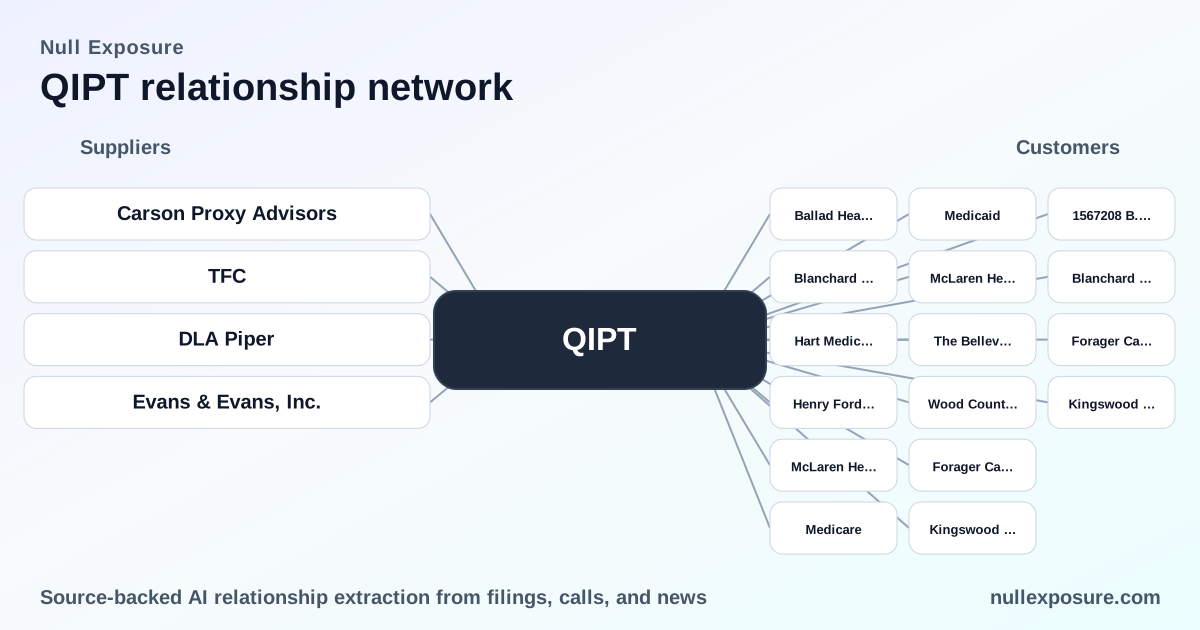
QIPT customer relationships: what investors need to know
Quipt Home Medical (QIPT) operates and monetizes as a U.S.-focused provider of durable/home medical equipment (DME/HME) that both rents recurring equipment on short monthly cycles and sells hardware and consumables at delivery, while recognizing the majority of revenue through reimbursement flows from government payors and private insurers. Recent corporate actions — a joint-venture-style acquisition of Hart Medical and a planned sale of the company to private buyers — change the company’s referral access and ownership profile and should be read as strategic moves to lock in discharge flows and recurring rental margins. For a concise intelligence snapshot and documentation, see Null Exposure’s research hub: https://nullexposure.com/.
What changed with the Q3 2025 announcements
Quipt disclosed a milestone transaction following Q3 2025 that centers on Hart Medical Equipment and a joint-venture arrangement anchored by major hospital systems. Management described a deal that preserves hospital partner ownership while giving Quipt access to embedded referral flows and continuity of institutional ties. According to an HME Business report (FY2025), Hart serves more than 67,000 patients monthly and is embedded in discharge processes across more than 19 hospitals; Quipt structured the Hart deal as a joint venture with hospital partners retaining a 40% stake to preserve those referral relationships. The combination of inpatient discharge access plus recurring rental revenue is a direct lever for improving utilization and margin recovery on existing inventory.
Company-level operating signals investors should factor
Across filings and commentary, several operating and business-model characteristics are explicit and material inputs into valuation and risk:
- Short-term contracting posture: Most payor contracts are cancelable on 30–90 days’ notice, and rental revenue is typically recognized monthly, creating sensitivity to payor behavior and volume swings.
- Mix of recurring rentals and spot sales: The company recognizes sales on delivery for equipment and consumables, while rentals are recognized over short non-cancelable rental periods (typically one month).
- Payor concentration and collection risk: Revenue is driven by reimbursements from Medicare, Medicaid and private insurers, so payor policy changes translate directly to cash flow.
- Geographic and segment focus: Quipt operates in the U.S. across 27 states and reports a single operating segment focused on DME/HME hardware and related services.
- Customer concentration: Management reports no customers accounting for 10% or more of consolidated revenue in FY2025, a signal of low single-customer concentration.
These signals imply high operational flexibility but elevated payor and volume risk, while the Hart JV and hospital partnerships are designed to partially offset that volatility by securing referral volume.
For more context on how these relationships map to value, visit Null Exposure: https://nullexposure.com/.
Relationship-by-relationship rundown (every name in the results)
Below I list each relationship mentioned in the collected results with a succinct, source-linked summary.
Ballad Health
Quipt announced a milestone transaction with Ballad Health, an integrated system of 20 hospitals serving four states, signaling expanded geographic referral reach in the Appalachian Highlands. This disclosure came in Quipt’s Q3 2025 earnings call (first seen March 7, 2026).
Blanchard Valley Health
Quipt said it had a definitive agreement to form a joint venture anchored by Blanchard Valley Health alongside Henry Ford and McLaren, which provides referral integration and institutional continuity for the JV. That comment was made on the Q3 2025 earnings call (March 2026).
Hart Medical Equipment
Hart is the center of the milestone transaction; it serves tens of thousands of patients monthly and is embedded in hospital discharge flows, and Quipt structured the acquisition to capture Hart’s referral streams while maintaining hospital ties. An HME Business article (FY2025) and Quipt’s Q3 2025 call provide the details.
Henry Ford Health
Henry Ford Health is an anchor partner in the announced joint venture, retaining equity in the arrangement that gives Quipt access to institutional discharge referrals. The JV was described during Quipt’s Q3 2025 earnings call and reported in HME Business (FY2025).
McLaren Health
McLaren Health was named as an anchor partner in the same JV, giving Quipt placement into McLaren-affiliated discharge flows and affiliated hospitals. Management discussed this on the Q3 2025 earnings call (March 2026).
Medicare
Quipt’s revenue model is explicitly driven by reimbursements from government agencies such as Medicare; the company reports revenues recorded at amounts estimated to be received under these reimbursement arrangements. This is summarized in a FY2025 market report and reflected in Quipt’s SEC filings as reported on TradingView (FY2025).
Medicaid
Medicaid is likewise a core payor in Quipt’s reimbursement mix and contributes to the firm’s top-line recognition policies tied to third‑party collections. TradingView coverage of Quipt’s FY2025 disclosures highlights this payor exposure.
McLaren Health Care
McLaren Health Care is referenced in HME Business coverage as one of the major hospital systems linked to Hart’s referral network, confirming Quipt’s extended access to McLaren-affiliated discharge processes through the Hart transaction (FY2025).
The Bellevue Hospital
The Bellevue Hospital is one of the facilities named by HME Business as part of Hart’s hospital affiliations, indicating additional institutional discharge channels that flow into Quipt’s service footprint (FY2025).
Wood County Hospital
Wood County Hospital appears among the hospitals HME Business identified as having longstanding referral relationships with Hart, further mapping Quipt’s downstream referral capture opportunity (FY2025).
Forager Capital Management, LLC
Forager Capital Management, LLC is a buyer-affiliate in the announced sale of Quipt for $3.65 per share, representing the private acquisition interest that will alter public ownership and strategic options. The Globe and Mail and SAHM Capital reported the FY2026 arrangement details.
Kingswood Capital Management, L.P.
Affiliates of Kingswood Capital Management are the co-bidders with Forager in the proposed cash acquisition of Quipt at US$3.65 per share, a transaction disclosed in the company’s FY2026 proxy and media coverage (The Globe and Mail; TradingView).
1567208 B.C. Ltd.
1567208 B.C. Ltd. is named as the purchaser in the arrangement agreement filed in connection with the proposed plan of arrangement, referenced in Quipt’s proxy and press release materials cited by The Globe and Mail (FY2026).
Blanchard Valley Health System
Blanchard Valley Health System is listed in HME Business coverage as a partner embedded in Hart’s referral network and as one of the anchoring hospital systems in the JV structure, reinforcing Quipt’s institutional distribution channels (FY2025).
Henry Ford Health (duplicate entry)
Henry Ford Health is reiterated in media coverage as an anchor JV partner; the repeat mention reflects both the earnings call disclosure and subsequent reporting in HME Business (Q3 2025 / FY2025).
Forager Capital Management, LLC (duplicate entry)
Forager Capital Management is again cited in press coverage and the proxy describing the $3.65-per-share acquisition terms that will take Quipt private if completed (FY2026).
Forager Capital
News outlets referenced Forager Capital in transaction coverage that summarized the acquisition terms; this naming reinforces the private equity buyer group narrative reported in FY2026 news flow.
Kingswood Capital Management (duplicate entry)
Kingswood Capital Management is again referenced across press accounts as the co-bidder in the acquisition, confirming alignment between public filings and media summaries (FY2026).
Strategic implications and risks
- Positive: The Hart JV and hospital partnerships materially improve referral exposure and lower customer acquisition costs for rentals and recurring billing, strengthening revenue visibility on the margin. The JV structure (hospital partners retaining economic interest) preserves institutional alignment and reduces integration friction.
- Negative: Short-term payor contracts and dependence on Medicare/Medicaid create vulnerability to rapid volume and reimbursement changes; the business remains exposed to collection and policy risk. The pending private acquisition at US$3.65 per share will change capital structure and governance, potentially altering strategic priorities.
Investors evaluating QIPT should weigh the near-term referral upside against the structural payor risk and the implications of private ownership on future disclosures. For deeper relationship analytics and document-level sourcing, visit Null Exposure: https://nullexposure.com/.