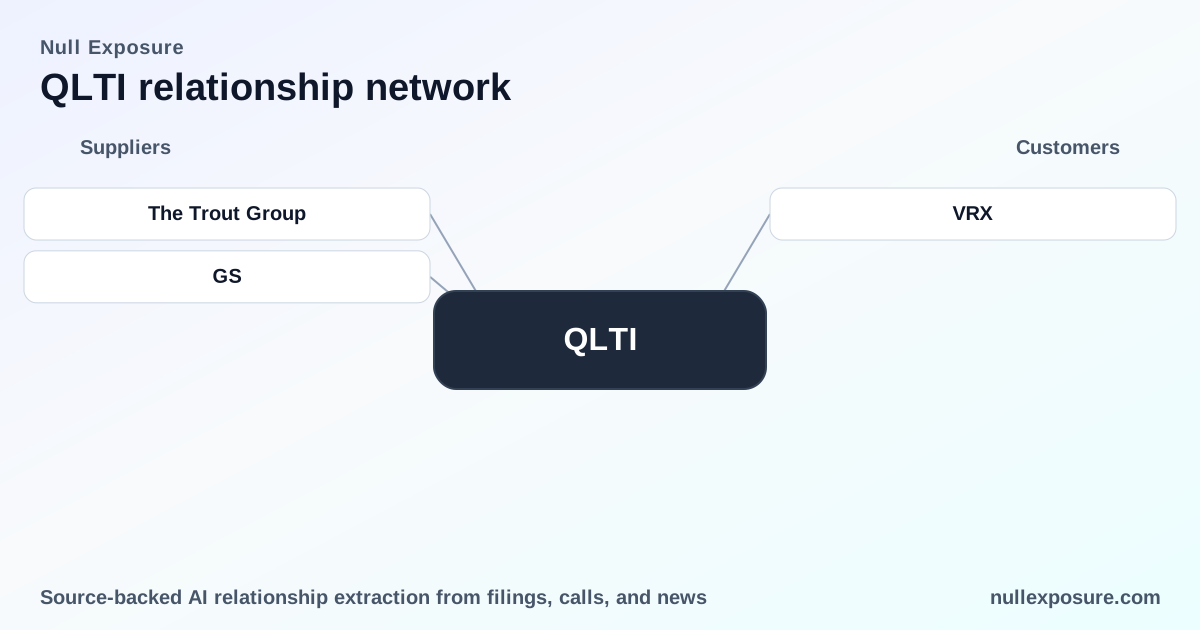
QLTI: The Visudyne divestiture and what it tells investors about concentration, liquidity, and strategic repositioning
QLT Inc. monetizes intellectual property through product licensing and asset sales; its most consequential customer/partner relationship historically was the sale of its flagship ophthalmology product, Visudyne, to Valeant, a transaction that converted an operational revenue stream into a near-term cash infusion and contingent royalties. For investors and operators, the deal structure and subsequent workforce reductions reveal a firm pivot from product commercialization toward balance-sheet management and narrower operational scope. Learn more about our analysis at https://nullexposure.com/.
Why the Visudyne sale matters to holders and counterparties
The sale of Visudyne for $112.5 million upfront plus up to $20 million in contingent consideration dramatically altered QLT’s revenue profile and counterparty exposure: recurring product sales to end customers were replaced by contractual receivables and contingent royalty upside tied to Valeant’s commercialization performance. That shift increases counterparty credit concentration and reduces operational complexity while creating earn-out dependency as a material component of future upside. A concise read of the press and filings tells the full story below.
The public record — each reported relationship and what it means
Valeant Pharmaceuticals International Inc (domain-b report, FY2012)
A domain-b industry report states Valeant acquired the Visudyne business from QLT for over $112.5 million, positioning the buyer to strengthen its ophthalmology portfolio and giving QLT immediate liquidity from the sale (https://www.domain-b.com/industry/canada-s-valeant-pharma-acquires-qlt-s-visudyne-for-over-112-5-mn). This transaction crystallized value for QLT but replaced operating revenue with transactional proceeds.
VRX (domain-b report, FY2012)
The same domain-b coverage repeats the buyer as VRX, confirming the buyer’s ticker identity and market intention to scale the acquired ophthalmology asset (https://www.domain-b.com/industry/canada-s-valeant-pharma-acquires-qlt-s-visudyne-for-over-112-5-mn). For investors, the repetition underscores market attention on the buyer’s role in unlocking product reach and royalties.
Valeant Pharmaceuticals Inc. (Globe and Mail, FY2025)
The Globe and Mail reported that the Visudyne sale triggered downstream actions at QLT, including a workforce reduction and a $2 million charge, explicitly linking the operational downsizing to the divestiture of its flagship product for $112.5 million (https://www.theglobeandmail.com/globe-investor/qlt-cutting-42-per-cent-of-work-force-to-take-2-million-charge/article6020639/). That public reporting frames the transaction as a strategic retrenchment, with immediate cash benefits offset by restructuring costs.
VRX (Globe and Mail summary, FY2025)
Globe and Mail headlines also referenced VRX in recounting the sale, reiterating that transaction pricing and strategic impacts were central to QLT’s subsequent restructuring (https://www.theglobeandmail.com/globe-investor/qlt-cutting-42-per-cent-of-work-force-to-take-2-million-charge/article6020639/). This confirms market recognition that the buyer identity and price materially influenced QLT’s corporate decisions.
Valeant Pharmaceuticals International, Inc. (Globe and Mail, FY2025 — deal economics)
Another Globe and Mail article documents the earn-out mechanics: under the deal Valeant could pay up to an additional $20 million—$15 million tied to royalties outside the U.S. and $5 million for a laser development program—making future cash tied to Valeant’s commercial execution and program development (https://www.theglobeandmail.com/globe-investor/valeant-buying-visudyne-treatment-for-blindness-from-qlt/article4563025/). That structure transferred commercialization risk to the buyer while preserving upside for QLT via contingent payments.
VRX (Globe and Mail confirmation, FY2025 — earn-out detail)
The Globe and Mail coverage also frames those contingent payments with the buyer’s ticker VRX, reiterating that the contingent consideration is dependent on VRX’s international sales and program milestones, and thus creates a concentrated counterparty credit and performance risk for QLT’s future receipts (https://www.theglobeandmail.com/globe-investor/valeant-buying-visudyne-treatment-for-blindness-from-qlt/article4563025/). Investors should treat that contingent pool as non-guaranteed upside tied to a single commercial partner.
What the deal structure implies about QLT’s operating model and constraints
- Contracting posture: QLT exercised a sell-down strategy that prioritized immediate liquidity and risk transfer. The company shifted from a seller-of-product model to a licensor/contingent-claim posture, reducing operational exposure to manufacturing, distribution, and direct sales contracting.
- Concentration: Post-sale, QLT’s prospective cash flow became highly concentrated on a single counterparty (Valeant/VRX) for contingent royalties and milestone payments, increasing counterparty credit risk and dependence on the buyer’s commercial execution.
- Criticality: Visudyne was QLT’s flagship asset; selling it reduces operational criticality in terms of product dependence but increases financial criticality tied to the sale proceeds and contingent recovery—cash management becomes critical.
- Maturity and strategic trajectory: The transaction signals corporate maturity toward asset monetization rather than continued commercialization, consistent with workforce reduction and cost rationalization described in subsequent reporting.
Investor implications — risks, returns, and monitoring priorities
- Risk profile moved from execution risk to counterparty credit and milestone realization. Investors must re-price QLT on the probability-weighted realization of the $20 million contingent consideration and the sustainability of cash reserves post-restructuring.
- Operational leverage declines while financial leverage and event risk concentrate. The workforce reductions and charge suggest reduced burn, but also diminished ability to relaunch product-driven growth absent new asset acquisition or partnering.
- Monitor Valeant/VRX commercial performance and regulatory filings closely. Royalty triggers and milestone payouts are the principal drivers of upside; track Valeant’s sales disclosures, geographic rollout, and the laser program’s development status.
Bottom line and next steps for analysts
The Visudyne sale converted a core commercial asset into a cash event plus contingent upside and forced QLT into a smaller operational footprint with concentrated counterparty exposure. Valuation must account for the upfront proceeds, restructuring impacts, and the probability-weighted value of contingent payments tied to Valeant/VRX performance.
For a deeper read on counterparties and contract-level signals, visit https://nullexposure.com/ for our full analytical toolkit and ongoing monitoring coverage.
Key takeaway: QLT traded recurring product revenue for immediate liquidity and concentrated contingent upside—investors should treat QLT as a company whose near-term value hinges on a single buyer’s commercial outcomes and the company’s ability to redeploy proceeds or manage a reduced cost base.