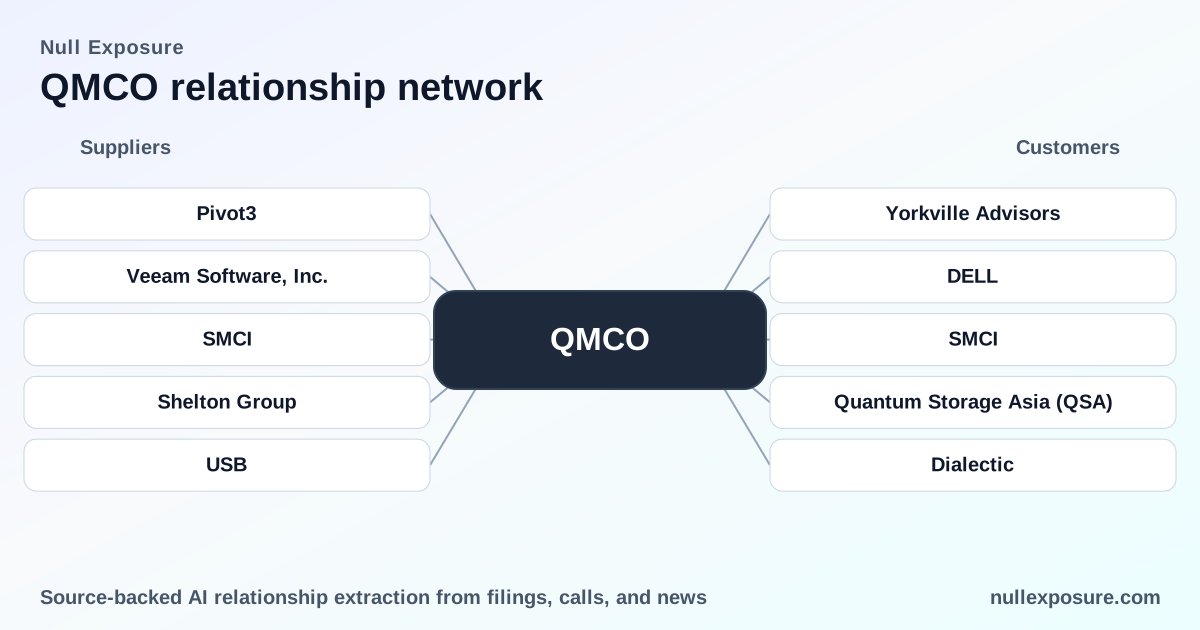
Quantum Corporation (QMCO): customer map and commercial implications
Thesis: Quantum generates revenue by selling a mix of hardware, software and recurring services to large enterprises and government agencies, monetizing through product sales, software licenses, per-unit royalties to manufacturers, and multi-year support and subscription contracts; the business is diversified across product segments and geographies, with service and licensing models that increase recurring revenue and reduce single-customer concentration. For a distilled view of customer relationships and the operational constraints that drive commercial risk, see our notes below or visit https://nullexposure.com/ for more company intelligence.
How Quantum’s commercial model works in practice
Quantum’s go-to-market blends three cash engines: device and media hardware (tape drives and media), storage software and systems (primary and secondary storage), and services/subscriptions (support, deployment, and Quantum-as-a-Service). Revenue recognition mixes up-front hardware sales with ratable service and subscription revenue and per-unit royalties where third-party manufacturers include Quantum IP in their products. That hybrid model supports stable recurring revenue while keeping capital intensity tied to hardware cycles.
Key revenue drivers:
- Hardware sales tied to data center refresh cycles and tape-market demand.
- Software & subscriptions that generate annuity-like revenue and sticky support contracts.
- Licensing/royalties from third-party manufacturers that broaden reach without fixed manufacturing cost.
Customer relationships you need to know
Below I cover every relationship surfaced in the source material and explain what each connection signals for investors.
Yorkville Advisors
Quantum announced a standby equity purchase agreement with Yorkville, positioning Yorkville as a strategic financial partner providing committed capital post‑quarter. This is described in Quantum’s 2025 Q3 earnings commentary and reflects financial backstopping rather than an operational customer contract (2025 Q3 earnings call).
NICSI
Quantum lists NICSI among Indian enterprise and government customers using its solutions for data protection and archiving, illustrating penetration into India’s public-sector IT market. This relationship is mentioned in an Economic Times profile of Quantum’s India business (FY2022 Economic Times).
Kalaignar TV
Quantum serves Kalaignar TV in India for broadcast media workflows and media retention, indicating traction in regional broadcast verticals that require long-term media asset management (FY2022 Economic Times).
Pink Elephant
Pink Elephant deployed Quantum’s ActiveScale Cold Storage as the foundation for a new archive service called DMaaS Clouddrive Cold, showing partner-led managed service deployment of Quantum storage technology (Intellectia / company news, FY2026).
Bharat Electronics
Bharat Electronics uses Quantum products for video imaging retention, reflecting deployment within Indian defense-related industrial customers and reinforcing vertical demand in government and public sector procurement channels (FY2022 Economic Times).
Isro
Quantum is cited as providing data archiving solutions to ISRO, signaling high-criticality government use cases where long-term data preservation and integrity are required (FY2022 Economic Times).
Miami HEAT
The Miami HEAT’s creative services team uses Quantum’s CatDV metadata and media-logging tools to accelerate live-sports production workflows, demonstrating enterprise media workflow adoption in sports and media production (MarketScreener, FY2026).
Dell
Quantum sources many products from third-party suppliers such as Dell, and management explicitly referenced buying products from Dell in the 2025 Q3 earnings call discussion of manufacturing footprints and supply chain (2025 Q3 earnings call).
Supermicro
Supermicro is another supplier mentioned alongside Dell as a manufacturing and sourcing partner for hardware components, which impacts Quantum’s supply chain footprint and cost of goods sold (2025 Q3 earnings call).
Quantum Storage Asia (QSA)
Quantum recorded a provision for an outstanding receivable after terminating QSA’s distribution rights, reflecting a credit and contractual dispute with a former distributor and signaling localized channel-risk and receivable concentration in Asia (InsiderMonkey transcript of Q3 2026/2025 call commentary, FY2026).
Dialectic
Quantum executed financing agreements that included a Registration Rights Agreement with Dialectic, giving investors registration protections for convertible securities tied to financing transactions—this is a capital markets relationship rather than a customer contract (TradingView summary, FY2025).
Constraints and what they signal about Quantum’s operating posture
The company disclosures and excerpts produce several consistent business-model signals investors should factor into valuation and risk assessment.
-
Contracting posture — direct sales plus channel: Quantum sells directly to large corporates and government agencies while also relying on distributors and third-party manufacturers that license its IP. This dual posture provides reach but elevates counterparty and channel-credit risk where local distributors concentrate receivables (evidence: customer disclosure and QSA receivable provision).
-
Concentration — broadly distributed revenue: Sales to the top five customers were 21% of revenue in FY2025 and none represented 10% or more, which implies low single-customer concentration and reduces idiosyncratic counterparty risk to the revenue line.
-
Criticality — high in select verticals: Customers include government agencies (ISRO, NICSI), defense-related firms (Bharat Electronics), and media/sports organizations that treat storage and archive as mission‑critical assets; loss of service would be high-impact in these verticals.
-
Maturity and product mix — legacy hardware transitioning to services: The company still sells tape drives and media, a mature market, while pushing software, support and ActiveScale cloud-cold storage—transitioning from capex hardware cycles to recurring software/service revenue.
-
Geographic reach — global support footprint: Quantum reports service capability across 100+ countries with 24-hour support centers across regions, indicating operational maturity to serve global enterprise and government clients.
-
Role diversification — licensor and service provider: Quantum operates simultaneously as licensor/manufacturer (royalties from third-party manufacturers) and as a service provider (support, subscriptions, QaaS), which smooths revenue volatility but introduces dependence on license compliance and channel partners.
Investment implications and risk checklist
- Upside: Recurring software and service growth combined with licensing revenue provide a path to margin stabilization and higher revenue visibility. Government and enterprise customers create stickiness in mission-critical storage use cases.
- Downside: Distributor credit risk (QSA provision) and supply-chain exposure to suppliers like Dell and Supermicro can pressure margins and working capital. The company’s fiscal profile shows negative EPS and mixed profitability indicators that require monitoring of operating leverage as services scale.
- Watch items: collection trends with former distributors, revenue mix shift to services, contract renewal cadence with large government customers, and capital markets activity tied to financing partners such as Yorkville and Dialectic.
For a concise intelligence brief on QMCO’s customer footprint and credit posture, visit https://nullexposure.com/ — and if you want ongoing monitoring of these customer and channel dynamics, our platform provides timely updates and source-linked analysis.
Bold takeaway: Quantum is a diversified storage vendor whose mixed model of hardware, licensed manufacturing royalties and recurring services reduces single-customer dependency while introducing distributor and supply-chain exposures that are material to short-term cash and receivable dynamics.