QNRX: Who is buying in, who will sell for them, and why investors should care
Quoin Pharmaceuticals (QNRX) is an early-stage specialty biotech focused on novel drug delivery and rare-disease therapeutics that currently generates no product revenue and monetizes through licensing, distribution partnerships and equity financing to fund clinical development. The company is building a U.S./European direct commercial capability for its lead program while signing regional distribution agreements for markets outside those territories; capital raises from healthcare-focused investors have been used to bridge development into potential regulatory milestones. For a concise, relationship-driven perspective on counterparties and commercial reach, visit Null Exposure. https://nullexposure.com/
Why the counterparty map matters for an investor in QNRX
Quoin is a pre-commercial, capital-dependent biotech: its income profile depends on successful regulatory outcomes and the structure of regional commercialization deals. The recent financing and an explicit distribution tie-up in MENA provide two complementary signals: funding depth and pathway-to-market outside the U.S./Europe. These relationships therefore matter both for runway and the practical reach of any approved product.
Key company-level signals:
- Pre-revenue, negative operating metrics and a small market cap (Market Cap ~$11.5M; EBITDA negative) point to an early-stage balance of financing risk and binary clinical upside.
- Contracting posture: Quoin plans to “establish our own sales infrastructure in the U.S. and Europe” while using distribution partners elsewhere — this is a hybrid commercialization model that keeps direct control in major markets and outsources in others.
- Geographic footprint: Evidence supports active plans for North America and EMEA commercialization and use of regional distributors in other territories.
- Concentration and criticality: Single regional distributors (e.g., in MENA) will be strategically critical in those territories; financing participants are numerous but not household names, implying a syndicate of specialized healthcare investors rather than a single anchor institution.
The institutional backers who participated in Quoin’s recent private placement
Quoin completed a private placement in early 2026 that brought in a syndicate of healthcare-focused investors. These participants provide near-term capital and signal specialized investor interest — useful context for assessing runway and strategic alignment.
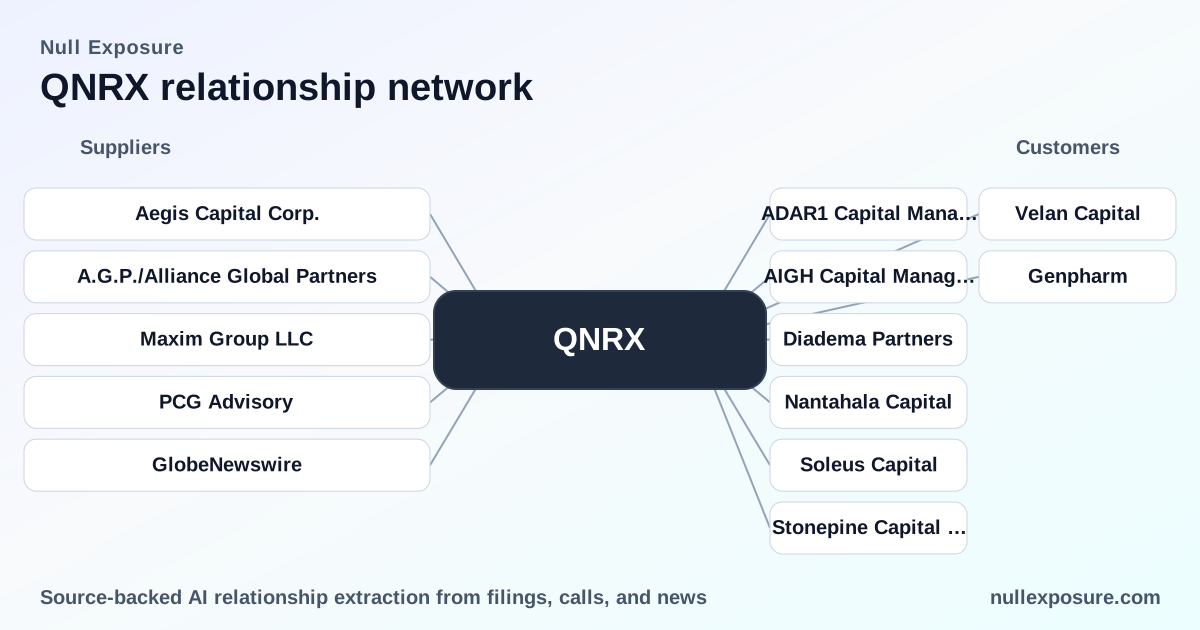
- ADAR1 Capital Management — ADAR1 participated in Quoin’s private placement, joining other healthcare-focused investors in the financing round. According to a Yahoo Finance release dated March 10, 2026, ADAR1 was listed among the participants.
- AIGH Capital Management — AIGH was named as a participating investor in coverage of the financing and was highlighted by market commentary that tracked the placement and subsequent share-price reaction on March 10, 2026. (Parameter.io, Mar 10, 2026).
- Diadema Partners — Diadema joined the financing syndicate that provided growth capital to Quoin, as reported in the March 10, 2026 Yahoo Finance announcement.
- Nantahala Capital — Nantahala Capital participated alongside other healthcare investors in the private placement that closed in early 2026, per the Yahoo Finance release (Mar 10, 2026).
- Soleus Capital — Soleus Capital was disclosed as a participating institution in reporting on the financing and market reaction; the participation was noted in contemporaneous coverage (Parameter.io, Mar 10, 2026).
- Stonepine Capital Management — Stonepine Capital Management was included among the institutions that funded the private placement, according to the March 10, 2026 Yahoo Finance release.
- Velan Capital — Velan Capital participated in the placement, joining the syndicate of healthcare-oriented investors noted in the March 10, 2026 Yahoo Finance report.
Each named investor’s participation is a financing signal: they provided near-term capital but are not described as strategic commercial partners, so their value to Quoin is financial and validation-oriented rather than operational.
Genpharm: the commercial partner that shapes regional access
Genpharm — Quoin’s announced distribution partner for QRX003 in Saudi Arabia and other MENA countries — is the single explicit commercial counterparty disclosed in public filings and releases. Quoin has described Genpharm as its established distributor for QRX003 in those territories, which creates a clear go-to-market route in a region with high unmet need for rare-disease therapies. This relationship was described in Quoin’s press release on January 20, 2026 (GlobeNewswire) and reiterated in subsequent market coverage. The Genpharm tie-up is operationally critical for MENA commercialization and will drive early revenue potential in that region if QRX003 receives approval.
What the constraints say about Quoin’s operating model
Quoin’s disclosures and evidence excerpts indicate two geographic constraints as company-level signals: focus on North America (NA) and Europe (EMEA) for direct commercialization, and the use of distribution partners for other territories. That operating choice implies:
- Higher fixed-cost commitment in NA/EMEA while relying on lower-capex, partner-led rollouts in other markets.
- Concentration risk in partner-dependent territories: if a distributor underperforms or a partner agreement is delayed, local market access and revenue timing will be affected.
- Maturity signal: the company is in a transitional phase from pure R&D to commercial execution; the financing syndicate increases runway but does not reduce the binary nature of regulatory risk.
Investment implications — positioning risk and upside
- Upside: If QRX003 secures approvals and the Genpharm channel performs, Quoin would convert an early-stage R&D asset into first-in-class commercial sales in underserved MENA markets while retaining direct control in the largest Western markets. That split model preserves upside in high-value markets and accelerates access in regions where a local partner has distribution capability.
- Downside: The company is pre-revenue with negative operating metrics and a small market capitalization, and the business is dependent on successful financing and regulatory outcomes. The private placement syndicate reduces near-term cash risk but does not eliminate milestone or execution risk.
- De-risking events to watch: breakthrough designation decisions, regulatory filings and approvals for QRX003, the formal terms and performance milestones in the Genpharm distribution agreement, and any follow-on institutional support from the current investor group.
For readers who want a relationship-first view of small-cap biotechs like Quoin, Null Exposure provides consolidated counterparty mapping and source-linked summaries. https://nullexposure.com/
Bottom line
Quoin’s recent investor syndicate and the Genpharm distribution agreement create a pragmatic commercialization blueprint: direct sales in the U.S./Europe coupled with partner-led access in MENA. That structure balances control and speed-to-market but preserves concentration and milestone-driven risk that investors need to price explicitly. Monitoring regulatory progress and the execution of the Genpharm partnership will determine whether the company’s commercialization posture converts into sustainable revenue.