QuinStreet (QNST): How customer contracts and carrier budgets are powering the FY2026 rebound
QuinStreet is a performance marketing company that sells qualified customer acquisition outcomes—clicks, leads, calls, applications, and customers—to large advertisers, primarily in financial services and home services. It monetizes almost exclusively on a usage-based, per-action model under short-duration, cancellable contracts, concentrating revenue in North America and with a small number of large customers responsible for a meaningful share of sales. For an investor, the thesis is straightforward: QuinStreet’s earnings are levered to auto-insurer marketing budgets and its ability to convert traffic into profitable, contract-defined outcomes; as carrier acquisition spend normalizes upward in FY2026, revenue growth and margin expansion follow. Learn more at https://nullexposure.com/.
Why the customer architecture defines the business outcome
QuinStreet’s contracts and revenue mix are the business model. The company is paid when it delivers a defined action, which aligns its incentives to client acquisition-cost targets but also makes revenue sensitive to marketer budget cycles. QuinStreet reports that most client agreements are month-to-month or terminable at will, and the company historically has had large customers that account for double-digit shares of revenue—two clients represented 23% and 12% of net revenue in fiscal 2025. This combination produces a high-quality, transactional revenue stream that is both scalable and cyclical.
- Contracting posture: Short-term, cancellable agreements are standard; enforceable obligations typically exist on a day-to-day basis, which reduces lock-in but increases client churn sensitivity.
- Pricing structure: Predominantly paid per click/lead/action—usage-based monetization ties revenue directly to deliverables and client acquisition budgets.
- Customer profile: Counterparties are large enterprises; QuinStreet’s client roster includes major auto insurers and other blue-chip advertisers.
- Geographic concentration: The business is predominantly North America—U.S. revenue forms the bulk of net revenue.
- Concentration risk: Material client concentration exists (two clients accounted for 35% of FY2025 revenue combined).
- Relationship maturity and role: The company has long-standing multi-year relationships since its service inception, operating as a seller and service provider of digital marketing outcomes.
These company-level signals define both upside (rapid capture of rising acquisition budgets) and downside (client voluntary exits or budget cuts).
Carrier relationships that matter — concise takeaways for investors
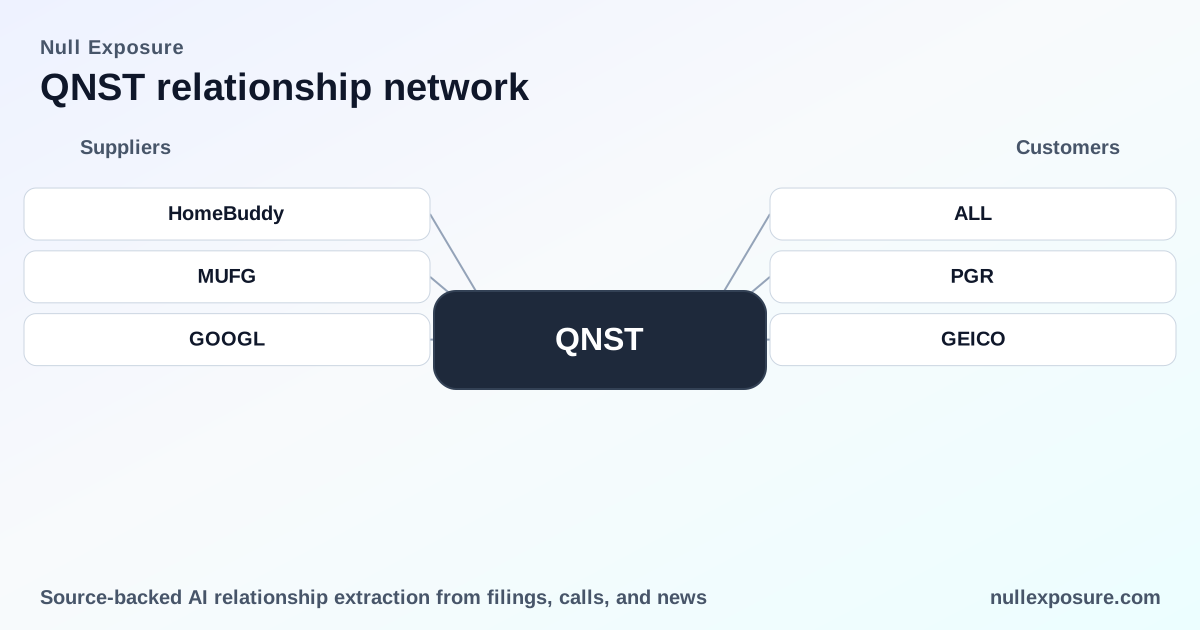
Below are the carrier-level client relationships reported in public sources during FY2026. Each bullet is a plain-English summary with the originating source.
State Farm
State Farm is listed among the major auto carriers whose return to aggressive customer acquisition has driven QuinStreet’s resurgence in FY2026. WebProNews highlighted State Farm alongside Progressive, GEICO, and Allstate as part of the recovery in auto insurance marketing budgets (WebProNews, May 3, 2026).
Allstate
Allstate is explicitly cited by management as one of the “great carriers” referenced on the Q2 FY2026 earnings call, indicating active engagement with QuinStreet’s acquisition services during the recovery (InsiderMonkey transcript, Q2 FY2026 earnings call, Mar 10, 2026). WebProNews also names Allstate when describing renewed insurer marketing spend (WebProNews, May 3, 2026).
Progressive (PGR)
Progressive is repeatedly identified by management and press as a core auto-insurance customer driving higher acquisition demand; the ticker PGR is used in transcripts to refer to Progressive on the Q2 FY2026 earnings call (InsiderMonkey transcript, Mar 10, 2026), and Progressive is listed in a May 2026 article discussing QuinStreet’s turnaround (WebProNews, May 3, 2026).
GEICO
GEICO is named with the same grouping of major carriers credited with boosting acquisition spend and, by extension, QuinStreet’s revenue growth in FY2026. Both the earnings call transcript and the May 2026 press coverage list GEICO among the returning advertisers (InsiderMonkey transcript, Mar 10, 2026; WebProNews, May 3, 2026).
How these relationships translate to financial upside and risk
QuinStreet’s FY2026 momentum is driven by the same two structural forces: (1) the cyclicality of insurer acquisition budgets and (2) the usage-based, short-term nature of its contracts. When carrier marketing spend increases, QuinStreet benefits almost immediately because it is paid per action; conversely, reduced budgets create rapid revenue downside because clients can terminate without penalty.
- Upside: Fast revenue capture when major carriers increase acquisition spend; scalable cost structure where digital media and lead-generation investments are incrementally deployable; improving margins if higher-quality leads increase conversion and lower per-action cost.
- Key risks: High revenue concentration (two clients = 35% of FY2025 revenue) and short-term contracts create client concentration and churn risk; North American concentration limits geographic diversification; usage-based pricing amplifies quarter-to-quarter volatility.
- Financial context: QuinStreet reports roughly $1.1B in trailing revenue and modest operating margins, which positions the company to materially benefit from a multi-quarter expansion in client acquisition budgets while remaining exposed to near-term client budget reversals.
What investors should watch next
Monitor the following indicators to track the sustainability of FY2026 gains:
- Quarterly disclosures on client concentration and any changes to the two clients that together drove 35% of FY2025 revenue.
- Management commentary on client retention and per-action pricing trends from the financial services vertical (Q2 FY2026 call already named major carriers).
- U.S. auto-insurer marketing spend trends and insurer margin cycles that influence acquisition budgets.
For a deeper operational read and continuous signal tracking, visit https://nullexposure.com/ to see how customer relationship intelligence maps to revenue risk and opportunity.
Final takeaway
QuinStreet is a high-leverage, outcome-seller to large North American marketers—especially auto insurers—whose FY2026 rebound is revenue-accretive but remains exposed to client concentration and short-term contract dynamics. Investors should balance the tactical upside from rising acquisition budgets against the structural volatility inherent to per-action, cancelable contracts.