Quantum BioPharma (QNTM): Royalties, CVRs and a non-operating revenue profile investors should price now
Quantum BioPharma builds value primarily as an IP holder and litigation claimant rather than a commercial manufacturer: the company monetizes its position through royalty streams on consumer wellness products and the distribution of contingent value rights (CVRs) tied to litigation outcomes. For investors, the relevant thesis is straightforward — the equity’s optionality is concentrated in a capped royalty contract and in contingent proceeds from settlements; operating cash flow is currently zero and balance-sheet durability depends on realized royalties and any litigation recoveries. For a deeper look at customer relationships and their investment implications, see more at https://nullexposure.com/.
How QNTM actually gets paid — a short investor primer
Quantum’s monetization today is contractual and contingent. The company does not report product revenue; instead it holds royalty entitlements on third-party sales of a branded wellness product and has structured compensation through CVRs tied to legal recoveries. Those arrangements convert third-party commercial execution and court outcomes into cash for Quantum. Given the company’s zero revenue, royalties and litigation proceeds are de facto the company’s revenue model until the firm commercializes its own pipeline or licenses additional assets.
What the published customer relationships reveal about commercialization and counterparty risk
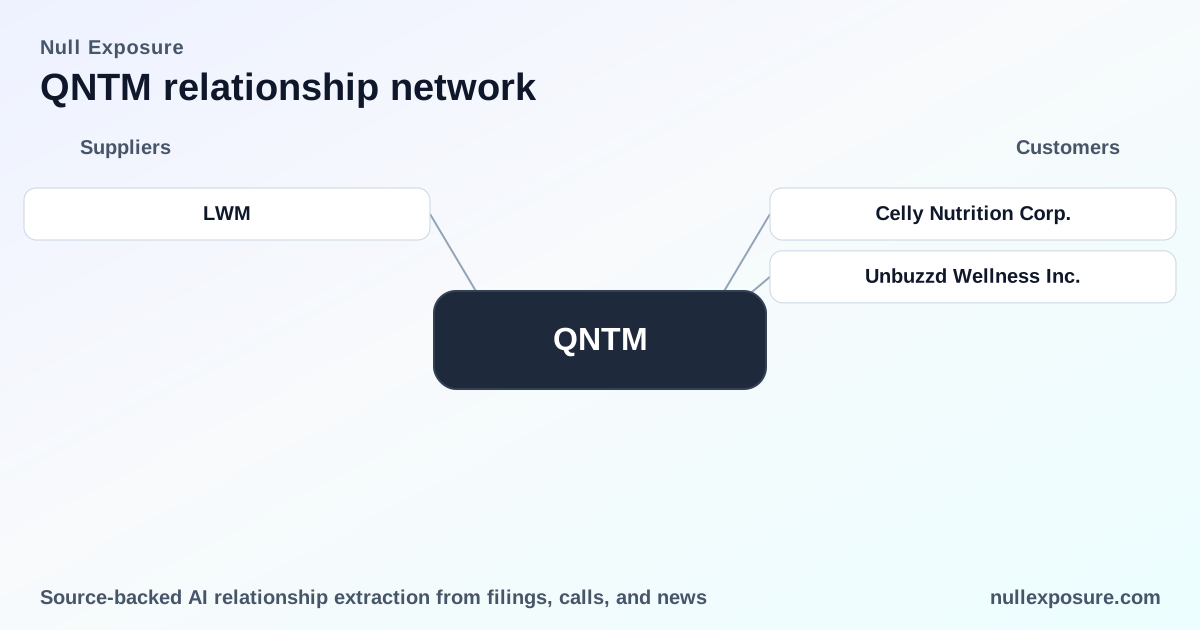
The public record shows two customer/counterparty names that matter to QNTM’s near-term cash flows: Unbuzzd Wellness Inc. and Celly Nutrition Corp. Both relationships are royalty-oriented and anchored to the same product family, creating concentration and execution dependency on third-party marketing and distribution.
Unbuzzd Wellness Inc.
Quantum has a royalty arrangement with Unbuzzd Wellness that provides 7% of sales of unbuzzd™ to Quantum until cumulative payments equal $250 million. This arrangement is referenced in Quantum’s communications and multiple press outlets; for example, a GlobeNewswire release on October 3, 2025 describing the record date for CVR distribution cites the 7% royalty and the $250 million cap. Additional press coverage through Quiver Quant and the Canadian Securities Exchange listing commentary reiterates the same contractual terms (GlobeNewswire, Oct 2025; QuiverQuant and CSE releases, FY2025/FY2024).
Celly Nutrition Corp.
Quantum’s economic interest in the unbuzzd™ OTC product is also reflected through a royalty linkage with Celly Nutrition Corp., which holds the OTC version of unbuzzd following a spin-out. Media reporting indicates that Celly’s agreement includes the same 7% royalty up to $250 million payable to the originating rights-holder (Quantisnow reported on the debt settlement intention and referenced the royalty clause in March 2026; a FinancialContent summary from Aug 2024 described the spin-out and the royalty structure). The commercial success of the OTC product sold by Celly therefore directly influences Quantum’s royalty receipts.
Operating model implications: contracting posture, concentration, criticality and maturity
- Contracting posture: Quantum is positioned as a non-operating rights-holder; its contracts are royalty-based and contingent on third-party sales and external litigation outcomes (company filings and press releases describing CVR distribution and royalty mechanics). This is a defensive monetization posture: low operational overhead but high dependence on counterparties to execute sales and on litigation to unlock CVR pots.
- Concentration: Public evidence points to high customer concentration — reported relationships are limited to Unbuzzd Wellness and Celly Nutrition, both linked to the same product family. For investors, a single-channel revenue path creates high execution and counterparty risk.
- Criticality: Given Quantum’s reported revenue TTM of zero and negative operating metrics, these royalty and CVR arrangements are the company’s critical near-term value drivers; absent new licensing or commercial launches, shareholder value is directly tied to royalties collected and any litigation settlement proceeds.
- Maturity: These contracts are early-stage commercial arrangements and contingent instruments, not mature recurring revenue contracts with diversified counterparties; the capped royalty structure and CVRs indicate a monetization strategy reliant on future events rather than established recurring cash flow.
Financial context that shapes valuation risk
Quantum’s public financials reinforce the operational picture: market capitalization roughly $30.8 million, EBITDA negative ~$14.8 million, EPS -7.68, and Price-to-Sales >100x because revenue currently registers at zero. Analysts have published a target price of $12.81, a figure that implicitly prices significant upside from litigation or royalty realization rather than current trading fundamentals. Insider ownership (~20%) and modest institutional ownership (~15.5%) signal concentrated shareholder alignment that often accompanies small-cap, event-driven equity stories.
Why the relationship terms matter to investors
- The 7% royalty up to $250 million is a clear payoff schedule: it defines the maximum contractual revenue Quantum can extract from the unbuzzd™ line under current agreements as publicly described; this creates a finite upside from that revenue stream unless other licensing deals supplement it (GlobeNewswire, Oct 2025; Quantisnow, Mar 2026).
- The use of CVRs tied to litigation settlement proceeds converts legal outcomes into shareholder cash, making legal strategy and case progress central to valuation; Quantum’s October 2025 CVR record-date disclosure confirms this structural reliance on litigation recoveries.
- Because royalties are paid by third parties, execution risk resides with Unbuzzd and Celly — marketing success, distribution reach, and regulatory compliance for OTC products will determine timing and scale of payments.
Investor takeaways and tactical implications
- High event dependency: Quantum’s near-term value is event-driven (royalty receipts and litigation outcomes) rather than driven by recurring operational revenue.
- Concentration risk is material: Two counterparties tied to one product family represent a fragile revenue base.
- Clear payoff cap exists: The documented $250 million cap on royalty payments is the largest single contractual ceiling investors should model when stress-testing upside scenarios.
- Balance-sheet reality: With negative EBITDA and zero reported revenue, liquidity and financing risk are relevant until royalties or settlements provide cash inflows.
For investors seeking focused, event-driven exposure in small-cap healthcare, Quantum’s structure offers binary upside linked to third-party commercial execution and legal outcomes. For systematic fundamental allocators, the combination of zero current revenue and concentrated royalty risk requires conservative position sizing.
If you want a curated dossier and ongoing signal tracking for QNTM’s counterparty-driven cash flows, review our coverage at https://nullexposure.com/.
Bold final takeaway: Quantum BioPharma is not a commercialized biotech selling products — it is a royalty and litigation-play. Investment returns will come from realized royalties and settlement proceeds, not from recurring operating income.