Qurate Retail (QRTEB): Customer Relationships That Drive Reach and Acquisition
Qurate Retail monetizes a multi-channel commerce model by combining owned live shopping networks (QVC, HSN) with third‑party streaming and social distribution to acquire customers, drive transactions, and sell inventory at scale. Revenue derives from direct retail sales, merchant/vendor margins and advertising/affiliate arrangements tied to distribution partners, while customer acquisition increasingly flows from social platforms and ad‑driven streaming placements. For a concise briefing and relationship intelligence, visit https://nullexposure.com/.
Where customer relationships sit in the economics
Qurate is a large, legacy retail operator with $10.24B of trailing revenue and $3.59B gross profit that now layers new distribution channels into its go‑to‑market model. That mix creates two competing dynamics: reach and conversion from platform partners accelerates scale, while platform dependency increases exposure to partner terms and traffic volatility. Insider ownership, capital structure and recent operating margins indicate the company balances cash‑generative retail operations with an ongoing need to optimize digital customer acquisition economics.
Customer relationships disclosed in the record
Below I cover every relationship cited in the provided results and the supporting source for each mention.
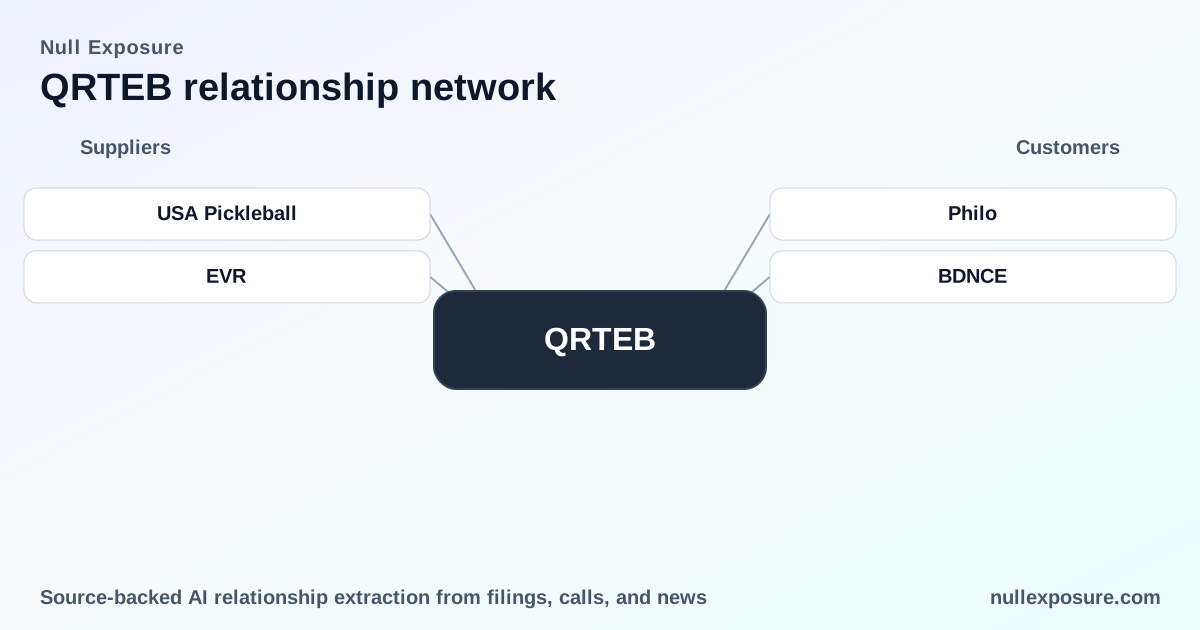
Philo — live streaming carriage expands reach
Qurate confirmed that QVC and HSN joined Philo, a live TV streaming service with roughly 1.3 million paid subscribers, positioning the brands on a lower‑cost over‑the‑top distribution platform to capture incremental viewer demand. According to the Q2 2025 earnings call transcript (published March 7, 2026), management highlighted the Philo launch as a distribution extension for linear channels.
BDNCE — social acquisition growth flagged
Qurate reported substantial growth in new social customers during Q2 2025, with management citing well over 100,000 new customers sourced through TikTok Shop in the quarter. That disclosure appears on the Q2 2025 earnings call (March 7, 2026) and signals meaningful recent customer inflow from social commerce channels under the BDNCE label captured in the report.
TikTok (TikTok Shop) — a major acquisition channel
Management specifically called out TikTok Shop as a high‑velocity customer acquisition funnel, confirming the platform generated in excess of 100,000 new customers in the referenced quarter and that social commerce is a material growth vector. The Q2 2025 earnings call (March 7, 2026) provides the source for this disclosure.
Amazon Freevee — linear channel launches on AVOD
Qurate announced the launch of QVC and HSN linear channels on Amazon Freevee, extending linear placements into Amazon’s ad‑supported streaming tier on June 30 (FY2026). The move was reported in SimplyWall listings (May 3, 2026) that referenced the FY2026 announcement; two separate SimplyWall entries recorded the same launch notice on that date, confirming media placement activity on Freevee for the group.
What these relationships collectively signal about the operating model
- Contracting posture: Qurate operates as a content vendor and channel partner rather than an exclusive platform owner, negotiating carriage and placements with third‑party streamers and social marketplaces to maximize audience reach.
- Concentration and diversification: The company is actively diversifying distribution — retaining owned linear/intended commerce while adding Philo and Amazon Freevee for streaming reach and TikTok for social acquisition — which reduces single‑channel concentration risk but increases counterparty exposure to platform policies.
- Criticality: Distribution partners are operationally critical for top‑line growth because they supply customers and monetizable audience scale; the quality of those relationships directly influences acquisition cost and sell‑through rates.
- Maturity and evolution: Traditional linear relationships are mature; investments in TikTok Shop and AVOD placement on Amazon Freevee reflect a mid‑cycle pivot toward social and ad‑supported streaming as growth levers.
These are company‑level signals derived from the relationship disclosures; there were no explicit contractual constraint excerpts in the provided materials that tie specific operational constraints to a named customer.
Key takeaways for investors and operators
- Distribution diversification is intentional and measurable. Management is extending QVC/HSN beyond traditional cable into AVOD and streaming services while leveraging social commerce for new customer acquisition.
- Social channels are driving measurable inflows. The cited 100,000+ new customers from TikTok Shop in Q2 2025 is a concrete indicator that social commerce is now a material acquisition channel.
- Platform dependence is an emerging risk vector. Gains in reach bring greater reliance on partner policies, ad economics and algorithmic changes; these are primary operational risks to monitor.
- Content-to-commerce integration is the competitive edge. Linear and live programming placements on Philo and Freevee preserve the company’s ability to convert viewers into buyers at scale.
Consider these monitoring priorities:
- Partner economics and revenue share terms for Philo and Freevee placements.
- Customer retention and lifetime value for cohorts acquired via TikTok Shop.
- Visibility into advertising CPMs/placement costs across AVOD and social channels.
- Any incremental announcements that change distribution breadth or exclusivity.
For deeper relationship scoring and ongoing monitoring, see our platform at https://nullexposure.com/ — structured to surface partner‑level signals and earnings‑call disclosures.
Conclusion
Qurate is executing a multi‑front distribution strategy that leverages legacy live shopping strengths while capturing audience and acquisition benefits from social commerce and ad‑supported streaming. The earnings‑call disclosures and press reports show clear tactical moves: Philo and Amazon Freevee expand linear reach into streaming, while TikTok Shop proves to be a high‑velocity acquisition channel. Investors should treat these relationships as both growth catalysts and concentration risks that require line‑item monitoring in future quarters.