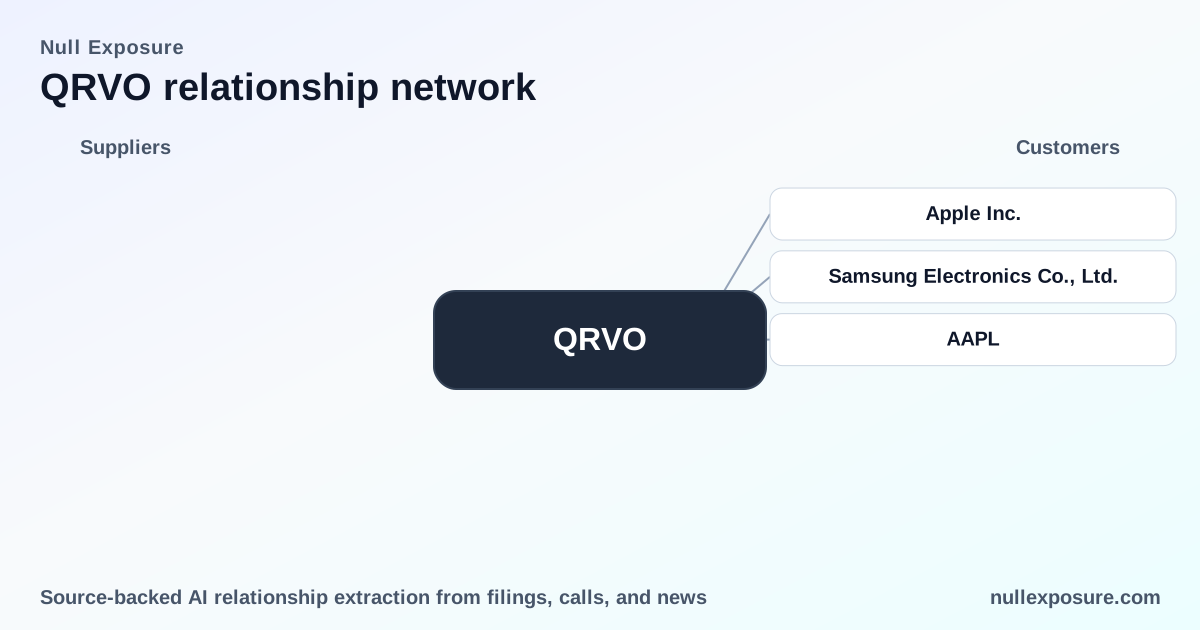
Qorvo’s customer map: who pays for its RF and foundry franchise — and what that implies for risk and returns
Qorvo designs and supplies radio‑frequency semiconductors and foundry services, monetizing primarily through hardware sales to large handset OEMs, contract manufacturers and defense customers, with revenue recognized mostly at shipment. The company’s cash generation and margin profile are driven by a concentrated set of very large customers (notably Apple and Samsung), a global supply footprint with heavy APAC exposure, and a mix of direct and distributor sales that creates both scale leverage and exposure to single‑customer volatility. For more detailed relationship analytics, see https://nullexposure.com/.
How Qorvo actually operates and gets paid
Qorvo sells semiconductor components and provides foundry/manufacturing services; revenue is earned when control transfers, typically at shipment, and through both direct OEM agreements and channel/distributor routes. Revenue recognition is predominantly point‑in‑time on hardware shipments, which produces pronounced quarter‑to‑quarter sensitivity to order timing and handset build cycles. The company also contracts directly with government and defense primes for advanced RF and packaging work, which introduces longer lead and programmatic relationships alongside spot commercial sales.
Customer relationships investors should track now
Below I list every customer relationship surfaced in the public results and give a concise investor‑oriented read with a direct source reference.
-
Apple Inc. (AAPL) — Qorvo supplies components that flow into Apple‑branded devices via multiple contract manufacturers, and those contract manufacturer sales aggregated 47% of revenue in FY2025; contemporaneous press coverage in early 2026 reports Qorvo is developing a custom product for Apple that has driven incremental R&D spending. Source: Qorvo FY2025 10‑K (filed Mar 29, 2025) and Yahoo Finance / Sharewise reporting (March 2026).
-
Samsung Electronics Co., Ltd. — Samsung accounted for 10% of Qorvo’s revenue in FY2025 (12% in FY2024), making it a material, large‑enterprise customer in the handset and component ecosystem. Source: Qorvo FY2025 10‑K (filed Mar 29, 2025).
-
Lumentum (ticker: LITE) — Lumentum completed a transaction to acquire a 240,000 sq. ft. Greensboro facility from Qorvo and will retrofit it to manufacture indium‑phosphide optical devices, including continuous‑wave and ultra‑high‑power lasers for AI data center applications; the press reflects an asset sale of legacy fab capacity rather than a customer supply relationship. Source: Sahm Capital / TradingView reporting (May 3, 2026) and InsiderMonkey (May 2026).
-
ON Semiconductor (ticker: ON) — Coverage notes that a SiC JFET product acquired from Qorvo has been integrated into ON’s PSG segment, signalling that Qorvo divested or licensed specific silicon IP or product lines that are now contributing to ON’s portfolio. Source: Yahoo Finance Canada reporting (May 3, 2026).
What the relationship map collectively tells you
These links show a two‑tier pattern: a small number of very large commercial customers drive the bulk of sales, while discrete asset and product divestitures are reshaping Qorvo’s manufacturing footprint and product mix. Apple and Samsung together are core demand anchors, but Qorvo also sells into defense and foundry channels and uses distributors — a structure that provides volume scale while concentrating counterparty risk.
For a deeper look at operational and contract constraints, visit https://nullexposure.com/.
The revenue concentration dynamic
Qorvo reports that its two largest end customers collectively accounted for approximately 57% of revenue in FY2025, up from prior years, which creates outsized sensitivity to handset cycles and design wins. That concentration drives high revenue volatility but also gives Qorvo leverage on pricing and volume economics when product ramps succeed. Source: Qorvo FY2025 10‑K (filed Mar 29, 2025).
Operating‑model constraints and what they imply for investors
The filings and evidence produce a consistent set of company‑level operational signals that matter for valuation, downside risk and portfolio construction.
-
Contracting posture — predominantly spot, delivery‑based sales. The company recognizes a majority of revenue at a point in time (shipment or delivery), which creates pronounced timing and inventory risk around quarterly results. Evidence: revenue recognition language in FY2025 10‑K.
-
Counterparty scale and types — very large enterprises and government programs. Apple and Samsung are explicitly named in regulatory filings as major customers; Qorvo also engages directly with U.S. government agencies including the Department of Defense and supplies defense primes, adding programmatic revenue with different margin and contractual characteristics than consumer handset work. Evidence: FY2025 10‑K excerpts naming Apple, Samsung and the DoD.
-
Geography — global with heavy APAC exposure. Qorvo ships globally and generated roughly 38–40% of revenue from Asia in FY2025, which concentrates exposure to APAC demand cycles, logistics, and geopolitics. Evidence: FY2025 international shipment figures.
-
Relationship role mix — manufacturer, seller and distributor channels. Qorvo operates as a manufacturer and sells both directly and via distributors and sales representatives worldwide; this hybrid route to market provides scale but introduces channel inventory and credit considerations. Evidence: FY2025 revenue and sales channel disclosures.
-
Materiality and criticality — top customers are critical. Because the top two end customers represent the majority of revenue, program wins and losses with those partners are critical to near‑term earnings and cash flow volatility. Evidence: aggregated customer share statistics in FY2025 10‑K.
-
Segment focus — hardware and specialty foundry work. Revenue is driven by semiconductor hardware sales and compound semiconductor foundry services, which are capital‑intensive, cyclical and sensitive to product lifecycle timing. Evidence: company segment and product descriptions.
Investment implications and risk checklist
- Concentration is both leverage and risk: successful product ramps with Apple and Samsung create margin upside; any design‑win loss or shift in wallet share would materially compress revenue.
- Spot recognition increases volatility: shipment timing can move results significantly; investors should underwrite quarterly seasonality and build/draw cycles.
- Defense and government work provide program stability: DoD and defense‑prime relationships smooth some cyclicality but typically have different margin and cadence profiles.
- Asset sales and portfolio pruning change long‑term margins: recent facility and product disposals (Greensboro site and SiC JFET transfer) indicate strategic reallocation away from certain legacy assets and into core RF and foundry priorities.
Bottom line for allocators
Qorvo is a high‑quality RF and foundry business with concentrated customer exposure, global delivery scale, and a mixed revenue profile that combines spot hardware sales with programmatic defense work. That combination supports attractive margin expansion when product ramps succeed but enforces elevated event risk tied to a handful of large OEM relationships. For structured diligence and model inputs around customer concentration and contract posture, start with Qorvo’s FY2025 10‑K and the contemporaneous press coverage summarized above.
If you want a navigable, relationship‑level view for portfolio stress testing and counterparty exposure, explore more at https://nullexposure.com/.