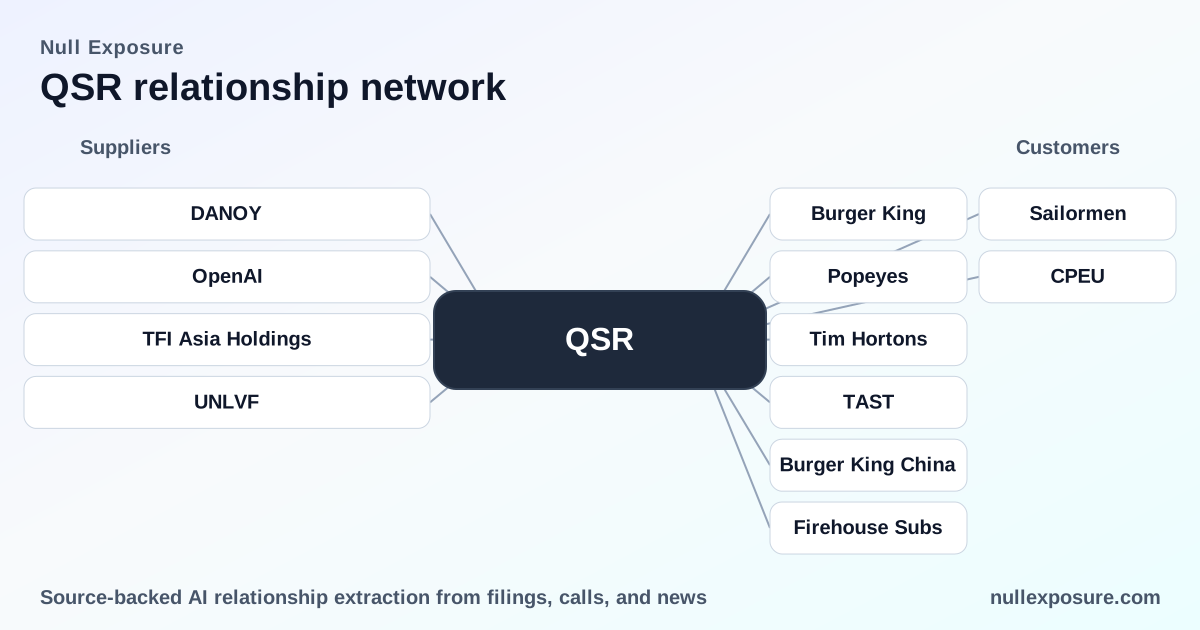
Restaurant Brands International (QSR): Customer relationships that underwrite royalty cash flow
Restaurant Brands International operates and monetizes as a pure brand-and-franchise platform: it owns four global quick-service restaurant brands (Tim Hortons, Burger King, Popeyes, Firehouse Subs) and collects recurring revenue through franchise royalties, ongoing service fees, and occasional supply-chain and property revenues. The company's economics rest on long-term franchise contracts, usage-indexed royalties, and selective asset ownership that support margin-insulating cash flows rather than store-level operating profits. For primary research into customer-level relationships and contract signals, see NullExposure’s coverage: https://nullexposure.com/
The operating model in plain English
RBI is a franchisor first and an operator second. Franchise agreements are long-dated (typical terms of 10–20 years) and generate usage-based royalties (commonly 3–6% of gross sales), supplemented by initial and renewal franchise fees that are recognized over contract life. The company also maintains supply-chain and manufacturing capabilities (coffee roasting and distribution centers for Tim Hortons) to protect margins and ensure brand consistency. RBI’s footprint—over 32,000 restaurants in more than 120 countries—creates diversified, recurring cash flow but introduces currency and regional execution complexity, especially across North America and international markets.
- Contracting posture: long-term, renewal options, and mixed ownership/sublease positions that allow RBI to convert owned units to franchised units over time.
- Revenue characteristics: high proportion of usage-based, royalty income; deferred revenue from upfront fees; some distribution and property revenue in consolidated results.
- Operational roles: licensor (primary), distributor/manufacturer (for Tim Hortons supply chain), and service provider via brand field teams.
Contract-level constraints that matter for investors
The company-level signals from filings and disclosures point to stable, contractually sticky revenue with limited customer concentration risk at the unit level but material exposure to large franchisees. Long-term contract durations and royalty step-ups (notably in certain international arrangements) produce durable revenue; however, reliance on major franchisees to execute locally makes refranchising strategy and franchisee credit health critical to forward cash conversion. Currency exposure in EMEA and other international markets is a persistent earnings driver.
Mapping every customer relationship flagged in the file
Below I summarize each relationship captured in the search results and provide the contemporaneous source.
-
THCH (TH International Limited / Tim Hortons China) — THCH is the exclusive master franchisee for Tim Hortons in mainland China, Hong Kong and Macau and is a strategic partner for Tim Hortons’ China expansion; THCH has also struck a deal to develop Popeyes in mainland China and Macau. Source: Yahoo Finance coverage and regional reporting on Tims China (news items dated March–May 2026).
-
Carrols Restaurant Group (TAST) — Carrols is a large Burger King franchisee whose 2024 acquisition was followed by RBI-led refranchising of more than 1,000 units to smaller local operators to lift operational standards and local marketing. Source: FinancialContent feature on RBI (Feb 26, 2026) and RBI’s 2025 results release (Mar 2026).
-
Burger King (brand-level relationship) — Burger King functions as a core royalty generator for RBI; investor commentary emphasizes that Burger King royalties are a stable compounder of franchise income within RBI’s mix. Source: Simply Wall St investor commentary (Mar 2026) and broader analyst notes (Mar 2026).
-
Popeyes (brand-level relationship) — Popeyes contributes franchise royalty streams and has been highlighted in analyst commentary as part of the franchise-heavy, low-capex model that underpins RBI’s cash flow profile. Source: Finviz and Simply Wall St commentary (Mar 2026).
-
Tim Hortons (brand-level relationship) — Tim Hortons remains a material segment with supply-chain revenues and franchise royalties; Tim Hortons operations are concentrated in Canada where a significant portion of reporting currency is CAD. Source: Simply Wall St and RBI disclosures referenced in March 2026 coverage.
-
TANNI (TravelCenters of America / TANNI) — TravelCenters’ food courts include quick-serve concepts such as Burger King and Popeyes, demonstrating distribution partnerships and third-party location deals that expand brand reach into travel and fuel retail channels. Source: CSTORE Dive and TruckingInfo coverage of TravelCenters openings (May 2026).
-
Sailormen — Identified as a large Popeyes franchisee that filed for bankruptcy, Sailormen’s distress is an operational credit event that has direct earnings and royalty implications for RBI in affected locales. Source: Restaurant Business Online reporting on Popeyes franchisee bankruptcy and brand leadership changes (Mar 2026).
-
Burger King China (BK China) — RBI sold an 83% stake in Burger King China to CPE for $350 million, and beginning in 2026 the BK China interest will be accounted for under the equity method with royalties initially set below traditional international rates and scheduled to step up over time. Source: RBI 2025 results release and Restaurant Business Online coverage of the China sale (Mar 2026).
-
CPE / CPEU (buyer of BK China) — CPE acquired the majority stake in Burger King China for $350 million, becoming the controlling partner in that market and creating a transitioning royalty arrangement for RBI. Source: Restaurant Business Online (Mar 2026).
-
Firehouse Subs (brand-level relationship) — Firehouse Subs is identified alongside the other brands as part of RBI’s franchise mix that produces recurring royalty income under franchising agreements. Source: Analyst commentary compiled in Finviz coverage (Mar 2026).
-
Carrols Restaurant Group Inc. (consolidation mention) — RBI’s 2025 results specifically note intersegment franchise, property, and advertising revenues tied to Carrols’ Burger King restaurants that are included in consolidated reporting footnotes. Source: RBI press release on fourth quarter and full year 2025 results (Mar 2026).
What these relationships imply for investors
- Royalty durability is the core asset: long-term contracts and usage-based royalties produce predictable cash flow, but that predictability depends on healthy same-store sales and franchisee solvency.
- Refranchising is both an execution lever and a transition risk: converting corporate or large-franchise units into many smaller operators improves unit economics but increases execution complexity and local marketing risk. The Carrols refranchising program is illustrative of that trade-off.
- International structuring creates step-up dynamics and accounting shifts: the BK China sale to CPE and the equity-method accounting change will lower near-term royalty rates for that market but contains contractual step-ups that should support longer-term royalty recovery.
- Supply chain ownership limits margin leakage for Tim Hortons: RBI’s roasting facilities and distribution centers create vertical control that supports gross margins for the Tim Hortons brand.
Bottom line — investment checklist
- Positive: high recurring, usage-based revenue; long-term, renewal-friendly contracts; diversified global footprint.
- Watch: major franchisee credit events (e.g., Sailormen), execution risk in refranchising programs (Carrols), and international royalty step-ups and currency translation effects (BK China, EMEA exposures).
For an extended view of customer-level signals and how these relationships translate into revenue run-rates, visit NullExposure’s research hub: https://nullexposure.com/ — our platform aggregates relationship-level signals that matter for premium finance and operational due diligence.