QTI: Customer Relationships and Commercial Footprint — What Investors Should Know
QT Imaging (QTI) manufactures and sells the Breast Acoustic CT™ scanner and complementary cloud software, monetizing through hardware sales, exclusive reseller distribution agreements with minimum order commitments, and a growing SaaS platform. The company's near-term revenue runway is driven by channel MOQs with an exclusive U.S. reseller and newly minted Gulf and UAE distribution partners, while clinical collaborations support adoption and validation.
For a structured investor read on customer risk, concentration and commercialization dynamics see our platform: https://nullexposure.com/
How QTI converts technology into revenue — the operating model in plain English
QTI’s commercial model is hardware-first: it sells scanners to imaging centers, hospitals and research institutions and layers a cloud service for image management and analytics. The company amplifies reach via exclusive reseller agreements that include minimum order quantities (MOQs) — effectively turning partners into committed revenue sources. This structure creates strong near-term revenue visibility when MOQs are firm, but also concentrates execution risk into a small set of channel partners.
- Contracting posture: QTI relies on signed, multi‑year distribution agreements with MOQs to guarantee shipments and cash inflows — a long‑term commercial posture for a hardware company.
- Concentration: One U.S. reseller (NXC) is the primary distribution channel and a material revenue concentration under the company’s disclosures.
- Criticality: Customers depend on the physical scanner; QTI’s hardware is mission‑critical to a clinic’s breast imaging capability, giving the company pricing leverage on initial device sales but also creating dependence on fulfillment and installation services.
- Maturity: Commercial partnerships and international distribution deals demonstrate transition from development to commercialization, but unit economics and recurring software revenue are still early-stage.
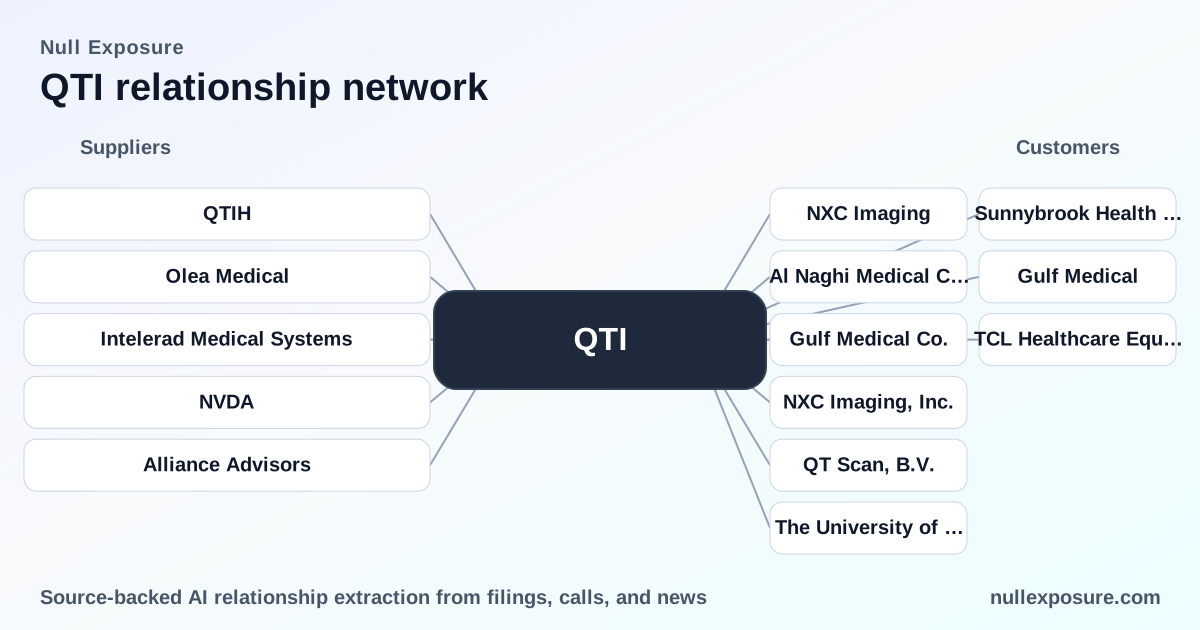
The customer roll call — relationships every investor should watch
Below I summarize each customer/distribution relationship disclosed in QTI’s filings and press coverage, with concise sourcing.
NXC Imaging / NXC / NXC Imaging, Inc.
NXC is QTI’s exclusive U.S. reseller and the single largest channel partner; the amended distribution agreement includes MOQs totaling $18.0 million in 2025 and $27.0 million in 2026, and QTI reported shipments of 17 scanners to the distributor in the period. According to QTI’s FY2024 10‑K and subsequent company reporting (FY2025/2026), NXC is responsible for a significant share of U.S. commercial sales and channel expansion. (Source: QTI 2024 Form 10‑K; QTI preliminary results and press releases, Mar 2026)
PerfeQTion Imaging Center (Haverford, PA)
PerfeQTion Imaging Center was announced as a recipient of a Breast Acoustic CT™ shipment as part of QTI’s commercial rollout with its U.S. distribution partner. This is a direct clinic installation that supports the company’s domestic install base expansion. (Source: QT Imaging press release via FinancialContent, May 2026)
Couri Center for Gynecology and Integrative Women’s Health (Peoria, IL)
QTI expanded device availability to the Couri Center, signaling penetration into specialty women’s health practices beyond traditional imaging centers. The announcement came through QTI’s marketing and distribution channels. (Source: QT Imaging press release via FinancialContent, May 2026)
Vitality Renewal Functional Medicine (Crystal Lake, IL)
Vitality Renewal is another clinic-level expansion where QTI’s scanner was deployed, indicating QTI’s strategy to place devices in a variety of outpatient settings to broaden clinical exposure. (Source: QT Imaging press release via FinancialContent, May 2026)
Al Naghi Medical Co.
QTI signed an exclusive distribution agreement with Al Naghi for the UAE covering both scanners and the QTI Cloud SaaS Platform, and QTI disclosed a $24 million revenue pipeline through 2028 tied to this arrangement. This creates a sizeable international revenue opportunity and a clear regional go‑to‑market partner. (Source: CityBiz and PharmiWeb coverage; preliminary results Mar 2026)
Gulf Medical Co. / Gulf Medical
Gulf Medical holds exclusive distribution rights for Saudi Arabia and is cited alongside Al Naghi as establishing QTI’s commercial presence in the two largest Middle East healthcare markets; QTI has referenced Gulf Medical in connection with minimum order commitments for the region. (Source: CityBiz and Yahoo Finance reporting, Mar 2026)
The University of Illinois, Urbana‑Champaign
The University of Illinois (Dept. of Electrical and Computer Engineering and Grainger College of Engineering) appears as an academic collaborator on studies using the Breast Acoustic CT™ scanner, supporting clinical research and technology validation outside commercial deployments. (Source: ITN Online coverage, Mar 2026)
Sunnybrook Health Sciences Centre (Toronto)
Sunnybrook received a Breast Acoustic CT scanner under a collaboration with Radiation Oncology and the Radiation Treatment Program, representing a research/clinical deployment in a major academic medical center in Canada. This is a validation and reference account for clinical use cases. (Source: ITN Online coverage, Mar 2026)
QT Scan, B.V.
QT Scan, B.V. is listed as a distribution partner for Europe, the Middle East and North Africa in earlier announcements, reflecting QTI’s established channels for EMEA market access. (Source: GlobeNewswire, Jan 2022)
TCL Healthcare Equipment
TCL Healthcare Equipment participates in a joint venture referenced by QTI that expanded international reach into Asia (earlier shipments to Singapore), indicating QTI’s use of joint ventures for selected markets. (Source: GlobeNewswire, Jan 2022)
What the disclosed constraints mean for investors
The filing and press evidence create a clear set of operating signals:
- Long‑term contracting with MOQs is a core feature of QTI’s U.S. commercialization strategy. The amended distribution agreement with NXC explicitly contains minimum order commitments that translate into multi‑year cash inflows, which materially shape near‑term revenue expectations (company‑level disclosure; NXC referenced in the 10‑K).
- High channel concentration around NXC is both a revenue accelerator and a single‑point risk. Filings identify NXC as the exclusive U.S. reseller and a top customer; the company expects NXC to produce a significant portion of revenues while the agreement is in effect (company disclosure).
- The business remains hardware‑centric with nascent SaaS upsell potential. The primary product is the scanner; QTI is positioning the QTI Cloud as a platform add-on sold through the same distribution channels (company descriptions and press releases).
- Spend scale from MOQs places QTI in a meaningful spend band. Stated MOQs ($18m in 2025 and $27m in 2026) put contractual sales into the $10m–$100m band for those periods, creating both revenue visibility and execution dependency on partner fulfillment (10‑K excerpt).
Investment implications — the tradeoffs
- Positive: Signed MOQs and Gulf/UAE distribution agreements give QTI near‑term revenue visibility and faster international scale than pure direct sales would deliver. Clinical partnerships (Sunnybrook, UIUC) strengthen the clinical narrative and ease commercial adoption.
- Negative: Concentration risk around NXC and execution risk on meeting MOQs are the dominant downside vectors; failure by a distributor to place units or fulfill contracts would disproportionately impact revenue. Hardware delivery, installation and service capacity are critical operational levers that will determine whether contract value converts to cash and recurring software revenue.
For a deeper corporate relationships review and to monitor ongoing shipment and distribution disclosures, visit our analysis hub: https://nullexposure.com/
Investor actionables: track NXC order fulfillment announcements, Gulf/Al Naghi revenue realization, and incremental SaaS adoption metrics; these are the clearest leading indicators for QTI’s next two annual revenue cycles.
Bold takeaway: QTI has moved from prototype to commercial scale through distributor MOQs, but its valuation sensitivity is concentrated on a small set of channel partners — investors should weigh the revenue visibility provided by signed MOQs against the operational risk of converting those MOQs into deployed, serviced units.