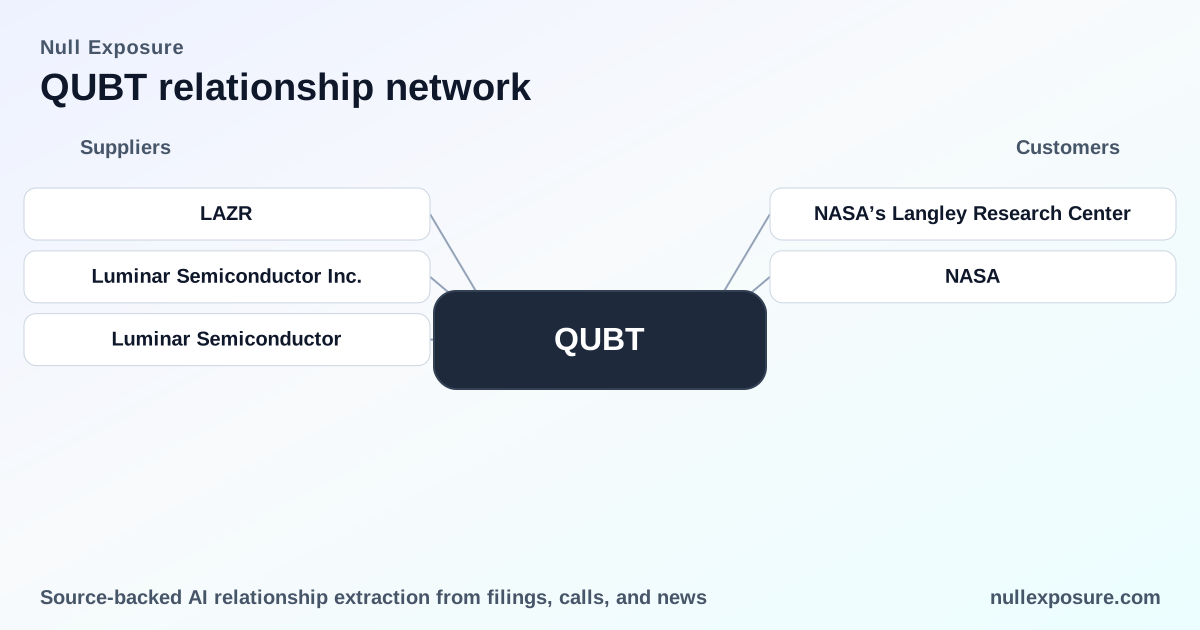
Quantum Computing, Inc. (QUBT): Customer Relationships Shape an Early-Stage Commercial Push
Thesis: Quantum Computing, Inc. monetizes by selling integrated photonic quantum machines, software (Qatalyst), and professional services to commercial and government customers, combining hardware sales and short-term services with a cloud-style subscription option for its EQC offering; revenue today is concentrated in services and early hardware deployments, while customer relationships—commercial data-center partners and select government contracts—drive validation and near-term demand. For a concise investor briefing and relationship mapping, see https://nullexposure.com/.
Why customer relationships matter now
QUBT is transitioning from R&D to commercial deployments. Its business model mixes hardware sales, software integration, and professional services, with machines that can be sold on-premises or accessed as a subscription. That hybrid monetization creates multiple revenue streams but also exposes the company to short contract durations, concentrated early customers, and reputational sensitivity from government engagements and related-party scrutiny.
- Revenue posture: QUBT recognizes most near-term revenue from professional services and short-term multi-month contracts, not long-term annuities.
- Delivery model: Machines are sold as on-premises units or offered as cloud subscriptions, increasing flexibility but limiting long-term revenue visibility.
- Customer mix: Both commercial data centers and government agencies are buyers, concentrating risk regionally in the Americas and Europe and functionally in services and hardware.
For a platform-level view and competitive positioning, review the company summary at https://nullexposure.com/ — the relationship map below is calibrated for investors evaluating customer risk and runway.
What the relationships are and what they mean
Quantum Corridor
Quantum Corridor is a commercial partner where QUBT deployed a Dirac-3 quantum optimization machine into a data center, marking a first-of-its-kind installation in a commercial facility. This deployment is evidence of product-market fit for on-premises hardware and validates channel placement with third‑party data centers. According to coverage on May 3, 2026, the Dirac‑3 installation is live on the Quantum Corridor network (Simply Wall St and Quantum Computing Report, May 2026).
Digital Crossroad Data Center
Digital Crossroad hosts the Dirac‑3 installed through the Quantum Corridor partnership, representing the commercial footprint of QUBT’s hardware. The installation demonstrates the company’s route-to-market via data-center partners and the ability to integrate machines into third-party infrastructure (Simply Wall St, May 2026).
NASA’s Langley Research Center
QUBT was awarded a subcontract valued up to $406,478 to support NASA’s Langley Research Center, highlighting government validation and a modest but strategically valuable program. The award was disclosed in a March 2026 press release and positions QUBT within federal research and procurement channels (The Globe and Mail press release, March 2026).
NASA (general)
Beyond the Langley subcontract, QUBT has publicly referenced collaboration with NASA under subcontract arrangements as it expands manufacturing and platform capabilities; this relationship provides technical credibility and supports grant/contract pathways into government programs (company disclosures and media coverage, March 2026).
Quad M
Quad M is named in litigation filings as a counterparty that allegedly qualified as a related-party transaction, raising questions about the independence and disclosure of certain early revenue sources. The company’s dealings with Quad M were cited in a class-action complaint filed in May 2026 that claims related-party revenue was not fully disclosed (National Law Review, May 2026).
million ways
The entity “million ways” is also alleged in the same litigation to have been a related-party counterparty, with plaintiffs asserting that some revenue streams relied in part on transactions with affiliated parties rather than independent customers. These allegations were made public in class-action filings in May 2026 (National Law Review, May 2026).
Constraints that define the operating model
QUBT’s operating model is best understood through cross-cutting signals rather than isolated metrics:
-
Contracting posture — short-term and project-based. Revenue is largely recognized from multi‑month contracts for professional services and hardware sales; this limits recurring revenue visibility and increases the need for continuous deal flow. Evidence in company reporting shows revenue derived from hardware and professional services under multi-month agreements for 2023–2024.
-
Subscription capability — optional recurring channel. The EQC and similar machines can be offered as a cloud-based subscription or as an on-premises product, creating optional recurring revenue but not yet displacing the dominant services-led model.
-
Counterparty mix — commercial plus government. Government customers are part of the go-to-market, supporting credibility and technical contracts, but these engagements are generally modest in size relative to market capitalization.
-
Revenue concentration and segment tilt. The firm’s revenue mix is service-heavy, with hardware and software integrated around those service engagements; that structure implies client relationships are often project-critical but not yet high-value recurring enterprise contracts.
-
Geographic focus and maturity. Reported regions are the Americas and Europe, indicating limited international diversification and an early commercial maturity curve.
Collectively, these constraints indicate a capital-efficient commercialization path but with revenue volatility, concentration risk, and sensitivity to customer disclosure and third‑party validation.
Investment implications and risk checklist
QUBT’s customer signals create a clear checklist for investors and operators:
-
Positive: Early commercial deployments (Dirac‑3 in data centers) and NASA subcontracting deliver technical validation and channel proof points. These relationships support a narrative of product viability and market entry.
-
Watch: Litigation alleging undisclosed related‑party transactions (Quad M, million ways) introduces governance and revenue quality risk that can materially affect investor sentiment and partnering confidence.
-
Revenue visibility: Short-term contracts and a services-first model mean quarter-to-quarter variability; subscription options reduce but do not eliminate this volatility.
-
Concentration: Regional concentration in the Americas/Europe and reliance on a handful of marquee deployments increase sensitivity to partner performance and reputational events.
Use this relationship map to prioritize diligence: verify contract terms for installed machines, confirm the scope and deliverables of government subcontracts, and assess the independence of counterparties cited in litigation.
Bottom line for portfolio and operating decisions
Quantum Computing, Inc. is at an inflection where commercial proofs—data‑center deployments and small government awards—translate technical capability into revenue but do not yet create durable recurring streams. Governance and related‑party allegations are the most immediate investor focus; operationally, the company’s path to scale requires expanding subscription arrangements and diversifying commercial partners beyond early data‑center pilots.
For a deeper set of relationship analytics and ongoing monitoring, visit https://nullexposure.com/ to see how these customer links evolve and what they imply for valuation and execution risk.